




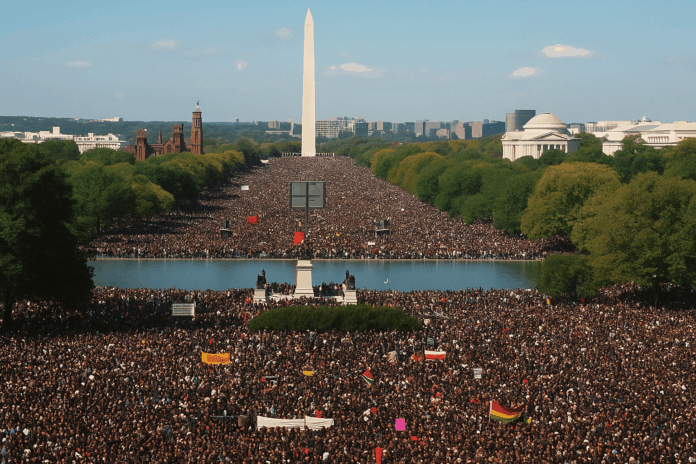




Thirty years ago, I stood on the National Mall in Washington, D.C. I was 27 years old, surrounded by a sea of Black men—nearly two million strong—who had come from every corner of the country. I remember brothers greeting each other like long-lost family, hugging, smiling, sharing prayers and stories. For the first time in my life, I truly saw what freedom could look like. Not the kind the government grants, but the kind that comes from our unity, love, and accountability among our own. We were not just a crowd, but a brotherhood, a community united in purpose and spirit.
It was a day of unity, not just for men, but for our entire community. The media said one million, but those of us who stood shoulder to shoulder know better—it was closer to two million strong individuals. The air that day was thick with purpose, not protest. We didn’t come to beg for handouts or chant for change. We came to stand before God, before our families, and before one another to take responsibility for our lives, our homes, and our communities. That was the true meaning of the Million Man March—atonement and reconciliation.
A Day That Changed the Image of the Black Man
That day, the world witnessed something powerful and unprecedented: millions of disciplined, peaceful, prayerful Black men united under one mission. There were no fights, no arrests, no chaos—just dignity. It shattered every stereotype that America had built around us. For one day, the world saw our strength, not our struggle. They saw organization rather than outrage, leadership rather than lawlessness, and love rather than fear.
The numbers may still be debated, but the impact cannot be. It wasn’t just a march—it was a spiritual movement. Every man who was there left differently. We walked in with burdens and walked out with a renewed sense of purpose, a rekindled spirit of brotherhood, and a commitment to personal and collective growth. The Million Man March was not just a moment in history, but a catalyst for change, a beacon of hope for our future.
What the March Really Meant
The Million Man March wasn’t about politics—it was about personal transformation. Minister Louis Farrakhan and Dr. Benjamin Chavis called for a day of spiritual renewal: to reconcile with our families, to restore our faith, and to rebuild our communities. Every man was challenged to make a personal pledge—to be a better father, a better husband, a better brother, and a better man.
It was a call to repair what had been broken: our self-image, our leadership, and our unity. That message is timeless, and today, it’s needed more than ever.
Atonement and Reconciliation: Then and Now
Thirty years later, our communities still cry out for that same healing. Too many of our young men are lost to violence, too many homes are fatherless, and too many leaders chase fame instead of faith. The spirit of accountability that filled the Mall that day has been replaced by finger-pointing and division. But we cannot lose hope. We must remember the unity and purpose of that day and continue to work towards healing and reconciliation.
Atonement means more than saying we’re sorry—it means changing direction. Reconciliation means healing what’s been divided. We have to atone for how we’ve allowed distractions, politics, and systems to pull us apart. And we must reconcile the gap between who we say we are and how we actually live.
The Family Is Still the Foundation
The strength of any nation begins at home. The Million Man March was a call to rebuild the Black family—to remind men to be present, protective, and principled, guarding the women and children who carry our future. Thirty years later, that message is more urgent than ever. No government program can fix what only love, faith, and discipline can restore. But we must ask ourselves—what happened? We left that Mall with a mission, but today nearly 80 percent of Black children are born outside of marriage. That wasn’t the promise we made. Somewhere between that moment of unity and this generation, the meaning of our oath was lost. It’s time to restore it, to remind our sons and daughters what we stood for, and to rebuild the family as the foundation of our freedom.
Why We Must Remember
Commemorating the Million Man March isn’t about nostalgia—it’s about revival. The same unity that filled Washington, D.C., that day can fill our communities again if we choose to stand on the same principles: faith, discipline, and love for our people. That day proved what’s possible when we come together with purpose.
The question now is—do we still believe in that purpose?
A Call to Action
This anniversary should not pass quietly. Every Black man should pause and reflect: Have I kept the promise I made that day? Have I mentored a young brother, reconciled with my family, or poured back into my community? The Million Man March was never just about one day—it was about the life we built afterward.
We don’t need another march on Washington; we need a march through our neighborhoods, our schools, our homes, and our hearts.
Closing Thought
I was 27 years old when I stood in that crowd and felt the power of brotherhood, love, and unity. I saw a glimpse of the freedom our ancestors dreamed of—and I still believe in it. We can reclaim that spirit if we remember the vow we made: to be men of God, men of vision, men of accountability.
As we honor this 30th anniversary, let’s recommit to that promise. Because the Million Man March wasn’t the end of a journey—it was the beginning of one. And that journey must continue—until our families are whole, our communities are strong, and our people are truly free. The message of the Million Man March is not a relic of the past, but a guiding light for our present and future. It’s up to us to carry that torch forward.


You make complex topics feel accessible and easy to understand
Your posts always deliver exactly 💪 what your audience needs at the right time
Really appreciate how you make everyone feel included 🌟 and welcome in this space