




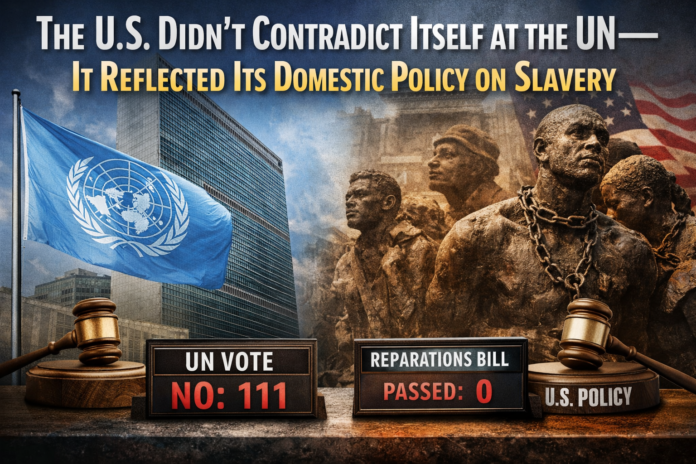




There is a growing conversation about the United States opposing international efforts at the United Nations to recognize slavery as an ongoing justice issue formally. For some, this raises outrage. For others, confusion. But before looking outward, it is worth asking a more uncomfortable question: what has been done inward?
If slavery is to be treated as a present-day policy issue rather than a historical fact, then it must show up in legislation, executive action, or funding. That is how governments demonstrate priorities—not through statements, but through outcomes.
And by that standard, the record is clear.
The most frequently cited legislative effort tied to slavery is H.R. 40, a bill to study the impact of slavery and explore potential remedies. It has been introduced repeatedly over the past decades. It has never become law. Not once.
This is not due to a lack of opportunity. During the presidency of Barack Obama, there was a period when one party controlled both chambers of Congress and the White House; if there was ever a moment for alignment between rhetoric and action, that was it.
Yet no reparations bill was passed. No executive order was issued. No federal program was created specifically addressing slavery as an active policy concern.
That absence is not symbolic. It is measurable.
In politics, what is funded gets done. What is legislated gets enforced. What is signed into law becomes reality. Everything else is a discussion.
This is where the conversation becomes uncomfortable. Many political organizations, including the Congressional Black Caucus, publicly acknowledge the historical impact of slavery. But acknowledgment is not policy.
The same pattern extends beyond Congress. Major national organizations such as the NAACP, the National Urban League, and the National Action Network have all addressed inequality in various forms. But there is no unified, enforceable national reparations agenda—no coordinated policy framework with legislative backing, funding mechanisms, and measurable outcomes tied specifically to slavery.
That distinction matters.
Advocacy is not the same as execution. Statements are not the same as statutes. And without a defined, actionable agenda that moves through the legislative and executive process, the issue remains in the realm of discussion rather than governance.
The most recent example reinforces the pattern. In Maryland, Wes Moore vetoed a reparations-related bill. That is not an international decision. That is a domestic one—made at the state level, within reach of the very communities and leaders who say this issue matters.
Yet there was no sustained national outrage. No coordinated response. No measurable political consequence.
That silence is just as telling as any vote.
It raises a hard question: if there is no consistent pressure at the local or state level, why would we expect a different outcome at the federal level—or on the international stage?
I have said many times that our struggle has been hijacked. Political energy is often redirected toward a wide range of issues affecting multiple groups. At the same time, there is no sustained, outcome-driven push for policies directly tied to the historical condition of Black Americans—specifically the recompensation for over 400 years of unpaid labor that was not just a social reality, but codified and enforced under U.S. law.
This is the deeper problem within Black politics in America. There has been a gradual shift where the specific legal and economic claims of the descendants of slavery have been absorbed into broader ideological movements. In that process, a distinct historical claim risks being diluted into broader conversations about equity, diversity, and inclusion—frameworks not designed to address a specific, legally defined historical harm.
When a specific claim becomes generalized, it becomes easier to ignore.
And when it is not clearly defined in policy, it becomes easier for other groups to dismiss, reinterpret, or compete with it.
That has real consequences.
Consider the contrast in legislative behavior. Across many Democratic-led cities, counties, and states, there has been a clear and coordinated effort to pass laws and policies limiting cooperation with federal immigration enforcement, particularly around ICE. Whether one agrees with those policies or not, the outcome is undeniable: when an issue is prioritized, legislation is written, passed, and enforced.
Black Americans, who overwhelmingly support the Democratic Party in elections, have not seen a comparable level of legislative urgency when it comes to policies addressing slavery, its economic impact, or recompensation tied to that history. There are no widespread state-level frameworks, no coordinated municipal strategies, and no consistent legislative push matching the scale or intensity seen in other policy areas.
That contrast is not about opinion. It is about observable outcomes.
When the United States resists international language that frames slavery as an ongoing legal or financial obligation, it is not acting in contradiction to domestic policy—it is acting consistently with it. A government cannot be expected to adopt a stronger position abroad than it is willing to implement at home.
This is not a moral argument. It is a structural one.
Governments operate within constraints: political capital, coalition support, legal exposure, and economic cost. Issues that do not clear those thresholds remain in perpetual discussion. Slavery, as a modern policy issue, has remained in that category.
The result is a disconnect between narrative and action.
Public discourse often treats slavery as unfinished business. Policy outcomes treat it as settled history. Until those two align, the expectation of international leadership on the issue will continue to collide with domestic reality.
The question is not whether slavery happened. That is documented and undisputed.
The question is whether it is being treated as a current policy priority.
So far, the answer is found not in speeches or statements—but in what has not been done.


Bravo!