




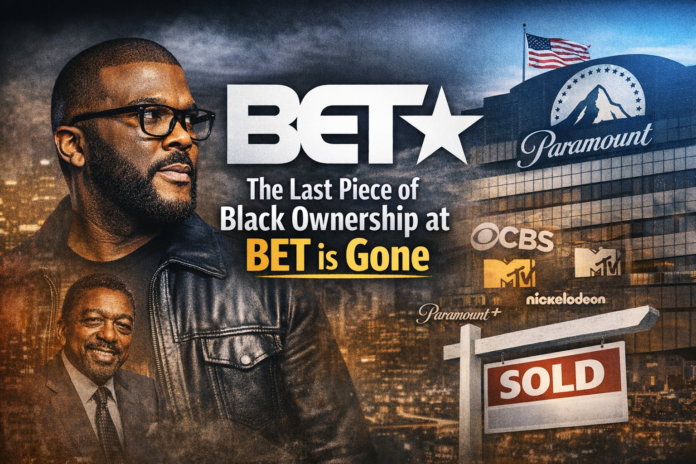



The recent buyout of Tyler Perry‘s ownership stake in BET+ by Paramount Skydance (formerly Paramount Global) is more than a routine corporate move—it’s the end of the last direct link to Black ownership within the BET ecosystem.
Paramount has acquired Perry’s minority stake (reportedly around 25% from his 2019 deal), paving the way for BET+to shut down as a standalone service. Starting in June 2026, its content library (over 1,000 hours) will be folded into Paramount+, unifying the platforms under one roof.
To many, this might seem like standard media consolidation—big companies restructure assets constantly. But the symbolism here is hard to overlook.
Tyler Perry’s investment represented the final piece of Black capital tied directly to the BET brand. While BET itself has long been part of a larger corporate structure, Perry’s equity in the streaming arm meant a prominent Black creator still held a stake in content distribution for Black audiences.
That connection is now gone.
The entire BET ecosystem—BET, BET Her, BET+ content—sits fully within Paramount‘s vast portfolio.
Why Ownership Matters (Beyond Representation)
Black culture remains one of the most influential forces in global entertainment. Black actors, writers, directors, musicians, and producers shape trends and drive audiences every day.
But influence ≠ ownership.
- Ownership decides who controls the platform.
- Ownership captures the long-term economic value from media.
- Ownership ultimately determines what stories get told, how they’re told, and how they reach viewers.
This doesn’t mean Black creators or content will vanish—Black stories will keep appearing on streaming and TV. The deeper question is:
- What kind of Black content will be prioritized?
- Who decides which narratives about our history, communities, and experiences get amplified?
- What messages will future generations absorb through the media they consume?
Major studios know the economic power of Black culture. Yet when platform ownership lies entirely outside the community, the power to define the message shifts away from the culture that created it.
For decades, BET symbolized more than entertainment—it represented the potential for Black entrepreneurs to build and control national media platforms. Even after BET’s corporate sale years ago, Perry’s BET+ stake kept a thread of Black ownership alive in distribution.
That thread has now been cut.
Paramount’s Massive Portfolio
To put this in context, Paramount owns one of the world’s largest entertainment empires:
Broadcast Networks
- CBS
- CBS News
- CBS Sports
- CBS Television Stations
Streaming Platforms
- Paramount+
- Pluto TV
- CBS News 24/7
- CBS Sports HQ
Cable Networks (via Paramount Media Networks)
- BET
- BET Her
- MTV
- VH1
- Nickelodeon
- Nick Jr.
- Comedy Central
- Paramount Network
- TV Land
- Logo
- CMT
- Pop TV
- Smithsonian Channel
- Showtime
- The Movie Channel
- Flix
Film & Studios
- Paramount Pictures
- Paramount Animation
- Paramount Players
- Paramount Television Studios
- Nickelodeon Movies
- Republic Pictures
- 49% stake in Miramax
Production & Distribution
- CBS Studios
- Showtime/MTV Entertainment Studios
- Nickelodeon Animation Studio
- Paramount Global Content Distribution
International Networks — Versions of many channels operate across Europe, Africa, Latin America, Asia, and beyond.
This buyout isn’t just the end of a partnership—it’s a stark reminder of today’s media landscape: Black culture is highly visible and profitable, but Black ownership of major national platforms is increasingly rare.
The BET brand will live on. Programming will continue. Audiences will stay engaged.
But with this transaction, the last remnant of Black ownership tied to the BET ecosystem has vanished.
That leaves a critical question for the future of Black media: If Black institutions no longer own the platforms distributing Black culture, what will it take to build new ones?

Tyler Perry introduced victim entertainment geared towards a particular niche I don’t fit. I found his projects detrimental,not inspiring or uplifting. It keeps our people locked in a primitive mindset that keeps us from moving forward.
Perry on one side and the boule on the other.
Give me a break!
Whether you like Tyler Perry or not… that’s not the point.The point is ownership.You can critique his content all day. That’s your right.
But while we’re debating preferences—We’re missing the bigger reality:There is no Black-owned national TV network.
Not from Perry.
Not from the so-called “boule.”
Not from the Black Power crowd.
Not from anybody.
Nothing.
So the question isn’t whether you liked his movies…The question is—Who owns distribution?
Because whoever owns distribution controls the image, the message, and the money.
And right now—That’s not us.
THAT’S sad, but we still must understand the real power and how we can shape the future.
absolutely