



We all know what it feels like to be tired. But there’s a different kind of fatigue that lingers even when you technically should feel rested. The kind of fatigue that makes everything feel harder than it should. The fatigue we’ve learned to push through, ignore, or explain away because we honestly don’t have language for it.
What I want to discuss this month is the deeper fatigue. The kind that settles into your bones and clouds your thinking and makes you wonder why you don’t feel like yourself anymore.
Understanding What Fatigue Actually Is
At its simplest, fatigue is your body’s way of telling you that your internal resources are running low. It’s a protective signal, like a fuel gauge warning you before the tank hits empty. But fatigue doesn’t show up in just one way. It can be physical, showing up as heaviness in your limbs and a body that doesn’t want to move. Or, it can be cognitive, as foggy thinking, forgetfulness, and trouble concentrating. And it can also be emotional, and manifest as a short fuse, a low mood, or a feeling of detachment from things you usually care about.
What makes fatigue tricky is that these dimensions talk to each other. When our body is exhausted, our thinking suffers and when our mind is depleted, our body feels heavier. That’s because they share the same pathways, the same stress hormones, the same inflammatory signals. You can’t draw a clean line between them because they’re part of one interconnected system.
So, when someone tells me they feel “mentally fatigued,” I presume it’s both physical and mental, until we can sort it out.
When Fatigue Becomes Chronic
Short-term fatigue is normal. It’s your body doing its job, asking for rest so it can recover. But when fatigue becomes a constant companion, something deeper is happening. Chronic fatigue is a physiological state with real consequences for how you think, feel, and function. It is associated with dysregulated stress hormones, increased inflammation throughout the body, changes in immune function, and even structural shifts in the parts of the brain responsible for attention and emotional regulation.
What often goes unspoken is that mental fatigue is just as real and just as costly as physical fatigue, but it rarely gets the same respect.
The Fatigue Nobody Talks About
Physical fatigue is easy to legitimize. You ran a race, you moved furniture, you worked a double shift. There’s a clear cause and a socially acceptable reason to rest.
Mental fatigue is different.
There’s no sweat, no sore muscles, nothing to point to that explains why you’re so depleted. So we dismiss it. We tell ourselves we shouldn’t be this tired because we didn’t really do anything.
But mental fatigue often comes from sustained effort that doesn’t look like effort. It comes from making decisions all day, from carrying worry in the background, from managing emotions and relationships and logistics, from being “on” when you’d rather retreat. It can also come from the kind of cognitive and emotional labor that never makes it onto a to-do list but draws on your reserves just the same.
Research shows that mental fatigue impairs reaction time, judgment, and emotional regulation just as much as physical exhaustion. The effects are measurable and significant. And yet we’ve been taught to push through it, to treat it as a character flaw rather than a signal worth heeding.
The Subtle Signs Worth Noticing
The obvious markers of mental fatigue are hard to miss. You can’t concentrate, you’re irritable, you keep forgetting things. But often the signs are quieter than that, and if you’re not paying attention, you’ll miss them until the deficit is deep.
You might notice that small decisions feel strangely heavy, that choosing what to make for dinner or how to respond to an email takes more effort than it should. You might find yourself avoiding things you normally enjoy, and dragging yourself through the day, not because anything is wrong but because you just don’t have the bandwidth. Conversations might start to feel like work. You might be quicker to snap at people, more easily frustrated by minor inconveniences.
There might even be a vague sense of dread or flatness (a blah feeling) that you can’t quite name or explain. Ever feel that way?
One of the most telling signs of fatigue is when sleep stops refreshing you. You get your hours, but you wake up feeling like you never quite rested. That’s often a signal that the fatigue runs deeper than what a single night of sleep can fix.
Why This Hits Some of Us Harder
Mental fatigue doesn’t land equally, and I want to speak directly to the experience of people in communities who carry weight that rarely gets acknowledged.
Beyond the ordinary demands of work and family, some of us move through the world with an extra layer of effort that stays invisible. There’s the fatigue that comes from constantly reading the room, adjusting how you speak and present yourself depending on the environment. There’s the vigilance of being highly visible in spaces where you feel like you’re always being evaluated. There’s the mental energy spent navigating situations where you’re not sure if what just happened was what you think it was, and whether it’s worth saying anything, and what the cost might be if you do.
That kind of ongoing alertness is exhausting even when nothing happens. The body stays ready, the mind stays scanning, and the toll accumulates whether or not there’s a specific incident to point to.
Our communities also carry deep traditions of strength and perseverance, and those traditions are genuinely valuable. But they can become a trap when they leave no room for honesty about how depleted you are.
When rest feels like weakness and struggle becomes an identity, fatigue has nowhere to go. It just builds quietly until something breaks.
There are also practical barriers that make recovery harder. When access to care is limited, when trust in the healthcare system has been earned the hard way, when you’re managing multiple jobs or caregiving across generations, when financial stress is constant, the advice to practice better sleep hygiene can feel disconnected from real life.
Any honest conversation about fatigue has to account for the fact that rest requires resources that aren’t evenly distributed.
The Fatigue That Hides in Busy
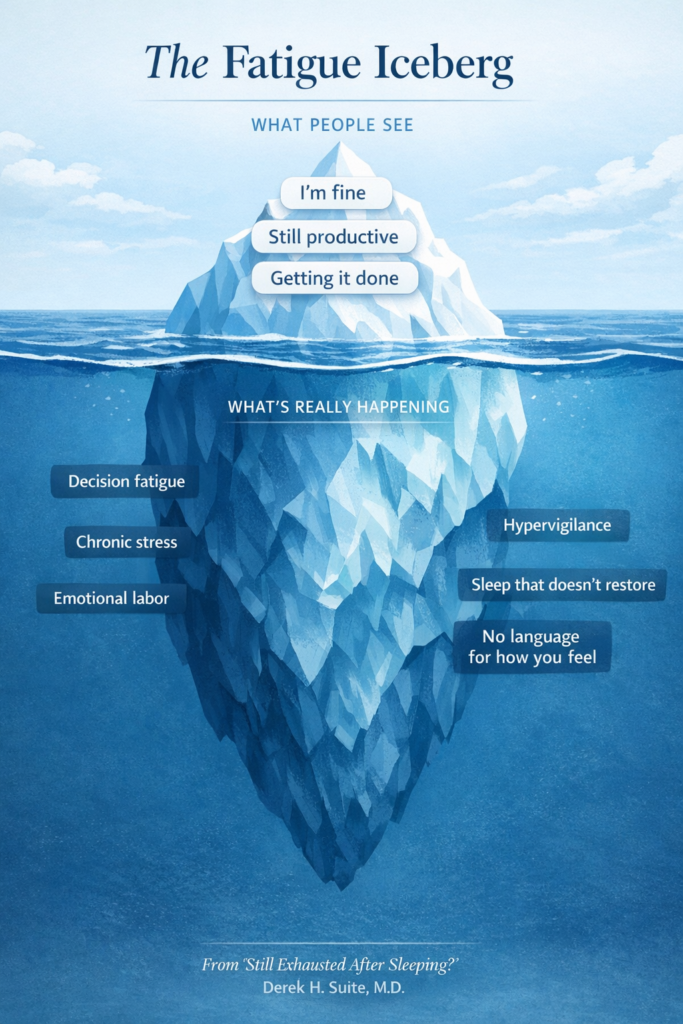
I want to name something I see often in my work, including with high performers who seem to have everything together. Some of the most exhausted people don’t look tired at all. They look busy, accomplished, always in motion. But underneath the productivity is a motor running on fumes.
This kind of fatigue hides in plain sight because output masks depletion. The person keeps achieving, keeps saying yes, keeps showing up, and nobody thinks to ask if they’re okay because they seem like they’re thriving. Sometimes they don’t even know to ask themselves, because slowing down feels more frightening than continuing to push.
If you recognize yourself in this, I want you to know that your fatigue is real even if no one can see it. Productivity is not proof of wellness.
The Screens in Our Pockets
I would be leaving out a major piece of the puzzle if I didn’t talk about how our relationship with technology and information has changed the fatigue landscape.
Our nervous systems evolved to respond to threats in our immediate environment. A rustling in the bushes, a predator nearby, a conflict within the tribe. Those systems are now being activated by a constant stream of global crises, political conflict, tragic news, and outrage, all delivered through a small device we carry with us everywhere.
The brain doesn’t distinguish very well between a threat in your living room and a threat on a screen. It activates the same stress response either way. So when you scroll through headlines about disasters, violence, and injustice, your body responds as if those dangers are present and immediate. That chronic low-grade activation contributes to fatigue in ways most people never connect.
What makes this worse is that most of us reach for our phones precisely when we’re tired, thinking we’re giving ourselves a break. But scrolling through social media is cognitively demanding. The constant novelty, the quick judgments, the comparisons, the emotional micro-reactions to each piece of content, all of this draws on mental resources rather than restoring them.
It feels like rest but functions like work.
And then there’s the particular fatigue of measuring your life against the curated highlight reels of everyone else’s. That background hum of not being enough, not doing enough, not looking or achieving or living the right way, is its own quiet tax on your reserves, before you are even aware of it.
What Helps
So what does the science say about recovering from this kind of fatigue? Not just managing it or pushing through it, but genuinely restoring yourself.
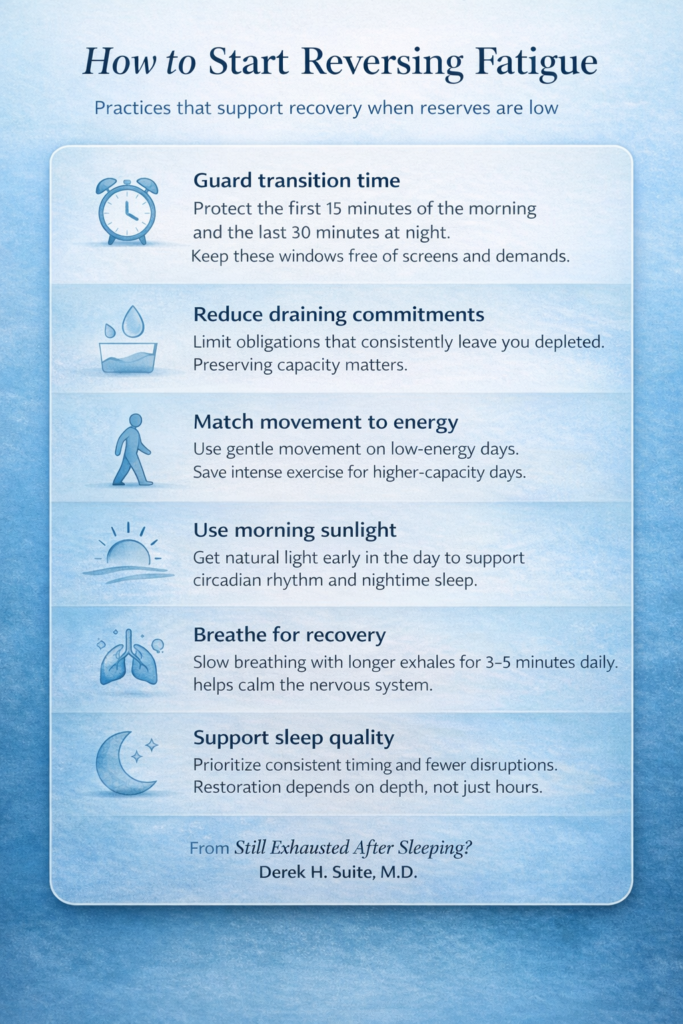
The first thing worth understanding is that sleep quality matters more than sleep quantity. You can spend eight hours in bed and still wake up unrested if your sleep architecture is fragmented. Alcohol, late-night screens, and irregular schedules all disrupt the deep sleep and REM cycles where real restoration happens.
Protecting the consistency and quality of your sleep is more important than obsessing over hitting a specific number of hours.
The second thing is that your brain doesn’t restore itself through passive rest. Research on cognitive fatigue shows that doing something with low mental demand but active engagement, like taking a walk, cooking a meal, working with your hands, or listening to music, restores executive function better than simply collapsing in front of a screen. Your mind needs a different channel, not just an off switch.
Breathing is one of the most powerful and underutilized tools we have. Slow, controlled breathing with a longer exhale than inhale directly activates your parasympathetic nervous system and lowers cortisol. This is physiology, not wellness fluff. Even three to five minutes of intentional breathing can shift your body from a stress state to a recovery state, and you can do it anywhere without anyone knowing.
Getting natural light early in the day helps anchor your circadian rhythm and regulate melatonin timing. If your fatigue includes a persistent feeling of being off or sluggish no matter how much you sleep, morning light exposure can help recalibrate your internal clock.
Movement helps with fatigue over the long term, but it has to be calibrated to your current state. When you’re already depleted, intense exercise can dig the hole deeper. Gentle movement when reserves are low, more vigorous activity when you have capacity, is the wiser approach.
And finally, boundaries are not a luxury or a sign of selfishness. They’re a biological intervention. Every obligation, every decision, every social demand draws on finite cognitive resources. Saying no to things that drain you is how you protect the organ that runs everything else.
Men, Women, and the Shape of Exhaustion
Fatigue doesn’t look the same in everyone, and some of the differences between how men and women experience it are worth naming.
Women’s energy levels and sleep quality are directly influenced by hormonal cycles in ways that are still underrecognized, even by healthcare providers. Fluctuations in estrogen and progesterone affect not just mood but also how restorative sleep is. Perimenopause and menopause bring additional shifts that can make fatigue feel relentless and unpredictable.
Research also consistently shows that women carry more of what gets called cognitive household labor, meaning the mental tracking of schedules and needs and logistics and emotional caretaking that runs constantly in the background. This invisible load contributes to mental fatigue even when the visible task list looks balanced.
Men experience fatigue too, but they often interpret and express it differently. Mental fatigue might show up as physical restlessness, boredom, irritability, or a vague sense that something is wrong without being able to name it. Men are more likely to push harder when they’re depleted rather than slowing down, and more likely to externalize exhaustion as frustration with their circumstances rather than recognizing it as an internal state that needs attention. By the time fatigue gets acknowledged, the deficit is often significant.
For the Skeptic in the Room
If some part of you is reading this and thinking it sounds like BS, I understand. We’re taught to push through, to treat tiredness as weakness, to believe that rest is earned only after the work is done.
But here’s what the science shows: mental fatigue changes how your brain functions in measurable ways. Reaction time slows, judgment suffers, and emotional regulation weakens. This is physiology, documented in study after study.
You wouldn’t try to run a marathon on a sprained ankle and call it toughness. So why do we treat a depleted mind any differently?
Ignoring mental fatigue doesn’t make you stronger. It just means the bill comes due later, and usually with interest.
Permission to Take This Seriously
If you’ve read this far, my guess is that some part of this resonates with you. Maybe you’ve been carrying a fatigue you couldn’t quite explain or didn’t feel entitled to claim. Maybe you’ve been waiting for permission to admit that you’re running on empty.
Consider this that permission.
Another way of thinking about this is to understand that your fatigue is valuable information that you must no longer ignore. It’s your body and mind telling you something true about the load you’re carrying and the resources you have left. The people who learn to take that information seriously, honestly and without shame, are the ones who sustain health, wellbeing and sustained performance for the long haul. In sports, it can be the invisible difference between who wins and who loses. Period.
The good news here is that you don’t need a complete life overhaul or to become a different person with better habits and a perfect morning routine. You just need to start being honest with yourself about how you feel, and to make one or two small moves in the direction of recovery.
Protect one window of time, even if it’s just the first fifteen minutes after you wake up (don’t reach for the phone) or the last thirty minutes before you sleep (stop scrolling). Try letting one thing go that’s been draining you more than it’s been giving or taking a few slow breaths when you notice the tension building. Step outside and let daylight reach your eyes every morning. If nothing else, put the phone down for an hour during the day—or an hour earlier than usual.
These are small reclamations, but, trust me, they add up. And they’re far more sustainable than grand resolutions that collapse because they asked too much of someone who was already depleted.
The Long View
We’re not going to solve the larger forces that contribute to fatigue in our communities through individual choices alone. But we can start by telling the truth about what we’re carrying and refusing to pretend that exhaustion is just a motivation problem or a character flaw.
Your goals and ambitions and responsibilities aren’t going anywhere. But you’ll meet them better and sustain longer, if you stop treating yourself like a machine that should be able to run indefinitely without maintenance. I have seen athlete and high perfumers make one or two minor adjustments to improve fatigue and achieve surprising results.
Rest is the foundation that makes everything else possible, not the reward for finishing.
So, let’s make it a priority starting now.

Derek H. Suite, M.D., is a guest health contributor for Black Westchester Magazine, who spends much of his time thinking about how people cope under pressure. His work sits at the crossroads of psychiatry, performance, and recovery, with a particular focus on sleep and the small, often overlooked factors that make a real difference when things matter most. He’s currently working on a book about recovery and execution under pressure and hosts The Suite Spot, a podcast that blends science and soul to explore what it means to perform well in real life.