






And Why Too Many Black Leaders Refuse to Talk About It
In politics, policies are often judged by their intentions. In economics, they are judged by their outcomes.
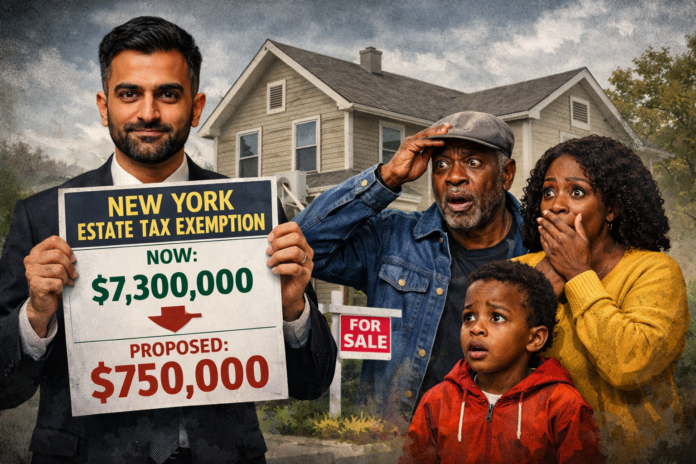
That distinction matters when examining the estate tax proposal being pushed by Zohran Mamdani, which would dramatically lower the estate-tax exemption in New York from roughly $7 million to about $750,000 while raising the top rate as high as 50 percent.
Supporters frame the proposal as a tax on the wealthy.
But when viewed through the lens of economic reality, the estate tax proposal could severely harm Black middle-class wealth, especially those relying on family homes as their primary asset, highlighting the urgent need for opposition.
Because for many Black families, wealth is not held in hedge funds or stock portfolios.
It is held in one asset: the family home.
The Fragile Foundation of Black Wealth
Decades of research from institutions like the Federal Reserve and the Urban Institute have consistently shown that Black households possess far less financial wealth than white households. Black families are less likely to own large stock portfolios, businesses, or investment accounts.
Instead, their wealth is overwhelmingly concentrated in housing.
For many Black middle-class families, the home represents the primary asset accumulated over a lifetime of work.
A house purchased in the 1990s for $150,000 may now be worth $700,000 or more simply because of New York’s inflated housing market.
Under a $750,000 estate-tax threshold, that modest family home could suddenly become a taxable estate.
Not because the family is wealthy.
But because the housing market has increased the value of the property.
Black Homeownership Pockets in New York
Across the Hudson Valley and Westchester County, there are long-standing pockets of Black homeownership where families finally gained stability after generations of housing discrimination.
Communities such as Mount Vernon, Yonkers, White Plains, Ossining, and Peekskill represent some of the strongest centers of Black middle-class homeownership in the region.
These communities are the result of decades of struggle against redlining, discriminatory lending, and limited access to capital.
Homeownership became the path toward stability and generational wealth.
But under a drastically reduced estate-tax threshold, many of those homes could fall into taxable territory when passed down to children, raising urgent concerns about community stability.
The Forced Sale Problem
Estate taxes are not theoretical. They are paid in cash.
When heirs inherit property but do not have the liquid funds required to pay the tax liability, they often face only one option: sell the property.
This is how generational wealth disappears.
Across cities like Chicago, Detroit, and Philadelphia, economists have documented how probate costs, taxes, and legal fees have forced families to sell homes that had been owned for generations.
For Black communities already struggling to close the wealth gap, this dynamic is particularly destructive.
The home is often the first—and sometimes the only—piece of generational wealth.
Remove that, and the ladder collapses.
The Pattern of Anti-Homeowner Policy in New York
The estate tax proposal does not exist in isolation.
New York has spent decades implementing policies that steadily weaken homeowners while expanding government dependence.
High property taxes, restrictive zoning laws, rising regulatory costs, and increasing government fees have made homeownership more expensive every year.
For middle-class Black families, these policies -like the estate tax proposal-slowly erode the very asset that provides financial stability and generational wealth.
And yet, these policies are rarely challenged by the very leaders who claim to represent Black communities.
The Silence of Black Leadership
Perhaps the most troubling aspect of this debate is the silence.
Too many Black political leaders, activists, and even pastors refuse to confront policies that harm Black homeowners openly.
Instead, conversations about economic policy are often reduced to emotional political loyalty rather than economic outcomes.
Economist Thomas Sowell once warned that the most dangerous policies are those judged solely by their intentions.
Politicians promise fairness. Activists promise justice. But if the outcome is the destruction of Black middle-class wealth, those promises become meaningless.
Yet many Black institutions—political organizations, advocacy groups, and even churches—remain silent when policies threaten homeownership.
The same leaders who mobilize voters every election cycle rarely mobilize their communities around protecting property ownership.
The Question We Must Ask
For decades, Black leaders have encouraged families to pursue one strategy that has proven to work: buy property, hold it, and pass it down.
Homeownership became the foundation of community stability and generational wealth.
But policies like this threaten to reverse that progress.
Work your entire life to buy a home.
Pay property taxes for decades.
And when you die, the government may force your children to sell it.
That is not wealth building.
That is wealth extraction.
The Bottom Line
If New York truly wants to close the racial wealth gap, policymakers should focus on expanding Black homeownership, protecting inherited property, and helping families transfer wealth across generations.
Lowering the estate-tax threshold to levels that capture middle-class housing will do the opposite.
It risks undermining the fragile gains Black homeowners have made in communities like Mount Vernon, Yonkers, White Plains, Ossining, and Peekskill.
And until Black political leadership and clergy are willing to confront policies that threaten generational wealth openly, the cycle will continue.
Because the greatest threat to Black wealth in New York may not be discrimination alone.
It may also be silence.