


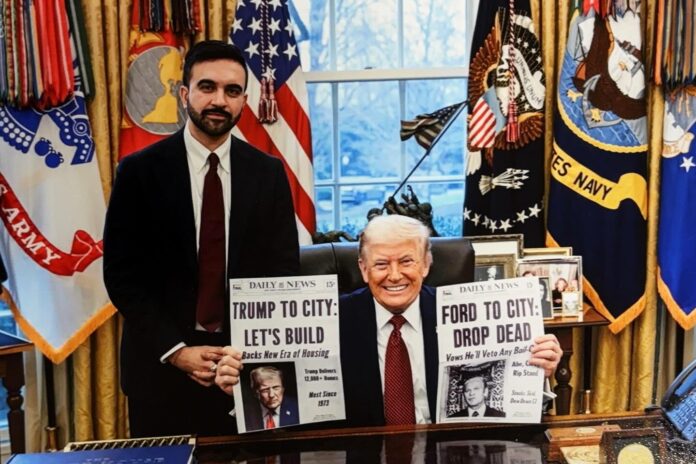





New York — Only days after Democratic lawmakers staged visible protests during President Donald Trump’s State of the Union address, New York City Mayor Zohran Mamdani traveled quietly to Washington to meet with the same president in the Oval Office. This meeting’s political and fiscal implications highlight the ongoing tension between public rhetoric and actual governance responsibilities.
For years, leading voices within the Democratic Party have described Trump not merely as a policy opponent but as a threat of historic proportions. The language has often been existential rather than procedural. Voters who supported him were frequently portrayed not simply as mistaken but as complicit in something dangerous. Engagement was framed as normalization. Cooperation was treated as a compromise of principle.
Read: The State of the Union: What it Means to Black America
Yet governance operates under constraints that rhetoric does not.
Mamdani’s reported discussions centered on housing affordability and economic pressures in New York City. Those problems cannot be solved with applause lines. They involve federal tax credits, HUD allocations, infrastructure funding, regulatory waivers, and administrative discretion. A mayor may campaign on ideology, but he governs within fiscal realities and institutional dependencies. Federal authority still matters.
There is also the financial context. New York City is carrying significant fiscal strain, in part due to the prolonged cost of managing the migrant crisis — including emergency housing, shelter operations, and associated services. Billions have been spent maintaining temporary accommodations and support systems. Whatever one’s view of immigration policy, the budgetary burden is real. When a city absorbs large-scale migration without matching federal reimbursement, deficits expand, and trade-offs intensify. In that environment, meetings with the federal executive are not symbolic; they are financial.
What remains unclear are the conditions attached to any potential cooperation. President Trump has been explicit in his position on immigration enforcement and border policy. If federal resources are directed toward housing, questions naturally follow about eligibility, criteria, and whether funds are tied to enforcement. These policy questions carry significant fiscal and social consequences that directly impact New York City’s budget and priorities.
If federal housing support expands under this administration, it could foster hope for NYC’s recovery, making citizens feel optimistic about future aid. It is reasonable to ask whether such support would prioritize citizen households, work-authorized migrants, or broader shelter populations. It is equally reasonable to ask what policy concessions, if any, accompany federal assistance. In politics, funding rarely comes without expectation.
This meeting, therefore, is not surprising from a governance standpoint. Unsurprisingly, a city leader facing affordability pressures and fiscal strain would seek federal leverage. What is notable is the contrast between years of moral condemnation and the practical necessity of negotiation.
If a political figure is truly viewed as an existential danger, reconciling engagement becomes difficult. If he is portrayed as uniquely unfit, cordial meetings invite scrutiny. The issue is not whether leaders should speak across party lines. In a constitutional system, they must. The issue is the degree of moral absolutism used in public discourse compared to the flexibility exercised in institutional practice.
During the State of the Union, elements of the Democratic caucus chose symbolic resistance. Within days, one of the most visible progressive municipal leaders chose strategic engagement. This does not necessarily reveal hypocrisy. It reveals structure. Campaigning rewards clarity and intensity. Governing demands calculation and compromise.
Supporters will argue that securing federal support for a strained city justifies the meeting. That argument stands or falls on results. Critics will question whether years of existential rhetoric were overstated if functional partnership remains possible.
In the end, outcomes will serve as a measure of leadership and accountability. If New York secures measurable fiscal relief, housing stability, or infrastructure support without compromising core municipal interests, the meeting will be seen as pragmatic leadership. Conversely, if the city’s debt deepens or federal aid comes with restrictive conditions, the episode will be judged more critically.
Voters would be wise to look past the theater and examine the terms. In public life, the true measure is not how leaders speak but the obligations they assume and the tangible results they deliver, especially in terms of fiscal and policy outcomes that affect the city’s future.