


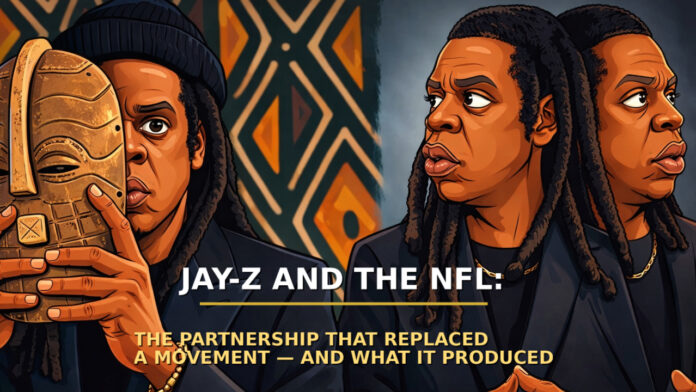





I watched the recent GQ interview of Jay-Z, conducted by Elliott Wilson, and let’s stop pretending this was journalism. This was a superficial rebrand because it lacked measurable outcomes or accountability, which are essential to evaluate genuine progress. No real pressure, no real follow-up questions, no moment where he actually had to explain anything that mattered. It was a safe space to reshape perception. That’s not an interview, that’s a rebrand, and you don’t do a rebrand unless something has been damaged.
This isn’t speculation. You can hear it in the transcript. When the conversation approached controversy, there were no follow-ups on facts, timelines, or evidence. The focus immediately shifted to emotion. He said he was “angry,” “heartbroken,” and that it “took a lot out of him.” That may be true, but it’s not an answer. It changes the conversation from what happened to how it felt, and those are two different standards. One requires evidence; the other, empathy. The interviewer never brought it back to evidence.
Then came the philosophy. “Everything happens for you, not to you.” That “there’s no good or bad.” Those are his words. Again, that may be how he sees life, but it does not explain outcomes. It does not address criticism. Whether intentional or not, the effect is the same—it moves the conversation into a space where nothing can be tested. You cannot fact-check a mindset, and that makes it difficult to challenge.
He also reframed how criticism should be viewed. He described himself as someone who sees the world “for what it is,” not what people want it to be. That framing doesn’t prove anything, but it does position disagreement as a difference in perspective rather than something that requires a direct answer. And again, it went unchallenged.
Now let’s deal with the part that should have been pressed but wasn’t. “We’re past kneeling.” That statement has been public since his partnership with the NFL. If you’re going to say that, then logically, there should be something to evaluate on the other side of it. So what should we look for? Policy changes—measurable reductions in incidents. Structural reforms are tied to the institutions involved. Not feelings. Not branding. Outcomes.
There were initiatives tied to that partnership, including funding through the NFL’s Inspire Change program, which has supported grants to organizations focused on criminal justice reform, education, and community relations. That matters. But those are localized, grant-based efforts. They do not directly change policing policy, prosecutorial standards, or federal accountability frameworks—the structural issues at the center of the original protest. That’s not dismissal—it’s a difference in scale and impact.
The underlying problem that sparked the protest has not been resolved at a systemic level. High-profile cases involving police encounters with Black men continue to occur, and public trust in institutions remains divided. According to Gallup, confidence in the police among Black Americans dropped sharply from 56% in 2019 to 19% in 2020, and while it has partially recovered since, it remains significantly lower than pre-2020 levels. That is not a resolved issue. That is an unstable one. Declaring a phase “over” while those conditions persist is not proof of progress. It raises a reasonable question: Did the strategy change faster than the outcomes?
What also gets left out of that conversation is what was happening around the NFL at the time. There was active cultural and economic pushback against the treatment of Colin Kaepernick. Fans, artists, and segments of the public were openly calling for a boycott, and viewership pressure—whether overstated or not—had become part of the league’s narrative. That’s the environment Jay-Z stepped into. He didn’t enter as a neutral observer. He entered as a bridge between the league and the culture, helping shift the energy from protest to participation. However, it was framed—social impact, partnership, progress—the reality is that it also aligned with the NFL’s need to stabilize its image and reconnect with an audience it risked losing. That’s not inherently wrong, but it is business. And once it becomes business, it deserves to be evaluated by results, not messaging.
This is where the distinction matters. Influence is proximity to power, but impact changes outcomes and produces measurable results. Highlighting this should make your audience feel motivated to seek real change over superficial influence.
Now, to be clear, no single person controls a movement. The shift away from protest was influenced by many factors—media cycles, internal disagreements, public fatigue, and political shifts. But it is also true that when a high-profile figure publicly reframes a moment, it affects perception. That’s influence. The question is whether that influence led to stronger results.
The interview presents this shift as an evolution. The idea that protest raises awareness and that institutional engagement is the next step. That’s a reasonable argument in theory. Protest and engagement do not have to be opposites. Pressure outside and negotiation inside can coexist and even reinforce each other.
But theory is not enough.
If the argument is that the strategy improved, then the improvement should be visible in clearly identifiable outcomes—policy shifts, accountability measures, or measurable changes in how institutions operate. This should make your audience feel the importance of concrete progress.
And that’s what the interview never addressed-actual outcomes. This omission underscores the need to demand tangible results over superficial messaging in social justice efforts.
When someone uses their platform to redefine a moment in the culture, that redefinition should be tested the same way the original protest was—by what it produces. We need to shift our focus from messaging to measurable results and hold public figures accountable accordingly.
The interview avoided that test.
That’s why it matters.
Because controlling the conversation is not the same as answering it.
And until the outcomes are as clear as the messaging, the questions won’t go away.