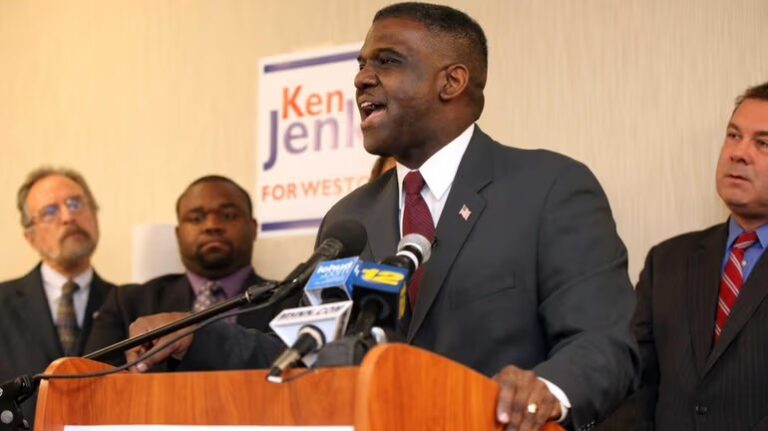
— a leader who has consistently demonstrated integrity, accountability, and an unwavering commitment to both public safety and community trust.
A Proven Partner in Public Safety
As Deputy County Executive, Ken Jenkins has worked to strengthen the relationship between law enforcement and the communities we serve. He understands that proper public safety requires more than arrests — it requires prevention, engagement, and fairness. Jenkins has supported efforts to ensure our officers are adequately trained, equipped, and held to the highest professional standards.
His collaborative leadership has helped advance initiatives focused on de-escalation training, mental health response, and building public confidence in policing. Jenkins recognizes that accountability and community partnership are not opposing forces — they are the foundation of justice.
Standing Up for Equal Opportunity and Justice
Ken Jenkins has been a consistent voice for equal opportunity in hiring, advancement, and leadership within law enforcement and county government. He has long understood that diversity in public safety makes departments stronger, more responsive, and more reflective of the communities they serve.
From his time as County Legislator to his current role as Deputy County Executive, Jenkins has supported programs that give young people — particularly from communities of color — pathways to careers in public service, ensuring that the next generation of officers and leaders come from all backgrounds.
A Leader Who Listens and Leads
Our organization values leaders who respect law enforcement, but who also demand fairness and accountability. Ken Jenkins embodies that balance. He listens to the concerns of officers and citizens alike, working to bridge divides rather than widen them. His approach to governance mirrors the principles we stand for: service, integrity, and responsibility to the people.
Our Endorsement
At a time when public trust in institutions is fragile, Westchester County needs steady and principled leadership. Ken Jenkins has proven he can deliver both safety and justice — without compromising one for the other.
For his record of service, his commitment to fair and effective policing, and his vision for a safer, more united Westchester, Blacks in Law Enforcement of America proudly endorses Ken Jenkins for Westchester County Executive.
Black Westchester Magazine proudly endorses Ken Jenkins for Westchester County Executive, recognizing his proven record of service, fiscal discipline, and lifelong commitment to equal opportunity for all residents of Westchester County.
A Record of Steady, Accountable Leadership
As Deputy County Executive, Ken Jenkins has shown that progress and responsibility are not opposites — they’re partners. Working alongside County Executive George Latimer, he has helped restore Westchester’s financial stability, protect essential services, and steer the county through some of its most challenging times.
From his years as a County Legislator and Chairman of the Board of Legislators, Jenkins developed a deep understanding of budget management, consensus-building, and policy-making that reflect fairness and fiscal prudence. His steady leadership has helped ensure that Westchester remains one of New York’s strongest and most well-managed counties.
A Champion for Equal Opportunity
Ken Jenkins has long been a champion of equal opportunity and fair representation across every community in Westchester. Representing District 16 — which includes parts of Yonkers and Mount Vernon — Jenkins earned a reputation for accessibility and results.
His commitment to expanding opportunities for minority- and women-owned businesses, improving public health access, and advancing affordable housing demonstrates his understanding that inclusion is not a slogan — it’s a responsibility. Jenkins’ leadership has directly supported programs aimed at reducing racial health disparities, expanding small-business growth, and strengthening historically overlooked neighborhoods.
A Vision for a Stronger, Fairer County
Ken Jenkins embodies the kind of results-driven leadership that Westchester needs to move forward. He has always focused on outcomes that matter — safer neighborhoods, stronger schools, and policies that help working families thrive.
Jenkins understands that government should work for the people, not political interests. His forward-looking approach balances economic growth with compassion and accountability, ensuring that every resident — from Mount Vernon to Peekskill — shares in Westchester’s success.
Why We Support Ken Jenkins
At a time when leadership is often defined by division, Ken Jenkins stands out as a bridge-builder — someone who listens, learns, and leads with integrity. His experience in both legislative and executive roles gives him the insight needed to deliver practical solutions without political gamesmanship.
Black Westchester Magazine supports Ken Jenkins because he represents what this moment demands: steady leadership, proven experience, and an unwavering belief in equal opportunity for all.
Editorial Note
This is an official editorial endorsement from Black Westchester Magazine. It reflects the publication’s independent evaluation of candidates and their record of public service. We encourage all voters to stay informed, participate in local elections, and make their voices heard
Welcome to the digital edition of the October 2025 Pre-Election Edition. As always, we would like to take this time to thank all the readers, listeners, supporters, sponsors, contributors, and advertisers for their support in our effort to deliver the “News With The Black Point Of View” since 2014. We are always looking for writers, photographers, and interns.
Email BlackWestchesterMag@gmail.com to inquire. Send us your feedback, let us know what you think of this issue. Let us know subjects/topics you would like to see us cover in the future, and send your letters to the editor to BlackWestchesterMag@gmail.com.
To advertise or support Black Westchester and The People Before Politics Radio, you can make a donation using the QR code below to help us to continue delivering The News With The Black Point of View free to the people!
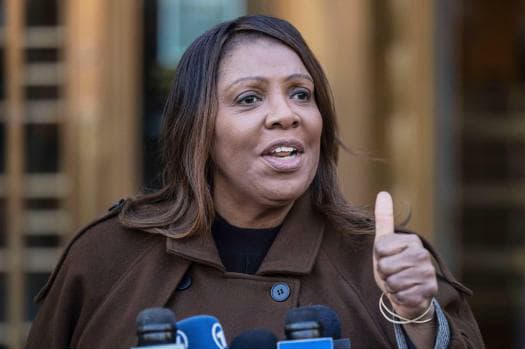
New York State Attorney General Letitia James is scheduled to appear in federal court in Norfolk, Virginia, on Friday, October 24th. The United States District Court for the Eastern District of Virginia in Norfolk is expected to be the location of a large rally in support of James. The prosecution of the Attorney General of New York is widely viewed as a retaliatory act driven by President Trump, who was prosecuted by the New York Attorney General last year.
James was indicted by a federal grand jury in Virginia on October 9, 2025, for charges of bank fraud and making false statements to a financial institution. The charges are related to her 2020 purchase of a property in Norfolk, Virginia, where she is accused of misrepresenting the property as her primary residence to get more favorable mortgage terms, when in fact it was an investment property. She has denied the allegations, calling them politically motivated.
It has been widely reported that prosecutors who challenge the James prosecution are being fired by the Trump Administration. Following their alleged refusal to charge James, newly appointed U.S. Attorney Lindsey Halligan sent termination letters to two prosecutors in the Eastern District of Virginia, Beth Yusi and Kristin Bird.
According to the five-page indictment against Attorney General James, she made a false assertion that the house she bought in Norfolk, Virginia, in 2020 was a “second home.”
The allegations against James focus on a mortgage agreement the New York Democrat signed in 2020 to purchase a house in Norfolk, Virginia. James allegedly stated in loan documents that she would use the property as her secondary residence – a claim that prosecutors say won her favorable loan terms but was in fact a lie, as she instead rented it out to a family. Her misrepresentation violated her mortgage agreement, prosecutors say, which barred James from renting out the property.
Prosecutors allege James improperly saved $18,933 because the interest rate on a mortgage for a second home is lower than interest rates on a loan for an investment property. The lower interest rate and another credit, they allege, account for the savings.
The first count James faces, bank fraud, charges her with scheming to defraud two financial institutions: OVM Financial, which helped James apply for the loan, and First Savings Bank, which was assigned to the loan. The second count charges James with lying to OVM Financial about her plans to rent the house.
James will make her first appearance in court on Friday, during which she will be presented with the charges against her. Prosecutors could ask the judge assigned to oversee the case to impose conditions for her release, though such conditions are not common when defendants aren’t accused of violent crimes or at risk of fleeing.
In a healthy democracy, the press is supposed to hold the powerful accountable — not protect them. The goal of a newspaper, whether local or national, is to tell the truth as it is, not as we wish it to be. That means reporting facts, even when they make people uncomfortable.
As a Black newspaper, Black Westchester Magazine has a duty to hold our elected officials to the same standards that we hold white officials. Integrity does not change based on race or party. But because we do that, we get attacked from both sides — called “conservative” by white readers and labeled “coons” or “sellouts” by some in our own community. That’s fine, because our integrity goes farther than our feelings. In the end, outcomes matter more than placating party loyalty. Truth is not partisan; it’s a principle.
That belief has guided Black Westchester from day one. Over the past several weeks, we’ve reported on the federal indictment of New York Attorney General Letitia James — a case centered on the Norfolk, Virginia, home she purchased in 2020 and the terms of the loan she obtained. We’ve sat down with financial whistleblower Sam Antar, defense attorneys, and legal analysts to break down the filings and what they actually mean. What we’ve presented is not rumor or spin — it’s documentation straight from court records.
The Facts the Public Deserves to Know
According to federal filings, in 2020, James bought a Norfolk house for roughly $137,000. Prosecutors allege she obtained favorable loan terms by declaring it a second home — a designation that, under Fannie Mae rules, means the property must be personally occupied and cannot be rented out. Yet testimony and disclosures show that her grand-niece lived in the home rent-free and that James, at one point, described the property as an investment while reporting some rental income.
Those are the contradictions that form the basis of the indictment. They may not make for dramatic headlines, but they’re simple issues of paperwork, intent, and truth on federal documents.
How The New York Times Changed the Frame
The New York Times, in its widely shared feature on the case, didn’t dispute those facts. In fact, it confirmed them — noting the rent-free occupancy, the investment classification, and the rental income. But instead of centering those points, the story opened with the color of the house, the children who lived there, and the emotional imagery of a“modest yellow home.”
By paragraph five, the article had shifted from the legal contradictions to a broader story about Trump’s Justice Department and political retaliation. The focus wasn’t on whether the Attorney General violated mortgage law; it was on how she felt as a target. The tone turned the case from a matter of public accountability into a parable of persecution.
Sympathy Over Substance — and What the Documents Really Show
That framing — sympathy over substance — is how major outlets sanitize stories that would otherwise challenge their own political allies. But the irony is that even as the Times tried to soften the blow, its reporting still supported the underlying federal case. The very evidence it described aligns with the elements of bank fraud: misrepresentation to a lender and inconsistent use of the property.
Yet many readers, especially within our own community, are now pointing to that same Times article as proof that independent Black outlets like ours are “misleading” the public — when the facts we’ve printed are the same ones buried inside their piece.
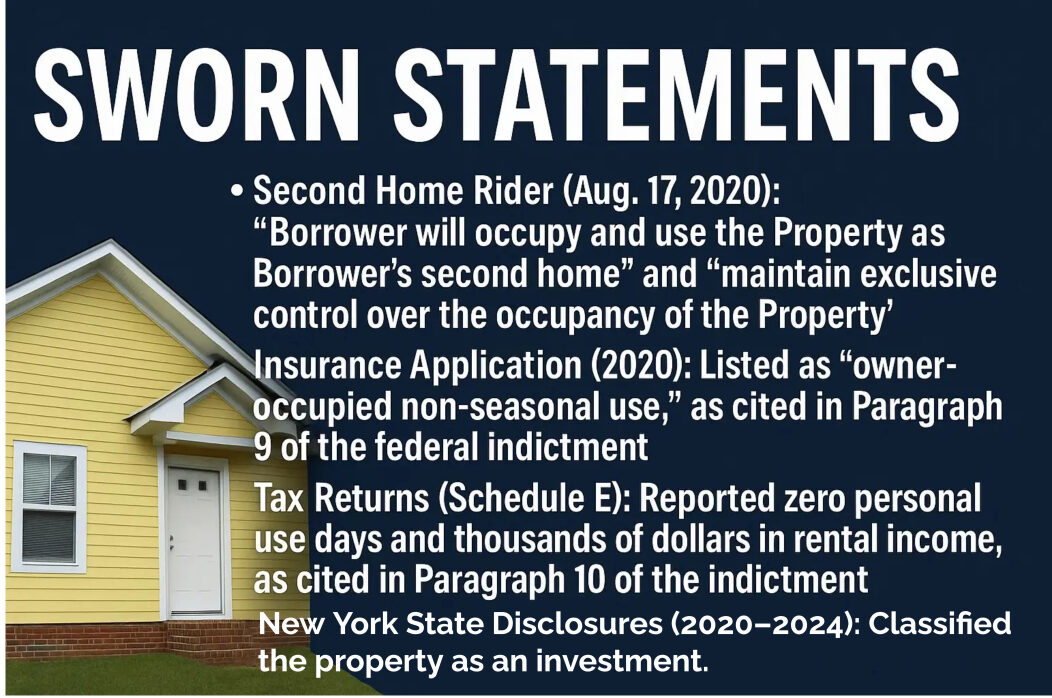
Financial investigator Sam Antar, who has appeared on our platforms, responded directly to the New York Times ‘ portrayal of the indictment as “weak.” His analysis cuts through the spin with facts drawn directly from the public record:
These four statements cannot all be true. You cannot occupy a property as a second home while reporting zero personal use days to the IRS, while telling insurance it’s owner-occupied, and while classifying it as an investment property to the state. At least three of these sworn statements must be false.
This isn’t about unclear guidelines — this is systematic fraud: telling four different government entities four different stories about the same property, all under penalty of perjury. When prosecutors have four contradictory sworn statements about the same property made to other institutions, it’s not just a weak indictment; it’s a clear indication of documented fraud. This level of deception and manipulation of the system is a serious breach of trust and integrity.
Every one of those documents is publicly available — from Virginia land records to the federal indictment and New York State ethics disclosures. The evidence is in plain sight. What the Times downplays as “political” or “minor” is, in fact, the pattern of contradictions that federal prosecutors look for in every financial fraud case. This pattern involves inconsistencies in the information provided to different government entities, which can indicate an attempt to deceive or manipulate the system.
What We Actually Reported
In our many coverages and YouTube discussions, Black Westchester never denied that this case could be political retaliation — in fact, it very well might be. But that doesn’t excuse the paperwork James signed, the way she filed her taxes, or the questions about her mortgages. The possibility of political motivation doesn’t erase the paper trail.
My mother always said, “When you live in a glass house, you shouldn’t throw stones.” Letitia James threw a lot of stones at Donald Trump. Now Trump is throwing them back, and the cracks in her own house are starting to show. That’s not bias — that’s balance. It’s a reminder that accountability is not a one-way street, and it’s essential for maintaining the integrity of our political and media institutions.
The Real Taboo
Let’s be honest: there is an unspoken rule in Black politics — we can challenge power when it’s white, but not when it’s ours. That double standard is precisely what weakens our collective integrity. But it’s the courage of Black journalists who tell uncomfortable truths that strengthens it. Accountability is not betrayal. It’s love of truth over loyalty to personality. If we silence these truth tellers, we aren’t protecting progress — we’re protecting power.
Why It Matters
This isn’t just about Letitia James. It’s about the pivotal role of independent Black media in shaping the narrative and holding power accountable. When we report facts — especially about our own — we prove that we take justice seriously, no matter who’s in the hot seat. That’s the very essence of equality under the law, and it’s a testament to the power of our voices in the fight for justice and equality.
Truth doesn’t need soft edges.
The Norfolk house isn’t a political weapon — it’s a case study in how media framing can shape perception and how fear of criticism can silence truth tellers.
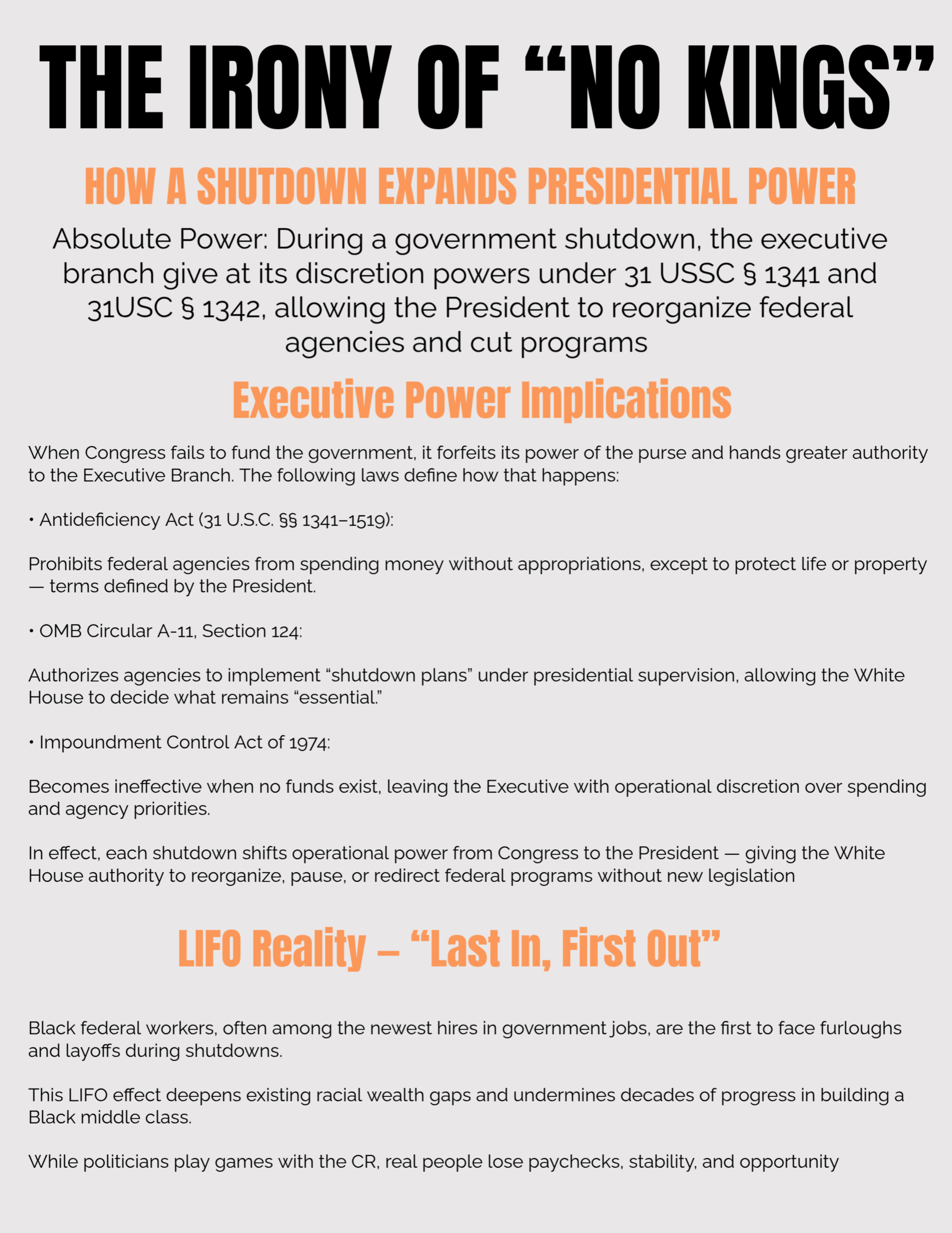
While protesters chant “No Kings” in the streets, Democrats have done the one thing guaranteed to create one—hand the presidency unchecked authority through its own inaction. The government shutdown, now entering its third week, is less about budgets than about power. And the people who warned America about authoritarianism are the ones expanding it.
When Congress refuses to fund the government, it surrenders the one constitutional weapon the Founders gave it—the power of the purse. Under the Antideficiency Act (31 U.S.C. §§ 1341, 1342, 1511-1519), agencies cannot spend a dollar without congressional appropriations, except to protect life and property. Who defines those exceptions? The President and the Office of Management and Budget (OMB). That means the Executive Branch decides which programs live, which die, and which employees remain “essential.” OMB Circular A-11, Section 124, gives every department authority—under presidential supervision—to implement shutdown plans that suspend, consolidate, or redirect operations. In short, the President rules by interpretation.
This shutdown didn’t have to happen. The Senate has failed 11 times to pass a Continuing Resolution (CR). This simple stopgap measure keeps the government funded temporarily while lawmakers negotiate long-term spending bills. What makes this impasse especially absurd is that it involves a clean CR—one without policy riders or partisan giveaways. Historically, Democrats have supported such clean resolutions to protect essential services. But this time they refused, not over spending levels, but because they wanted to attach health-care subsidy extensions tied to the Affordable Care Act.
Under standard legislative procedure, healthcare provisions—such as ACA subsidies, Medicaid funding, or Medicare adjustments—are handled through separate legislation, such as reconciliation bills or specific healthcare acts, rather than as part of a short-term CR. In plain English: you don’t rewrite national healthcare law inside a temporary budget patch. It’s like refusing to pay rent because you want your landlord to rebuild the entire neighborhood first. Even many Democratic budget veterans quietly admit this is not normal. Yet Senate leadership chose to stall a clean funding bill in pursuit of a political trophy. And by doing so, they handed President Trump something far more valuable than a policy win—expanded executive discretion to decide what functions of government survive during the shutdown.
During a shutdown, the Antideficiency Act and OMB guidance merge into a framework of “operational discretion.” The White House and agency heads determine what qualifies as essential. They control who stays on the job, which contracts are frozen, and which services continue. The Impoundment Control Act of 1974, designed to prevent presidents from withholding congressionally approved funds, becomes toothless because no funds are available to release. The result is practical autocracy: the President interprets necessity, and Congress watches from the sidelines.
That’s how every additional day of gridlock gives the Oval Office more precedent to shrink, reorganize, or redirect government—without legislation. And this time, it gives Trump the ability to demonstrate how leaner executive control can function while Washington bickers.
Nearly eighteen percent of the federal workforce is Black. Federal employment has long been a ladder to the middle class for families locked out of private-sector opportunity. When paychecks stop, mortgage payments, car notes, and tuition bills pile up. Black-owned contractors, depending on federal work, lose revenue. Small businesses serving government hubs face empty lobbies. Federal programs that stabilize low-income communities—from Section 8 housing to small-business grants—pause indefinitely. So while Washington’s elites argue over process, working-class Americans—disproportionately Black—bear the cost of a political chess match that was never theirs to play.
Thomas Sowell often wrote that outcomes, not intentions, should be the basis for judging policy. The outcome here is unmistakable: a shutdown that weakens Congress, strengthens President Trump, and punishes ordinary Americans. The longer this continues, the more the balance of power shifts toward the Executive. Congress may one day reopen the government, but it will find that the presidency has already expanded its reach.
You cannot claim to defend democracy while refusing to perform the basic duty of governing. Each day of delay doesn’t just close offices—it redefines power. And when the smoke clears, the President will be stronger, not weaker, because Congress handed him the scepter while pretending to resist the crown.
Understanding the political process isn’t optional—it’s the only safeguard against manipulation. You can’t have a “No Kings” rally while the very officials waving that slogan are surrendering their authority through negligence. When lawmakers refuse to pass a simple Continuing Resolution, they aren’t checking the Executive—they’re empowering it. Every shutdown becomes a civics lesson in reverse, showing that ignorance of how government functions is as dangerous as corruption itself. The Founders designed checks and balances to protect the people from concentrated power, but that system collapses the moment those elected to defend it choose performance over principle.
When Washington stops working, it’s always the working class that pays the price. The federal government has now been shut down for more than three weeks — one of the longest in U.S. history — and as usual, Black America is feeling the pain first and worst. This shutdown is not just a political issue, it’s a crisis that is disproportionately affecting Black federal workers, small Black-owned businesses, and families relying on federal programs.
Federal workers, contractors, small-business owners, and families relying on federal programs are caught in the crossfire of a political power struggle that has nothing to do with them. Over 750,000 federal employees are either furloughed or working without pay. In places like D.C., Baltimore, and Atlanta — regions with some of the largest Black federal workforces in the nation — households are already struggling to keep up with rent, utilities, and food costs that have climbed since the pandemic.
This is not a political abstraction. These are the same people who keep airports running, handle veterans’ claims, deliver mail, inspect food, and manage housing vouchers. Every missed paycheck creates a ripple effect in our communities — and every day Congress refuses to act, those ripples turn into waves.
A CLEAN CR — AND A DIRTY GAME
This shutdown didn’t have to happen. The Senate has failed 11 times to pass what’s called a Continuing Resolution (CR) — a simple stopgap measure that keeps the government funded temporarily while lawmakers negotiate long-term spending bills. This is not the first time such a deadlock has occurred, and each time, it’s the working class, especially Black America, that bears the brunt.
What makes this shutdown especially frustrating is that it is a clean CR — a term used to describe a temporary funding bill that doesn’t include policy riders or partisan wish lists. It’s the kind of temporary funding bill Democrats have historically supported to keep essential services running.
But this time, they refused to vote for it — not because of the funding levels, but because they wanted to attach healthcare subsidy extensions tied to the Affordable Care Act (ACA).
Here’s the truth:
Under standard legislative procedure, healthcare provisions — like ACA subsidies, Medicaid funding, or Medicare adjustments — are handled through separate legislation (for example, reconciliation bills or specific healthcare acts), not as part of a short-term Continuing Resolution.
In plain English, you don’t rewrite healthcare law in a stopgap bill. That’s not how the process works. It’s like refusing to pay your rent because you want your landlord to fix the entire neighborhood first.
Even many longtime Democratic budget experts admit this is not standard practice. Yet Senate leadership decided to hold the government hostage over an issue that could easily be taken up in a regular legislative session.
WHO GETS HURT WHEN THE GOVERNMENT SHUTS DOWN
The consequences fall hardest on the people least responsible for the dysfunction:
Black federal workers — roughly 18% of the federal workforce — face delayed paychecks and uncertainty.
Small Black-owned businesses that depend on government contracts or grants, many of which are now frozen.
Families relying on SNAP, WIC, or Section 8 are facing administrative delays that are slowing down approvals and payments.
HBCU research programs and workforce grants that depend on federal funding are being interrupted mid-semester.
Meanwhile, politicians who created this mess still receive their paychecks on time.
This shutdown doesn’t just pause pay; it delays progress on infrastructure, affordable housing, and public health initiatives that many Black communities have been waiting on for years.
FROM PRINCIPLE TO POLITICS
It’s easy to talk about compassion and equity on campaign stages, but leadership is tested in moments like this. If Democrats are willing to let the government close over a healthcare provision that should be debated separately, that’s not principle — that’s politics.
It’s a stark reality that both parties are using the livelihoods of working-class Americans, including those in Black communities, as bargaining chips for their policy wins. This unfairness is a bitter pill to swallow, especially when Black America rarely receives compensation for the collateral damage.
WHAT BLACK AMERICA SHOULD BE ASKING
Why are both parties using our pain as political leverage?
Why do we never hear about a contingency plan to protect essential workers during a shutdown?
Why aren’t more of our elected officials — especially those representing majority-Black districts — holding press conferences demanding accountability and relief for those most affected?
If our leaders truly believed in “equity,” they’d prioritize reopening the government first — then debate healthcare later. That’s what a clean CR is supposed to ensure: continuity, not chaos.
THE BOTTOM LINE
The shutdown is more than a Washington drama — it’s a mirror showing us how fragile our economy is for those living paycheck to paycheck. It’s a reminder that political grandstanding has real consequences for real people.
It’s high time for Black America to demand accountability, clarity, and leadership from our elected officials. We cannot afford to be the collateral damage in America’s partisan wars any longer. It’s time for action, not excuses.
Because when the government shuts down, it’s not the powerful who lose — it’s the people who can least afford another political delay.
Mount Vernon, NY —A Mount Vernon man has been sentenced to 40 years in federal prison for coercing and exploiting a minor, marking one of the harshest sentences for child exploitation ever handed down in Westchester County.
Tyquan Brown, 44, was sentenced on October 15 by U.S. District Judge Kenneth Karas following his December 2024 guilty plea to coercion and enticement of a minor.
According to the U.S. Attorney’s Office for the Southern District of New York, Brown used social media and online messaging platforms to lure a teenage victim into performing sexual acts, which he then recorded and threatened to share. Prosecutors said Brown’s conduct was both manipulative and calculated — using intimidation and emotional control to exploit the child.
“This case is every parent’s nightmare,” said U.S. Attorney Damian Williams. “The defendant preyed on a young victim’s vulnerability for his own gratification. Today’s sentence ensures that he will never again have the chance to harm another child.”
The case was investigated by the FBI’s Westchester Safe Streets Task Force, with assistance from the Mount Vernon Police Department and the Westchester County District Attorney’s Office, led by District Attorney Susan Cacace.
In a statement following the sentencing, DA Cacace commended federal partners and emphasized the ongoing commitment to protecting children in Westchester County:
“The justice system worked together to bring accountability and protection. Every child deserves to grow up safe, and this outcome sends a strong message to those who would attempt to exploit our most vulnerable.”
Judge Karas also ordered lifetime supervised release and that Brown register as a sex offender upon completion of his sentence.
Community advocates are calling for greater awareness of online grooming and parental involvement in monitoring children’s digital activity. “Predators aren’t hiding in dark alleys anymore — they’re hiding behind screens,” said one Mount Vernon parent interviewed by Black Westchester. “We need stronger education, tougher laws, and more honest conversations in our homes.”
Community Alert: If you suspect child exploitation or online grooming, contact the National Center for Missing & Exploited Children at 1-800-THE-LOST (1-800-843-5678) or submit confidential tips at CyberTipline.org.
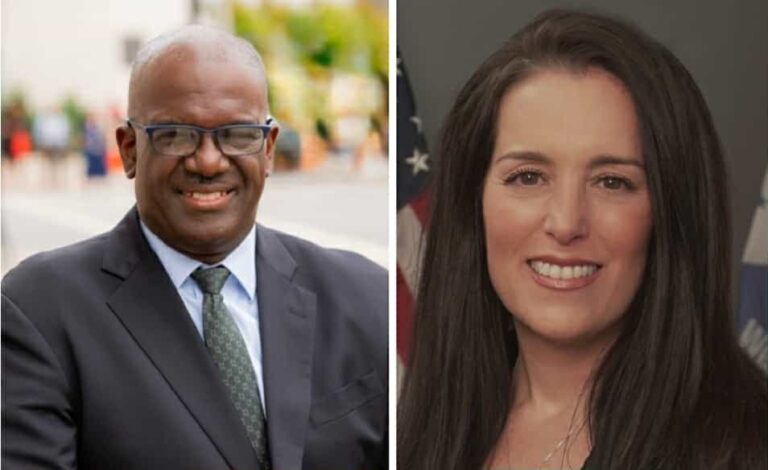
The League of Women Voters of Westchester County hosted a Westchester County Executive Candidate Forum, Monday, October 20th, between County Executive Ken Jenkins (D) and challenger Christine Sculti (R). The virtual candidate forum was moderated by Patricia Sibilia.
We posted the video below in its entirety for you to watch and hear the candidates address the issues and community concerns.
Local leagues throughout Westchester are hosting candidate forums for contested seats on the Westchester County Board of Legislators and in city, town, and village races. Visit LWVW’s Candidate Forum webpage for information on LWV candidate forums that have been scheduled thus far.
Election day is Tuesday, November 4th. Early voting for the General Election will be Saturday, October 25, 2025 – Sunday, November 2, 2025. Early voting for the General Election is a nine (9) day period where voters can vote in-person before Election Day in Westchester County.
The League of Women Voters® of Westchester (LWVW) is a nonpartisan organization whose purpose is to promote informed and active participation in government. The League neither supports nor opposes candidates or political parties. LWVW is an Inter-League Organization (ILO) and is composed of the local leagues of Larchmont/Mamaroneck, New Castle, New Rochelle, Northeast Westchester, Northwest Westchester, the Rivertowns, Rye/Rye Brook/Port Chester, Scarsdale, and White Plains and their members.
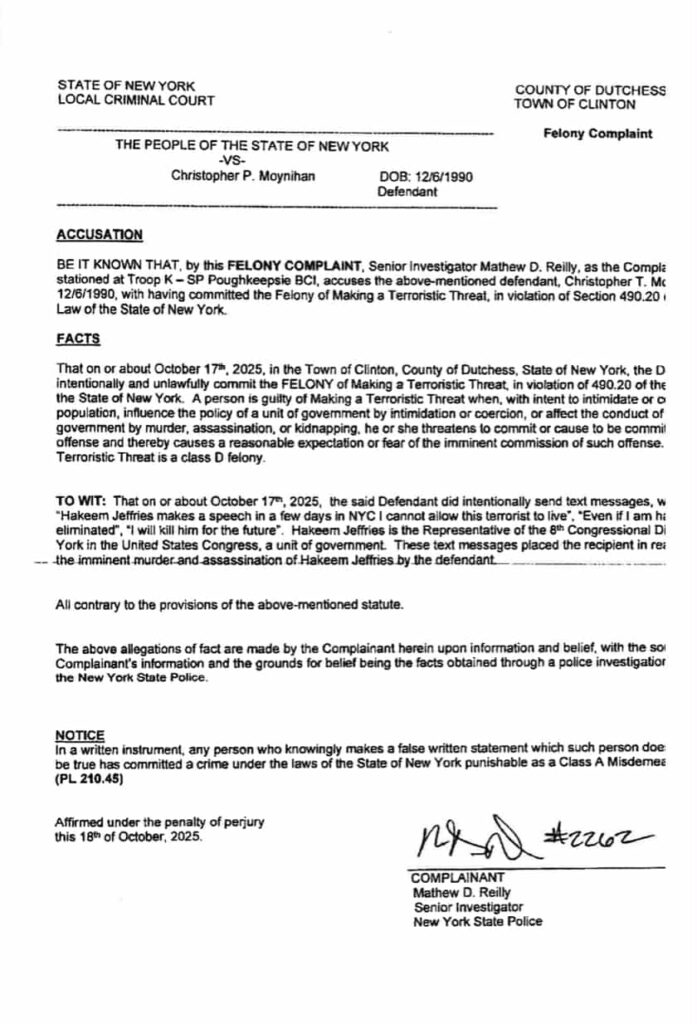
A Dutchess County man who was pardoned by President Donald Trump for his actions at the U.S. Capitol on Jan. 6 was arrested Saturday and charged with making a terroristic threat against House Minority Leader Hakeem Jeffries, New York State Police said.
Moynihan allegedly planned to target House Minority Leader Hakeem Jeffries during a speech to the Economic Club of New York, according to court filings obtained by Black Westchester. In the criminal complaint, investigators quoted text messages allegedly sent from Christopher Moynihan, 34, of Clinton, NY, on October 17th to an unidentified recipient.
“Hakeem Jeffries makes a speech in a few days in NYC I cannot allow this terrorist to live,” the texts read, according to the charging complaint filed in New York state court. “Even if I am hated he must be eliminated. … I will kill him for the future.”
On Tuesday, Democratic Leader Hakeem Jeffries released the following statement:
“I am grateful to state and federal law enforcement for their swift and decisive action to apprehend a dangerous individual who made a credible death threat against me with every intention to carry it out.
The person arrested, along with thousands of violent felons who stormed the US Capitol during the January 6th attack, was pardoned by Donald Trump on the President’s very first day in office. Since the blanket pardon that occurred earlier this year, many of the criminals released have committed additional crimes throughout the country. Unfortunately, our brave men and women in law enforcement are being forced to spend their time keeping our communities safe from these violent individuals who should never have been pardoned.
It is the honor of my life to serve in Congress during these challenging times. Threats of violence will not stop us from showing up, standing up and speaking up for the American people.”
In a press conference, Congressman Jeffries said, “When it comes to these extremists out there, you better watch how you talk when you talk about me.” He also says, “I think the reckless and irresponsible pardons of hundreds of violent felons on January 6th has consequences…There are consequences to that, beyond me…there are consequences to irresponsible actions and not a single House Republican has walked away from them.”
Speaker Mike Johnson (R-La.) on Tuesday denounced the alleged death threat against House Minority Leader Hakeem Jeffries (D-N.Y.);
“I don’t know any of the details of this at all. I don’t know who’s been alleged to have been involved in this,” Johnson told reporters in the Capitol. “I will say that anybody — anybody — who threatens political violence against elected officials or anyone else should have the full weight and measure of the Department of Justice on their head.
“I trust that that will happen — I hope it will,” he added. “We are intellectually consistent about that, obviously.”
Moynihan was sentenced to 21 months in prison in 2023 for breaching the Capitol on 6 January 2021 as part of the mob seeking to stop Congress from certifying that Joe Biden had won the 2020 election and to keep Trump in power.
Moynihan was arrested Saturday and charged with making a terroristic threat, a felony, and is scheduled to appear in court on Thursday. He is the first pardoned Capitol rioter to be arrested over alleged political violence.