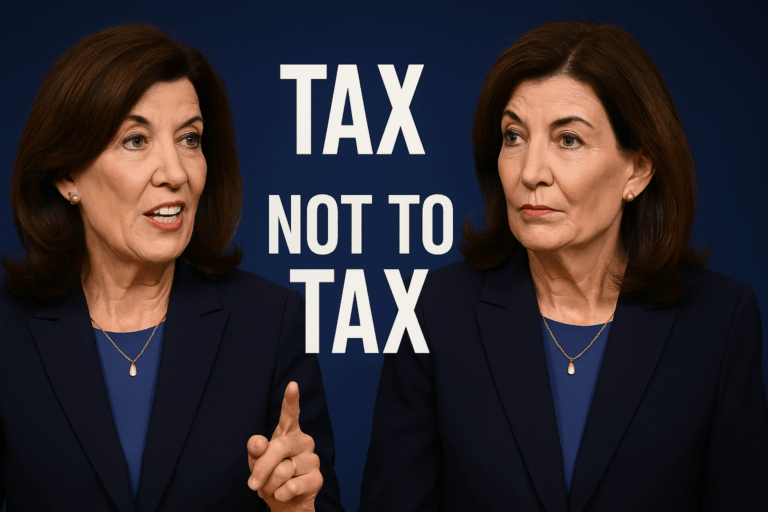
Governor Kathy Hochul is caught in a political storm of her own making. In just forty-eight hours, her administration managed to send two completely opposite messages on the future of taxes in New York. First came the leak: Hochul is considering raising corporate taxes to address a massive $34.3 billion budget deficit. That news sent New York progressives into celebration mode. Then the celebration ended abruptly. Hochul’s own budget director announced that raising taxes on the wealthy was “the last thing on my mind.”
Two positions. One administration. Zero clarity.
This confusion isn’t random — it is the direct result of what many are now calling The Mamdani Effect, the political pressure created by Mayor-elect Zohran Mamdani’s aggressive tax-the-rich agenda. His movement wants Albany to use taxes as a weapon to reshape the economy, and Hochul is trying to satisfy them without triggering a deeper economic crisis. The result is political inconsistency masquerading as leadership.
But the real issue is bigger than mixed messaging. It is the economic reality that New York refuses to confront. New York already has one of the highest tax burdens in America. The top state income tax rate is 10.9 percent. In New York City, the combined state and city rate approaches 15 percent. When federal taxes are added, high earners can see more than 40 percent of their income disappear before they touch a dollar.
Yet activists insist the wealthy still “aren’t paying enough,” as if tax policy can be built on slogans rather than math.
What they ignore — and what New Yorkers live with — is the unavoidable truth that the wealthy do not respond to tax increases by paying them. They respond by reorganizing their finances. They shift assets into trusts, restructure income through LLCs, relocate investments, or simply change residency to Florida or Texas. In other words, they move their money faster than New York can chase it.
And when the wealthy move their money, New York looks to replace it. But Albany never reduces spending; it increases fees, tolls, property taxes, utility costs, DMV charges, and payroll taxes. Every one of these lands squarely on the shoulders of the middle class — the only group without tax shelters, high-priced accountants, or the ability to move to another state.
This is the part of the tax debate that politicians never say out loud. New York’s system is dangerously dependent on the top 1 percent of earners, who already supply nearly half of all income tax revenue. If even a small slice of them leave, the impact on the state budget is immediate and severe. And every time New York raises corporate taxes, the cost is quietly passed to consumers through higher prices, fewer jobs, and higher rent.
So when Hochul wavers between raising taxes and backing away from them, she isn’t just revealing mixed priorities — she is exposing a structural flaw in New York’s entire approach to revenue. The Mamdani Effect has created a policy climate where economic reality is treated as an inconvenience, and where ideology is allowed to shape decisions that determine whether families can afford to stay in this state.
And in the end, the bill never arrives at the homes of the wealthy or the corporations being targeted. It always arrives in the mailbox of the middle-class New Yorker — the one group no one in Albany seems willing to protect.
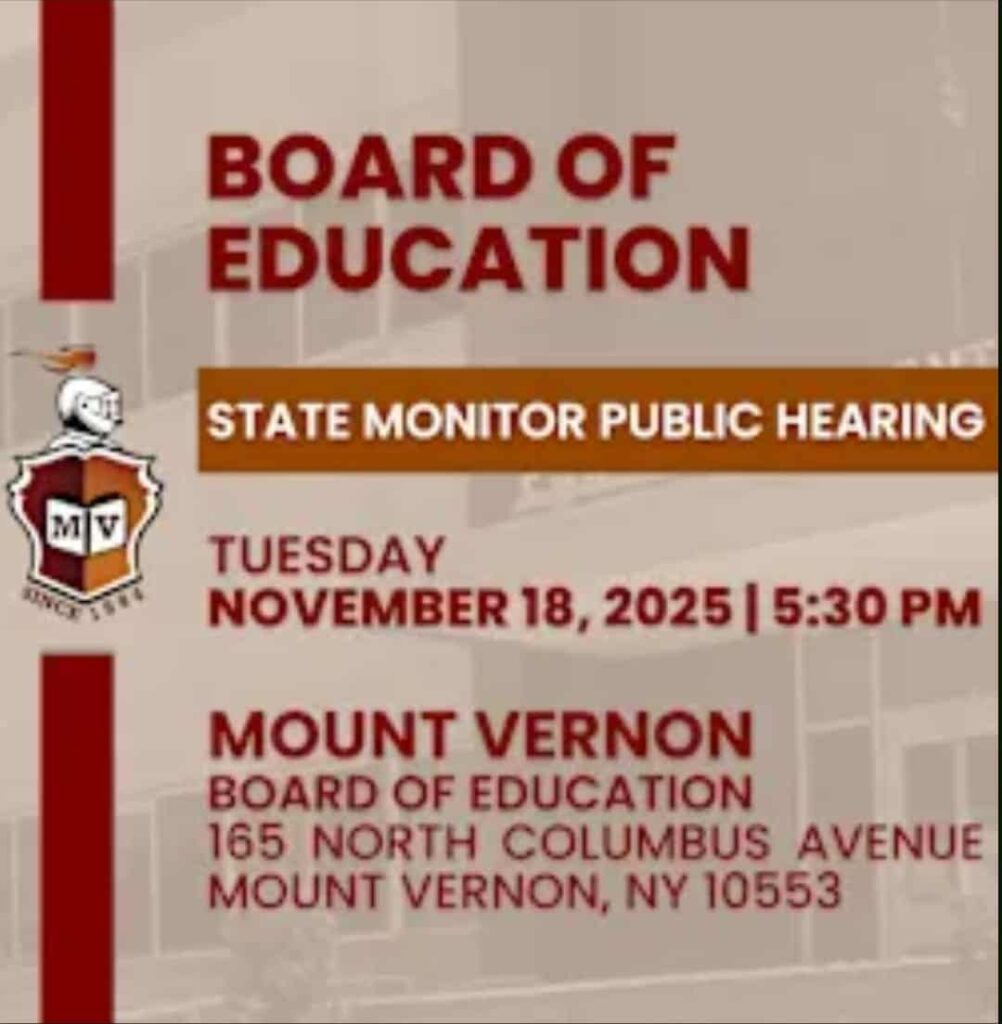
The Mount Vernon City School District (MVCSD) was appointed an academic monitor by the New York State Education Department (NYSED) and will hold a public hearing regarding the Monitor’s Findings Report. The hearing will take place from 5:30 PM to 7:00 PM on Tuesday, November 18, 2025, in the Board Room at the Education Center, 165 N. Columbus Avenue, Mount Vernon, New York, 10553.
You must register to speak in advance, no later than 12 noon on the day of the hearing, by contacting the District Clerk in person (165 N. Columbus Avenue, Mount Vernon, New York), by phone (914-665-5235), or by email rjames@mtvernoncsd.org. Anyone who did not submit a request to speak before the hearing can still submit comments to kyoungwilkins@mtvernoncsd.org
The NYSED appointed Dr. Kimberly Young Wilkins as state monitor for academic and financial plans for the District through June 30, 2027. The Board approved her appointment. Dr. Young Wilkins will provide oversight, guidance, and technical assistance related to the educational and financial policies, practices, programs, and decisions of the District, Board, and superintendent. Dr. Young Wilkins will work with the Board to develop a five-year financial plan and a five-year academic improvement plan by November 1, 2025.
If you are unable to appear in person at the public hearing, comments may be submitted to the state monitor via e-mail at kyoungwilkins@mtvernoncsd.org with “State Monitor” in the subject line.
You can view the Mount Vernon City School District Academic Improvement and Financial Plans 2025–2026 through 2029–2030 School Years Draft for the Board of Trustees below.
The draft states that, “The Mount Vernon Board of Education (“the board”) shall operate in accordance with the ‘Eight Characteristics of Effective School Boards.'” (See Eight Characteristics… below)
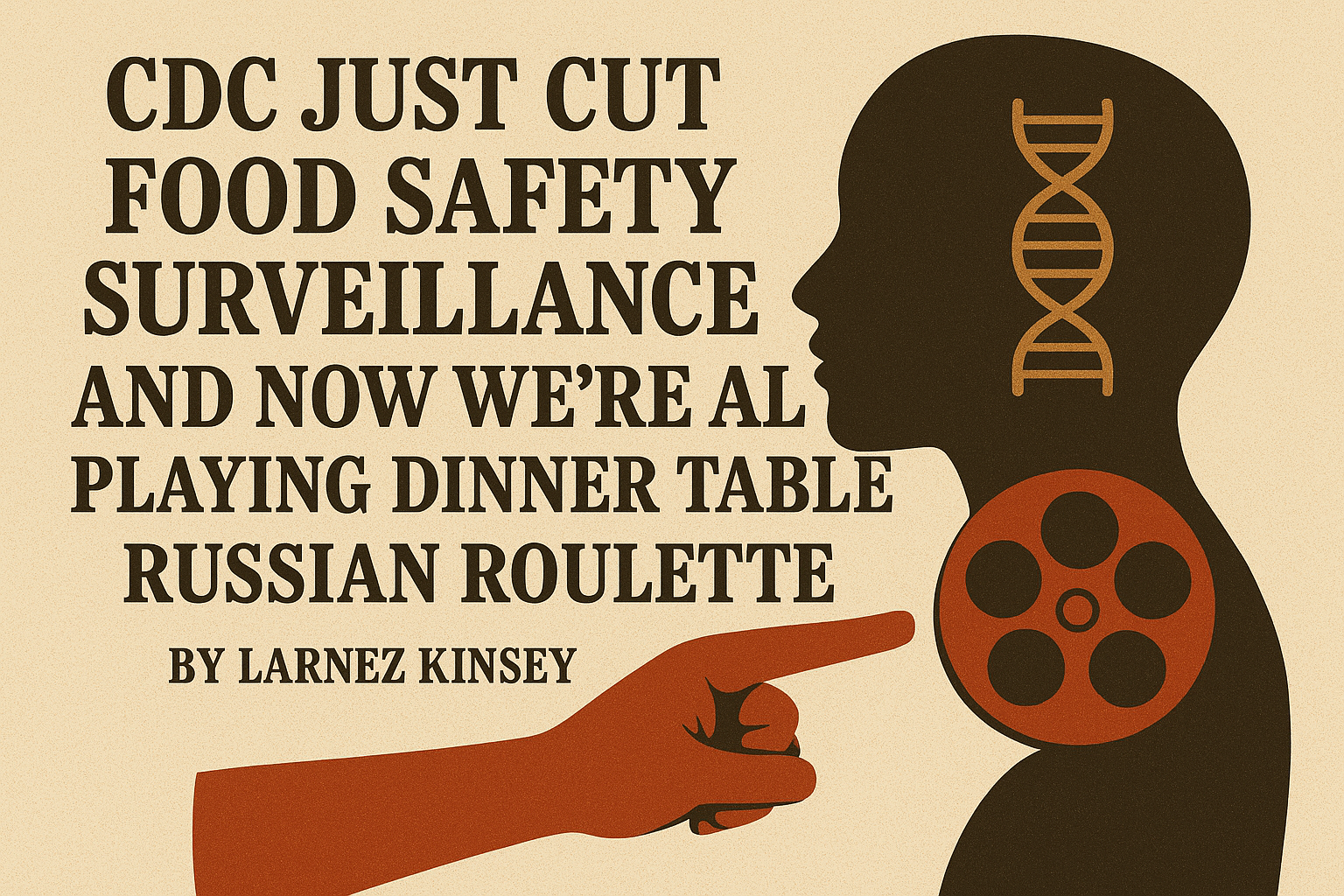
While we were out here living life, grilling, brunching, buying them Costco rotisserie chickens the CDC made a quiet little move on July 1, 2025. They took FoodNet, the program that’s been tracking foodborne illnesses for 30 years, and said: “We’ll only officially track two germs now, Salmonella and E. coli. The other six? Optional.”
Yes, Optional.
Like “wearing a seatbelt” is optional. Like “washing your hands after the bathroom” is optional.
That’s not optional. That’s survival.
Let’s Talk Numbers (Receipts Don’t Lie)
48 million people in the U.S. get sick from food every single year. That’s 1 in 6 of us. You, me, your auntie, your kids.
128,000 hospitalizations happen annually from foodborne illnesses. That’s whole hospitals filled with people who just wanted to eat dinner.
3,000 deaths every year are gone, because something as simple as spinach, cheese, or undercooked chicken was contaminated.
Listeria, one of the germs now “optional,” causes about 260 deaths a year, and it doesn’t play fair. It goes after pregnant people, newborns, and seniors.
Vibrio, that raw oyster demon? 80,000 illnesses and 100 deaths annually, with a fatality rate of nearly 20% for severe infections.
And let’s not forget Campylobacter, the #1 cause of bacterial food poisoning in America. It’s been climbing in recent years, and now it’s… optional.
So the question is: how you gonna fight a war with germs if you stop counting half the enemy?
Why This Is Bigger Than Food Poisoning
See, this isn’t just about a bad night on the toilet. It’s about systems.
When you shrink surveillance, you don’t just risk a few extra tummy aches; you risk delayed outbreak detection. That means:
People keep eating contaminated food longer before recalls.
Hospitals see spikes in cases with no clear answers.
Vulnerable populations, babies, seniors, and immunocompromised folks end up carrying the heaviest burden.
And history shows us what happens when oversight slips. Remember that E. coli outbreak in late 2024? Nearly 90 people were sick, one child died, and the public never even got told the source of contamination. Transparency vanished. And if transparency goes, accountability follows.
The Patchwork Problem
Here’s the kicker: because the CDC made six pathogens “optional,” now it’s up to states to decide. Some, like Minnesota and Maryland, are keeping full coverage. Others are already talking about scaling back. So, depending on your zip code, your food safety net might be full-strength or frayed.
That’s like saying: in some states, your fire alarm works; in others, it might not even be plugged in.
What You Can Do (Because I’m Not Just Gonna Scare You, I’m Gonna Equip You)
Here’s the starter pack for food safety survival when the system’s half-asleep:
In the Kitchen
The thermometer is queen. 165°F for chicken, 160°F for ground meats, 145°F for steak and fish. Don’t “eyeball it,” don’t “feel it,” don’t “grandma says it’s fine.” Science.
Two boards, two lives. One cutting board for raw meat, another for produce. Cross-contamination is sneaky.
The 2-hour rule. Leftovers in the fridge within 2 hours (1 if it’s hot outside). After that, bacteria’s doing the electric slide all over your food.
As a Consumer
Sign up for recalls. FDA and USDA send free alerts, text, and email. Be the first to know, not the last to throw up.
Follow your state health department. They often post outbreak info before it hits the news.
As a Citizen
Apply pressure. Call your reps. Ask your health department: “Are you still tracking all 8 pathogens?” Put them on record.
Share knowledge. Post this info, tell your family. Community power is real power.
The Real Talk Wrap-Up
Here’s the bottom line: when the CDC cuts back to just two germs, it’s like checking your gas tank but ignoring the brakes, the oil, and the engine light. You might keep moving for a while, but eventually, disaster.
And this isn’t just about food, it’s about equity. Because the people most likely to suffer when oversight slips? Black and brown communities, working-class families, the elderly, and the medically fragile. The folks with the least margin for error.
So yes, laugh at the absurdity, clown the system for real. But also know this: we can’t afford to shrug it off. Not when it’s our families, our kitchens, our lives on the line.
Because food safety ain’t optional. And neither are we.
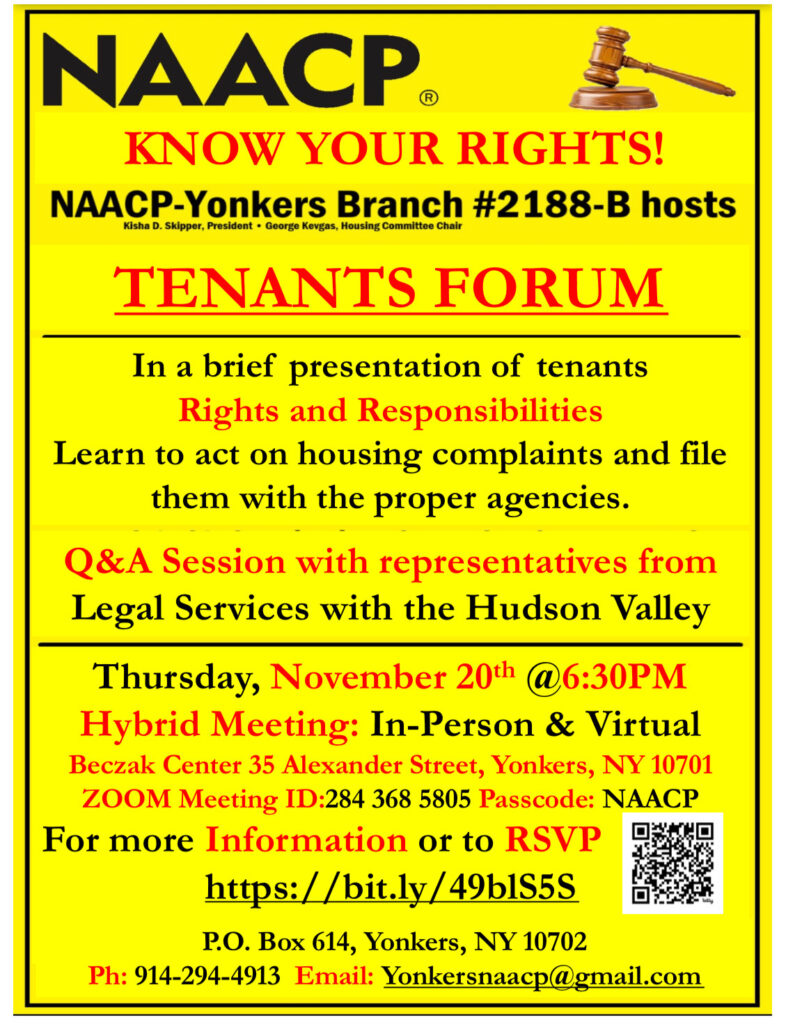
NAACP-Yonkers Branch Housing Committee will be hosting a Know Your Rights Tenant Forum on Thursday, November 20, 2025, at Sarah Lawrence College Center for the Urban River at Beczak located at 35 Alexander Street in Yonkers.
Understanding tenant rights in Westchester County is crucial for protection against illegal evictions, harassment, and unfair rent hikes, especially during challenging economic times. Knowing your rights allows you to access legal resources, defend yourself in court, and advocate for systemic changes. The county’s “Right to Counsel” program, established in 2023, is a key resource, but awareness of other protections—like those against retaliation, discrimination, and illegal rent overcharges—is also vital for preventing housing insecurity and homelessness.
This Tenants Forum will focus on:
Habitability concerns
Organizing Tenant Associations
Filing complaints with landlords, property management, and the City of Yonkers Department of Housing and Buildings
Contacting other appropriate agencies for tenant support
Representatives from Legal Services of the Hudson Valley will be present to answer questions (please note they will not be providing legal advice or representation).
The forum will be both in person and Virtual: ZOOM Meeting ID: 284 368 5805 | Passcode: NAACP
To those who need help, here are some great resources;
Local building departments: Report dangerous or unsanitary conditions to your local building department.
211 Helpline: Can connect you with various local assistance programs.
Even if you think you Know Your Rights, come out because there is always new caselaw that is often in the tenants’ favor. Share this with family, friends, and neighbors because knowing your rights can help you prevent eviction, which has increased sharply in New York since the end of the moratorium. Legal representation can significantly lower the eviction rate for tenants.
Mount Vernon, NY — November 7, 2025 — Community members, health professionals, and local leaders gathered Thursday evening at Westchester Community College’s Mount Vernon Extension Center for a public meeting on the rising asthma crisis in Black neighborhoods across Westchester County. Hosted by the Asthma Committee of the Westchester County African American Advisory Board, the forum focused on worsening air quality and its disproportionate impact on African American families.
The meeting was led by Marvin Church, Chair of the Asthma Committee, who opened the discussion by stressing the urgency of Mount Vernon’s environmental health challenges. Church introduced Barbara Edwards, Esq., Chair of the Westchester County African American Advisory Board, who outlined the county’s new legislative action to confront the crisis. The Westchester County Board of Legislators recently approved the formal establishment of an Asthma Subcommittee, a body charged with studying and addressing the burden of asthma within the county’s African American population.
“This initiative represents a measurable step toward environmental equity and community health,” Edwards said. “We are committed to identifying and eliminating the conditions that continue to put our residents at risk.”
Committee members in attendance included Nurse Practitioner Miesha Stokely, Yonkers School Board Member Larry Skpes, former Elmsford School Board Member Dr. Suzanne Phillips, and Black Westchester Magazine’s Publisher, Damon K. Jones. Each contributor spoke to the medical, educational, and social dimensions of asthma in Westchester’s Black communities.
Residents offered emotional testimony about daily exposure to polluted air. Many pointed to nearby factories, industrial facilities, and the steady idling of school and transit buses as persistent sources of harmful emissions. Parents expressed deep concern about children attending schools adjacent to heavy traffic and industrial zones.
“The idling of buses and the emissions from surrounding factories are not just environmental concerns—they are public health threats,” Church said. “Our children breathe this air every day. We have a responsibility to act, and this committee intends to work closely with the community and policymakers to drive long-term solutions.”
To help guide those solutions, Church asked attendees to provide their ZIP codes so the committee can build interactive maps illustrating asthma hot spots and pollution clusters throughout Mount Vernon and surrounding municipalities. This data will inform future policy recommendations and allow officials to prioritize the neighborhoods most in need.
The meeting also addressed the wider racial disparities linked to asthma, noting that Black families and low-income residents endure disproportionately higher rates of asthma and related complications. Participants emphasized the need for expanded public education, community outreach, and preventative measures across the county.
The Board publicly acknowledged Senator Jamaal Bailey for ensuring representation from his office at the event. His continued involvement underscores the need for coordination between state and local leaders to combat environmental health inequalities.
“This meeting allowed residents to be heard and policymakers to listen,” Edwards said. “By integrating community experience with data and legislation, we can build a healthier and more equitable Westchester County.”
The Westchester County African American Advisory Board and its Asthma Committee will continue hosting public forums throughout the county. Upcoming meetings are scheduled for New Rochelle, Yonkers, Elmsford, Greenburgh, White Plains, and Peekskill, as they broaden their push for cleaner air and healthier neighborhoods.
For years, people brushed off the idea that governments or foreign intelligence networks could break into the average person’s cellphone. That denial died the moment researchers around the world confirmed what insiders had warned about for more than a decade: powerful Israeli-built spyware, capable of turning your smartphone into a 24-hour surveillance device, has been deployed in dozens of countries — including right here in the United States. These programs were not created for everyday policing; they were designed as military-grade cyber weapons. Once they entered the global marketplace, the line between foreign intelligence, domestic security, and political spying became dangerously blurred.
The most infamous of these tools is Pegasus, created by the Israeli cyber-intelligence firm NSO Group. Pegasus doesn’t need you to click a link, download an app, or fall for a scam. It can enter your phone through a missed call, a message you never opened, or a software gap you didn’t even know existed. Once inside, it can monitor your calls, read your messages, turn on your camera and microphone, track your location, and access your photos and files without ever revealing itself. It is the closest thing to a digital ghost, capable of living inside your phone while you go about your day, completely unaware.
Pegasus is not the only Israeli program causing global concern. A newer system called Predator, developed by companies with Israeli cyber engineers, operates like a long-term surveillance parasite. Predator infects phones through poisoned links, fake app updates, social-media messages, or even compromised news articles. Once installed, it embeds itself so deeply inside the operating system that it becomes almost impossible to detect. Candiru, another Israeli spyware platform, takes a different approach and often enters devices through browser exploits or manipulated downloads. It is designed not only to spy on mobile phones but also to infiltrate laptops, tablets, and cloud accounts. Together, these programs represent an entire ecosystem of digital weapons that can quietly strip away a person’s privacy, undermine their rights, and expose their networks to whoever controls the software.
If this technology sounds like something a government would use only against terrorists, the global investigation known as The Pegasus Project proved otherwise. Journalists, political opponents, civil-rights activists, human-rights lawyers, heads of state, and even associates of the late Jamal Khashoggi were all found on targeting lists. In some countries, phones belonging to union leaders, student organizers, and opposition candidates were compromised. In others, even public-health officials were monitored. These programs were marketed as anti-terror tools but ended up being used to spy on critics, rivals, and inconvenient voices.
The most alarming part is this: you don’t have to be “important,” wealthy, or political. You only need to be connected to someone who is. In many cases, people were hacked simply because they communicated with or were related to a primary target. That means regular, everyday citizens — people who believe they have nothing to hide — can become collateral damage in a surveillance war they never signed up for. Your phone becomes valuable not because of who you are, but because of who sits in your contact list.
This is not science fiction. In 2025, the Associated Press confirmed that an Israeli-backed spyware system was used to target European journalists. WhatsApp successfully sued NSO Group for hacking accounts, and Meta won a major judgment after proving its platforms were exploited. Even the U.S. government placed NSO Group on a trade blacklist, acknowledging the national-security threat. When a federal government openly concedes that a foreign company’s spyware can compromise American devices, the public has no choice but to take it seriously.
If foreign spyware can infiltrate the phones of diplomats, CEOs, and senators, then it can infiltrate yours. And with every upgrade in AI and cyber-exploitation, these tools become more stealthy, more powerful, and more accessible to governments and private buyers. It no longer takes a nation-state to run a surveillance operation; all it takes is a contract, a budget, and a political motive.
This raises critical questions for Black communities. Who is watching our activists? Who is monitoring our journalists? Who is keeping tabs on our political movements, especially when we speak against corruption, police abuse, government failures, or foreign policy decisions? History already shows how often dissenting Black voices have been targeted — from COINTELPRO to modern digital monitoring. Now, the surveillance tools are stronger, cheaper, and harder to detect. A phone in your pocket today has more vulnerability than the wiretapped phone lines of the 1960s.
Protecting yourself isn’t about paranoia. It’s about awareness. It means keeping your phone updated, recognizing suspicious behavior, and understanding that cybersecurity is the new frontline of civil rights. This is especially true for independent Black media, organizers, and everyday citizens who rely on their phones for work, communication, and safety. A compromised device doesn’t just expose you — it exposes your movement, your strategy, and your community.
Israel may not be directly targeting you. NSO Group may not know your name. But the governments, agencies, or private actors who buy their spyware might. And if your phone becomes the weakest point of entry into a network of activists, journalists, or whistleblowers, you could be compromised without ever knowing it.
The age of digital weaponry is here. The question is not whether someone wants access to your phone — the question is whether the people who want it already have it.
5. Associated Press (AP News), 2025 Investigation confirming Israeli-backed spyware used to target European journalists. https://apnews.com (search: “Israeli spyware journalists”)
The Car Is Empty When the Conductor Finds Her — Again
“Grand Central, miss.”
Lauren Thomas jolts awake—same conductor, same gentle tap on her shoulder, same fog in her head. She thanks him, gathers her things, and steps onto the platform.
It’s Tuesday. Or Wednesday. The days blur when you sleep through most of them.
She’s been here before: asleep on trains, asleep in bathroom stalls between classes, asleep in backseats with a pillow and blanket she keeps in a “sleep kit.”
“My mom would read textbooks to me so I could study. My dad helped me type my school essays as I sleepily dictated what I wanted to say. They believed me when no one else did.”
Three Knee Surgeries by Seventeen
Lauren grew up a relentless and meticulous competitor, a basketball player and concert pianist who lived in motion.
By twelve, she’d already had her first knee surgery. By seventeen, she’d had three. Her dream of college basketball faded, but her drive didn’t.
In high school, she started fighting a different kind of opponent: a fatigue that made every morning feel like climbing a mountain in slow motion.
She napped in bathroom stalls, set alarms for eight-minute micro-rests, and built that sleep kit in her car.
“Everyone was tired at my prep school,” she says. “But this was different. I was running on empty.”
They Never Flinched
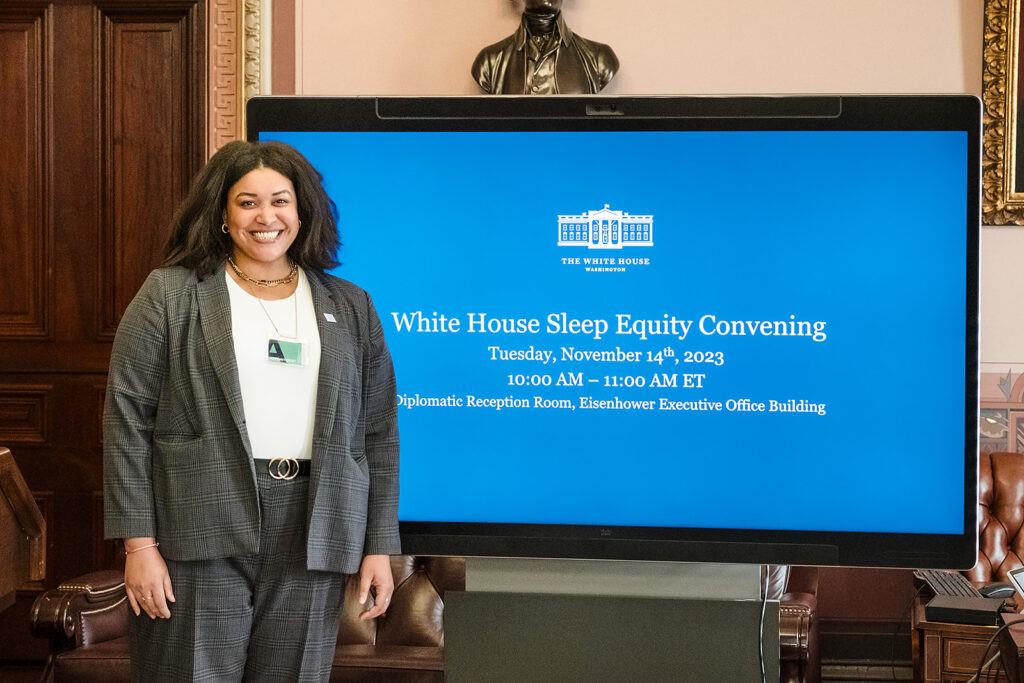
Lauren Thomas, with her parents, her mom Lynn Thomas (L), and her dad, Hall of Fame Basketball player Isiah Thomas (r) [Lauren Thomas]
Mom read the chapters for her schoolwork before audiobooks were popular.
Dad learned to speed-type as she dictated.
They tag-teamed mornings to get her to school.
They set alarms for her 3 a.m. dose once she had an actual diagnosis.
Treatment meant stimulants by day and sodium oxybate—a controlled substance that improves nighttime sleep quality—by night. And a family still checking that 3 a.m. alarm to ensure she got her dose in.
But more than medication, it meant learning to trust again.
“I’d lost faith in doctors,” she says. “Then I met one who actually listened. It gave me hope again.”
From Bathroom Stalls to Capitol Hill
Lauren Thomas, daughter of Hall of Fame NBA player Isiah Thomas [Lauren Thomas]
Reading Julie Flygare’s Wide Awake and Dreaming gave Lauren language for her own story. She reached out. Julie wrote back.
Soon, Lauren was helping plan World Narcolepsy Day, joining Project Sleep’s Board of Directors, and by 2024, being named Sleep Advocacy Champion.
“When I read Julie’s book, I realized I’d never even been taught what cataplexy was. Now I talk about it on panels, sometimes with my parents right next to me.”
Recently, she stood on Capitol Hill asking for a “home for sleep” within the CDC.
“There’s funding for epilepsy,” she said. “Why not sleep? Most med schools give it less than an hour.”
If Lauren could talk to her younger self, she’d say: “You know yourself better than anyone. Don’t let the world talk you out of that.”
Then she adds quietly, “There was a time I thought rest meant weakness. Now I see it for what it is…surrender that lets you heal.”
Proof
These days, Lauren doesn’t hide her naps anymore.
She speaks on panels, sometimes with her parents in the audience.
She pushes for CDC funding. She answers emails from people who are fourteen years into their own fog.
“For thousands living with narcolepsy, especially young women of color told they’re imagining things, Lauren’s story is more than inspiring. It’s proof.
Proof that you can trust yourself when the system doesn’t. Proof that fourteen years of being told you’re wrong doesn’t mean you are.
Proof that advocacy starts with one person refusing to disappear.
“My journey isn’t just about sleep,” she says. “It’s about determination and believing in yourself, no matter what happens.”
Her mother watches her daughter testify on Capitol Hill and thinks about all those mornings reading biology textbooks aloud, wondering if they’d ever find an answer.
Her father watches her advocate for sleep medicine funding and remembers learning to type fast enough to capture his daughter’s thoughts before exhaustion pulled her under again.
“We always knew she was extraordinary,” her mother says. “We just needed the world to catch up.”
And it is catching up—one diagnosis, one policy change, one teenager in a bathroom stall finding Lauren’s story and thinking: Maybe I’m not crazy either.
And when the train conductor sees her now, he just nods.
She’s awake.
Lauren Thomas serves on the Board of Directors for Project Sleep and was named a 2024 Sleep Advocacy Champion. She still has the voicemail from January 6, 2019, saved on her phone.
There is a strange ritual in American politics where temporary policies are treated as permanent achievements, and the inevitable return to reality is framed as cruelty. Nothing demonstrates this better than the current outrage over so-called “cuts” to the Supplemental Nutrition Assistance Program (SNAP). The loudest critics never stop to ask a simple question: Were these benefits ever permanent to begin with?
For years, SNAP spending grew because Washington layered emergency pandemic enhancements on top of the existing program. These “emergency allotments” were created for a crisis, not a new normal. They expanded eligibility, raised benefits, and suspended work requirements — all justified under the banner of an unprecedented national shutdown.
But emergency policies come with expiration dates. Everyone in Congress knew it. Every governor knew it. Every agency that administered SNAP knew it. The surprise only arrived when the temporary benefits ended and many households discovered, for the first time, that their pandemic boost was never part of the original law.
In other words, the “cut” was not a cut. It was the clock running out.
This matters, because public policy cannot function on wishful thinking. If temporary measures are treated as permanent entitlements, then we are no longer talking about economics — we are talking about political theater. And political theater has a long record of producing disastrous incentives. Once people become accustomed to elevated benefits, any return to normal becomes framed as harm, injustice, or cruelty. But the numbers tell a different story.
SNAP spending in 2024 is still far higher than it was before COVID-19. Participation remains historically high. Even after the pandemic enhancements expired, SNAP still reflects a 21 percent permanent benefit increase enacted in 2021 — one of the largest increases in the history of the program. If this is austerity, then words have lost all meaning.
The more important question — the one Washington avoids — is what happens when a nation builds expectations around temporary money. During COVID, Congress flooded the system with emergency expansions, then quietly allowed them to sunset. Now the very politicians who approved the expiration schedules are pretending someone else is responsible for the outcome. It is a pattern as old as government itself: write the law on Monday, deny the consequences on Tuesday, and demand more funding on Wednesday.
Another inconvenient reality is inflation. When the U.S. Department of Agriculture recalibrated benefit amounts for 2023 and 2024, the formulas reflected food prices, not political messaging. Even with increases baked into the Thrifty Food Plan, inflation eroded purchasing power faster than policy could keep up. The result felt like a reduction, even though the underlying benefit structure had not been cut.
Yet somehow, none of this makes it into the public debate. Instead, we are told that “Republicans cut SNAP” or “Congress reduced food aid,” as if math, time limits, and inflation adjustments are political weapons rather than physical realities. This is not analysis — it is advertising.
If we are serious about protecting vulnerable families, then we must start with an honest question: What is the purpose of the program? Is it to provide emergency relief? A permanent income supplement? A workforce alternative? Or a political tool whose value increases every election season?
A society that cannot answer these questions clearly will not manage SNAP effectively — or any social program, for that matter.
Thomas Sowell often reminded us that there are no solutions, only trade-offs. The trade-off here is simple: a temporary expansion provided immediate relief during a crisis, but it created long-term expectations that were never sustainable. When the emergency ended, the expectations remained — and the political blame game began.
What happened to SNAP is not a mystery. It is a case study in how government expands during emergencies, how voters become accustomed to the expansion, and how politicians then exploit the confusion for partisan gain. The real tragedy is not the end of temporary benefits. The tragedy is that we continue repeating the same cycle — and refuse to learn from it.
If America wants a safety net that actually works, it must be built on facts, not feelings; incentives, not illusions; and long-term thinking rather than short-term politics. Otherwise, the next “emergency” will produce the same temporary expansions, the same permanent expectations, and the same political outrage when reality eventually returns.
The law didn’t fail. The math didn’t fail. What failed was our willingness to tell the truth about how policy works.
SNAP References & Sources
U.S. Department of Agriculture (USDA) – Food and Nutrition Service
SNAP Annual Participation & Spending Data (2023–2024) USDA Food and Nutrition Service. SNAP Annual Summary. https://www.fns.usda.gov/snap
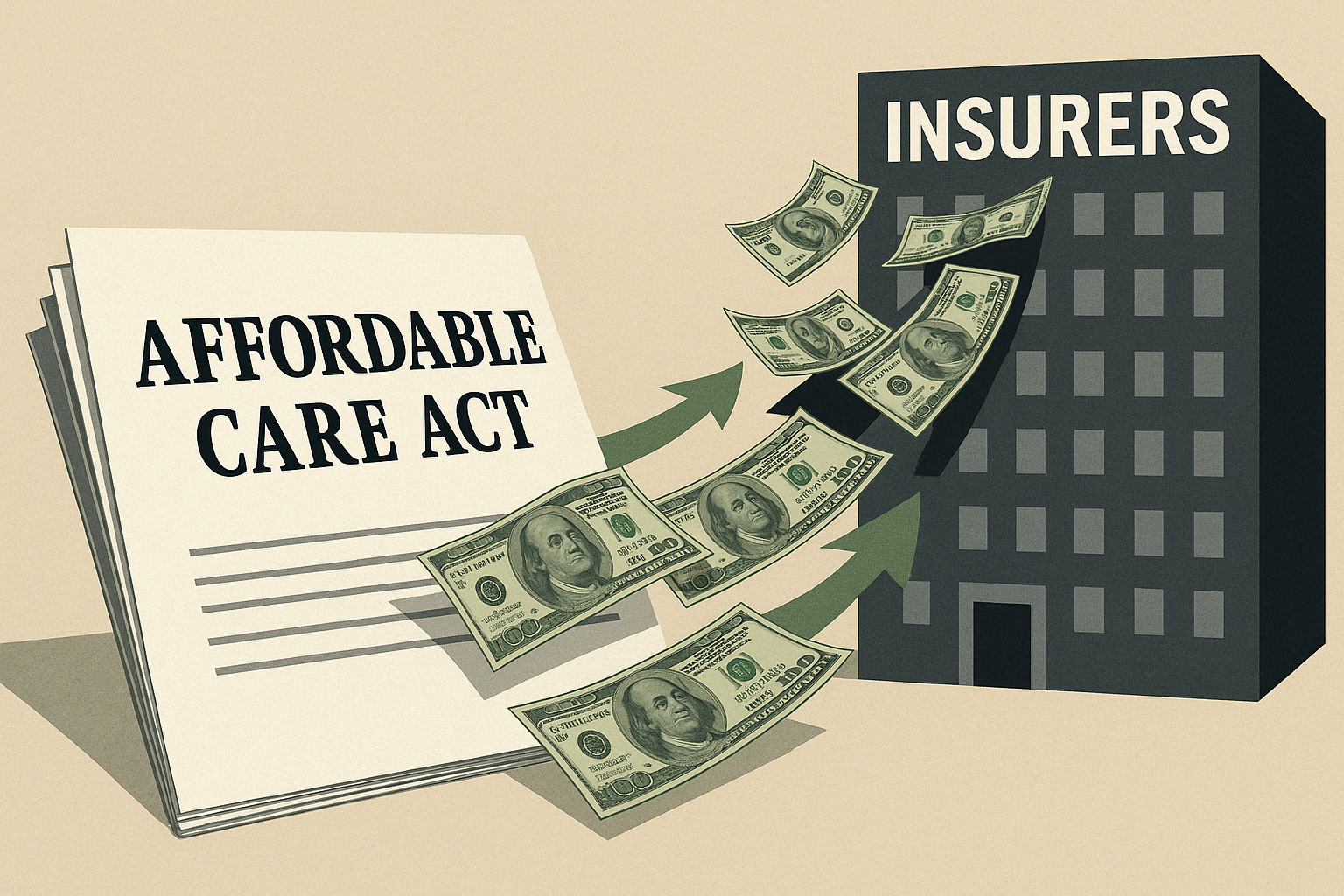
Public policy, often judged by its intentions, sometimes fails to deliver the desired results. The Affordable Care Act is a prime example. It was presented as a reform intended to lower costs, expand access, and introduce competition into the healthcare marketplace. However, it produced a system in which costs continued to rise, choices narrowed, and the most significant financial gains went not to patients but to the insurance companies set at the center of the law’s design.
President Trump has now challenged the fundamental structure of that system. He argues that the ACA’s subsidies should no longer be paid to insurance companies but should be paid directly to the American people. Whatever one thinks of Trump personally, his proposal forces a question that Washington has avoided for more than a decade: Why should billions of taxpayer dollars pass through corporate accounts before reaching the citizens the law is supposedly designed to help?
This is not a question of sentiment or partisan emotion. It is a question of incentives.
The ACA’s Incentives: A System Built Around Insurers
The ACA’s core mechanism is straightforward: individuals who qualify for subsidies do not receive the money. The government sends those subsidies directly to insurance companies. In practice, this means insurers are guaranteed federal revenue regardless of whether they innovate, reduce costs, or deliver higher quality coverage.
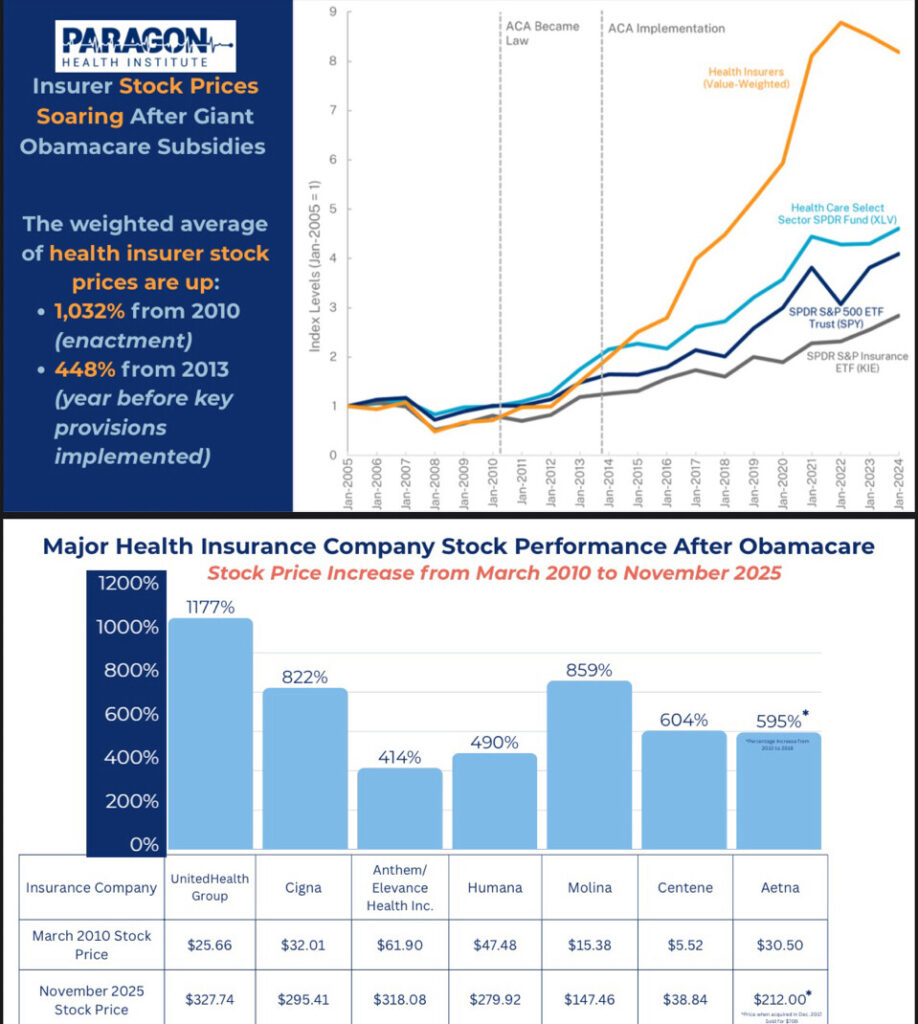
The results speak for themselves. Independent analysis shows that the weighted average stock price of major health insurance companies has risen more than 1,032 percent since the ACA was enacted in 2010. Premiums for ACA plans, meanwhile, are projected to rise again in 2026—double-digit increases in many states—despite more than a decade of promises that the law would control costs.
If a law produces one group of clear financial winners and another group of increasingly burdened consumers, the incentives are revealing. The ACA successfully expanded coverage for some Americans, but it did so by embedding private insurance companies deeper into the public financing structure. The marketplace did not become more competitive; it became more dependent on federal subsidies.
The Clarification Politicians Avoid
As with most major policy debates, misinformation thrives when political power is at stake. So a basic clarification is necessary: Trump’s proposal does not alter Medicaid, Medicare, union-negotiated insurance plans, employer-sponsored coverage, VA benefits, or TRICARE. Seniors keep their benefits. Low-income families keep theirs. Union workers and employees retain their existing plans.
The only component under scrutiny is the ACA’s subsidy design—the part in which the federal government pays insurers rather than individuals.
The significance of that clarification is substantial. This discussion does not touch Americans who rely on non-ACA coverage. The debate centers solely on whether ACA marketplace subsidies should continue flowing to corporations or be redirected to citizens.
The Insurance Companies Influence Over Congress
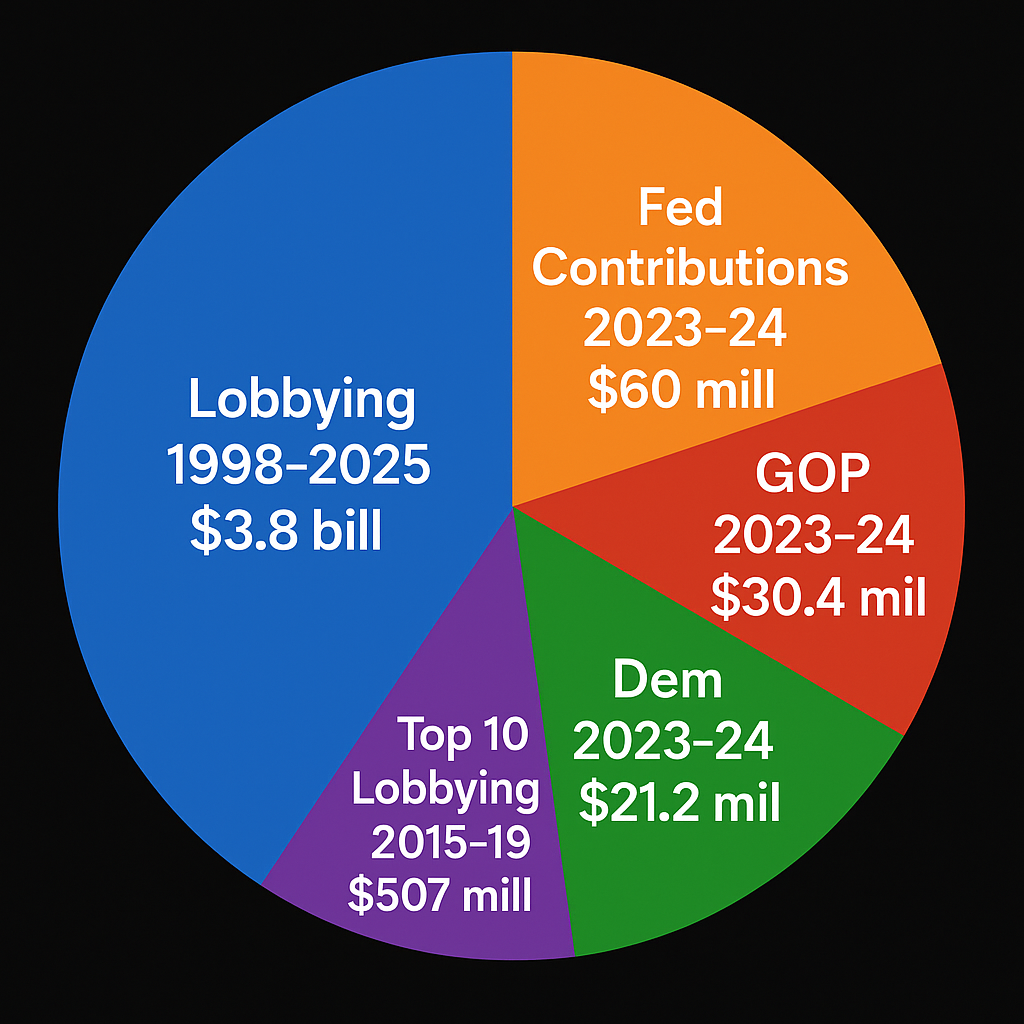
Insurance companies exert enormous influence over Congress, and the scale of their political spending makes that influence impossible to ignore. Over the last two decades, the insurance industry has spent nearly $3.8 billion on lobbying—an amount that guarantees access few ordinary citizens will ever have. In the 2023–24 election cycle alone, insurers poured more than $60 million into federal campaign contributions, directing about $30.4 million to Republicans and $21.2 million to Democrats, ensuring both parties remain responsive to industry interests. This is not new. Between 2015 and 2019, ten of the largest insurance and healthcare provider organizations spent more than $507 million lobbying Congress, while four major insurers spent $8.7 million on state-level campaigns in just a three-year window. These sums are not charity; they are strategic investments designed to preserve a system where guaranteed federal subsidies flow to insurers first and consumers last. When corporations with this level of financial power shape the rules, it becomes far easier to maintain the status quo—and far harder for meaningful reform to emerge.
Political Incentives and the Resistance to Change
The most notable feature of the current debate is not the complexity of the proposal but the intensity of the resistance. The insurance lobby benefits enormously from the existing structure. Pharmaceutical companies benefit from the lack of downward price pressure. And both political parties receive substantial financial support from the broader healthcare industry.
It is therefore not surprising that structural reform—particularly reform that redirects federal dollars away from insurers—is met with bipartisan discomfort. The status quo is politically profitable even if it is economically inefficient.
Policy must eventually be judged by outcomes, not promises. If premiums climb, if deductibles rise, and if the most significant financial gains appear on corporate balance sheets rather than household budgets, then the system is not serving the public interest.
Why The Free Market is Essential in Healthcare
Trump claims that redirecting subsidy dollars to individuals would create a genuine open market in which insurers compete for customers. Critics warn that destabilizing the ACA’s structure could reduce protections for those with pre-existing conditions or increase volatility in the risk pool. Both arguments have merit, but they rest on very different assumptions about human behavior and institutional incentives.
The ACA model assumes that centralized management and guaranteed subsidies produce stability. The U.S. healthcare economy since 2010 suggests otherwise. Guaranteed federal payments reduced the pressure on insurers to innovate or minimize costs, contributing to rising premiums and a consolidation of insurance providers in many states. A marketplace with minimal competition is not a marketplace at all.
Redirecting funds to individuals would reverse those incentives. It may not solve every structural problem in American healthcare—no single reform could—but it corrects a fundamental flaw: the absence of consumer power, offering a hopeful vision for the future of healthcare.
The Question Washington Can No Longer Ignore
A functioning free market is essential in healthcare because it restores the one force the current system lacks: accountability to the consumer. When insurance companies receive guaranteed federal subsidies regardless of cost or performance, they have no incentive to innovate, lower prices, or improve the quality of coverage. A free market reverses that dynamic. It forces insurers to compete for customers rather than lobby for government dollars. Prices fall when companies cannot rely on subsidies to survive, and quality rises when consumers—not bureaucracies—decide who deserves their business. Without a free market, healthcare becomes a protected cartel in which corporations profit while families pay more each year. With a free market, the power shifts back to the individual, which is the foundation of any system that claims to serve the public rather than the politically connected
The Question Washington Can No Longer Ignore
The real issue is not whether the ACA helped some people—it did. The real problem is that it did so through a mechanism that enriched insurers far faster than it helped patients, left premiums rising well above wage growth, and failed to deliver the competition it promised.
Trump’s proposal forces a long-overdue examination of whether healthcare dollars should belong to the people who need care or to the corporations that administer it.
The most important public policy questions are often the simplest. In this case, the question is: Who should control the money? It’s a question that demands our attention and thoughtful consideration.
Politicians may continue avoiding that question. Interest groups may continue lobbying to prevent it from being answered. But the reality remains: the ACA’s financial structure is a policy choice, not an inevitability.
And now, for the first time in more than a decade, that choice is finally being challenged, underscoring the urgency of the issue at hand.
References
1. Paragon Health Institute. “Health Insurer Profits Under the Affordable Care Act.” Shows that the weighted average stock price of major U.S. health insurers increased 1,032% from 2010 to 2025. https://paragoninstitute.org
2. OpenSecrets – Center for Responsive Politics. “Insurance Industry: Lobbying, 1998–2025.” Documents approximately $3.8 billion in lobbying expenditures by the insurance industry between 1998 and 2025. https://www.opensecrets.org/industries/lobbying?ind=F09
4. FollowTheMoney.org – National Institute on Money in Politics. “Health Insurance Companies Give Healthy Donations to Political Campaigns.” Analyzes state-level donations, including $8.7 million from major insurers (WellPoint, UnitedHealth, Humana, Aetna) between 2005–2008. https://followthemoney.org
5. AMA Journal of Ethics / PMC. “Influence of Health Care Industry Spending on Policy: Federal Lobbying by Health Systems and Insurers (2015–2019).” Reports $507 million in lobbying spending from the top 10 healthcare and insurance organizations during 2015–19. https://pmc.ncbi.nlm.nih.gov/articles/PMC8694571
6. Politico. “Obamacare Could Collapse Under Trump’s New Plan, Policy Experts Say.” Explains concerns about how redirecting subsidies could impact ACA marketplaces but confirms the ACA’s structural reliance on insurance company subsidies. https://politico.com
7. Kaiser Family Foundation (KFF). “Marketplace Premium Trends and Insurer Financial Performance.” Provides data on premium increases and insurer profitability under the ACA. https://kff.org
8. Congressional Research Service (CRS). “The Affordable Care Act: A Summary of Financial Structure and Subsidies.” Explains how premium subsidies are paid directly to insurance companies rather than individuals. https://crsreports.congress.gov
In the last two years, New York City has recorded wave after wave of shocking reports regarding bicycle accidents. And nearly half of such death cases were observed to be prevalent in places that lacked secure bike lanes. And even as the total amount of accidents has improved slightly, the traumatic nature of outcomes still persists.
Numbers That Can’t Be Ignored: Risk Map and Key Causes
According to the map of bicycle crashes in New York, the most dangerous locations are the residential and business continental districts of Manhattan and Brooklyn, which are densely populated. Broadway, 4th Avenue, 3rd Avenue, and 2nd Avenue in Manhattan and Bedford Avenue and Fulton Street in Brooklyn are the riskiest streets.
According to the NYPD and NYC Open Data, the main causes of accidents are:
Driver inattention and distraction: 1,544 injury cases in 2024;
Failure to yield: 648 cases;
Mistakes by pedestrians and other road users: 467 cases;
Failure to heed stoplights: 288 cases;
Following too closely: 160 cases.
Time of day and seasonality are also very essential elements. The death rate of cyclists is up to 35% during summer when using the city roads, approximately 25% during winter in spring and 29% in the fall. Accidents are minimal in winter despite the icy weather conditions; death rates during winter are only 18 percent of the accidents caused.
Accident distribution across New York’s boroughs shows that risk is unevenly spread. Brooklyn recorded the most injuries, 1,485 injuries and 8 cyclist deaths, followed by Manhattan, with 1,332 injuries and 3 deaths. Queens and the Bronx were marginally less but still high. Staten Island, with a lower number of cyclists, showed zero cyclist deaths in 2024.
Year: 2024
Borough
% of all traffic injuries
% of all traffic fatalities
Protected bike lane mileage
Cyclist deaths per 100,000 residents
Manhattan
23.1%
9.3%
62 miles
0.24
Brooklyn
11.3%
15.1%
58 miles
0.28
Queens
7.9%
13.3%
41 miles
0.19
Bronx
7.4%
12.5%
29 miles
0.21
Staten Island
5.3%
0.0%
9 miles
0.00
The numbers demonstrate that despite the great amount of secured bike paths, Manhattan and Brooklyn are still areas at risk. Similarly, the longer the length of the protected lanes, the lower the fatality rate per 100,000 inhabitants, which supports the efficiency of infrastructure solutions.
Why Protected Bike Lanes Are Not a Panacea, but a Step Forward
Notably, in recent years, the city has heavily invested in developing bicycle infrastructure. In 2024 alone, 29 miles of new protected bike lanes were built, and over the past three years, 87.5 miles. Still, that is less than what the law requires: under the NYC Streets Plan, 250 miles of protected lanes must be built by 2026, and only about 35% of that goal has been met so far.
But the overall effect of new lanes is unmistakable. For instance, after a protected bike lane was installed on Manhattan’s Third Avenue, total injuries on that stretch fell even as the traffic volume almost doubled. Pedestrian injuries fell too, clearly showing that not just cyclists benefit from protected lanes.
Protected lanes prove to be particularly effective on wide, busy streets where the risk is highest. Yet, even in places where infrastructure exists, accidents do still occur due to the violations, inattention, or aggressiveness of drivers and other road users.
E-Bikes and Micromobility: New Challenges
In the past few years, New York has experienced a surge in e-bikes and other forms of micromobility. They are convenient, fast, and environmentally friendly, but also hazardous at higher speeds, with greater weight, and with limited experience among many users. From 2020 to 2024, e-bikes resulted in 1,218 injuries and 13 deaths. Over the previous two years, accidents involving e-bikes increased 10%, and that trend continues in 2025.
The city is responding: in 2024, the maximum speed of Citi Bike e-bikes was reduced to 18 mph and shortly after to 15 mph. A campaign is underway to educate users on safe e-bike and scooter operation. But the lack of unified training and regulations leaves many questions unanswered because, despite new rules, e-bike accidents often result in serious injuries or fatalities.
Injuries and Consequences: What Cyclists Most Often Face
Injuries sustained in bicycle collisions vary widely; however, several are most common:
Damage to soft tissues (bruises, sprains, lacerations);
Internal injuries: organ damage, internal bleeding;
Road rash and burns from falling on asphalt.
Head and spinal injuries are particularly serious and commonly result in death or disability. Even with a helmet on, head injuries can still be severe — not all impacts strike the protected part of the head. Only about half of New York cyclists wear a helmet regularly, and among Citi Bike renters, that rate is exceedingly low.
Legal Nuances: How to Protect Your Rights
They have the same right to use the road as motor vehicle drivers do in New York. Accordingly, bicyclists are required to obey traffic laws, to use lights at night, and for children under 14 years of age to wear helmets. If the driver violates one of these rules — e.g., fails to yield, opens a door into traffic, or is otherwise distracted — their fault is proven, and the insurance company is required to compensate the injured cyclist.
In the case of a serious injury where there are fractures or disability, the cyclist can go beyond the no-fault system and claim emotional damages, lost income, and other expenses. If fault is shared between parties, compensation is divided proportionally. For example, if the cyclist is found 30% at fault, they receive 70% of the total damages.
Final Thoughts
While bicycle accidents in New York are not solely personal tragedies, they pose a challenge to the entire metropolis. And though there is progress, the risks remain high. Therefore, it is of prime importance to know your rights and follow the rules. If you or your loved one has been injured in a bicycle accident, do not wait, but seek legal assistance.