Suspect accused of stealing Shaquille O’Neal’s custom Range Rover in Georgia was arrested in New York; the vehicle is still missing
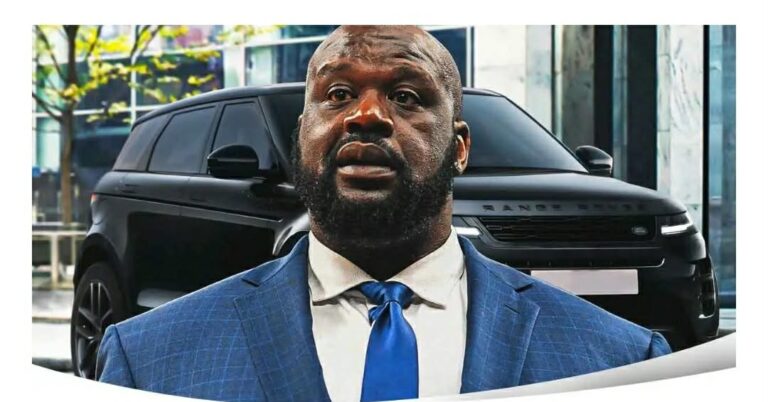
A man suspected of stealing basketball legend Shaquille O’Neal’s $180,000 customized Range Rover six weeks ago has been arrested in Mount Vernon, after a car associated with him had triggered a license plate reader.
According to Mount Vernon Police Deputy Chief Gregory Addison, the suspect was arrested around 8 p.m. on Friday, December 5th. Addison said officers received a license plate reader alert for a vehicle that might contain a wanted party with a warrant out of Lumpkin County, Georgia. The alert was for a specific South Carolina license plate. Officers located the vehicle within the city and watched as the driver walked into a local business. They followed the driver inside, detained him, and verified that he was the party wanted in Georgia.
Anthony Del Rosario, with addresses in Yonkers and Fort Lauderdale, Florida, was placed under arrest for the extraditable warrant and is currently being held at the Westchester County Jail as a “Fugitive From Justice,” the New York State designation for someone wanted in another state. The vehicle he was driving was impounded because it was not registered; authorities confirmed it was not O’Neal’s Range Rover.
Authorities tell Black Westchester that the stolen vehicle has not been recovered and is believed to be somewhere in the Middle East.
The arrest follows weeks of investigation into the disappearance of O’Neal’s customized 2025 Range Rover, which was taken from a Dahlonega firm on October 20th. The SUV, worth around $180,000, was meant to be delivered to Louisiana for O’Neal to use at an LSU game that weekend, but it never came.
According to the affidavit by a Lumpkin Sheriff’s investigator, an accomplice impersonated Effortless Motors of California’s transport provider by using a phony phone number. This allowed the thieves to change the pickup instructions and submit a phony certificate of insurance, prompting Effortless to accept the car’s release.
The owner of Effortless, a Riverside, Calif.-based firm that has customized multiple vehicles for the 7-foot-1 NBA Hall of Famer, offered a $10,000 prize for the car’s return following the theft, indicating that the transportation company had been hacked.
Ahmad Abdelrahman, a spokesperson for Effortless Motors, said the vehicle was removed from the shop under false pretenses. He said the company arranged transport through FirstLine Trucking LLC, which later claimed its system had been hacked.
Abdelrahman said the arrest is a major breakthrough in what appears to be a large, coordinated criminal operation.
MVPD Deputy Chief Addison said that Mount Vernon police were notified about 8 p.m. that night that the car associated with Del Rosario, with South Carolina plates, had triggered a license plate reader.
After officers found the car and saw Del Rosario walking into a business on East Lincoln Avenue just east of Hutchinson Boulevard, they followed him inside and detained him. Once they confirmed he was the wanted man and the Lumpkin County Sheriff’s Office sought his return, he was arrested on a fugitive from justice charge and held at the county jail.
Denise came to see me after her third panic attack in two months. A senior vice president at a financial services firm, she was the kind of person who had spent twenty years building a reputation for being unshakeable. Denise ran a department of forty people, sat on two nonprofit boards, and still managed to show up for her teenage daughters’ track meets whenever she could. On paper, she had everything figured out.
In my office, Denise was fighting back tears and telling me she thought she was losing her mind.
The panic attacks had started coming out of nowhere, or at least that’s how it felt to her. She would be in a meeting or driving home from work when suddenly her heart would race, her chest would tighten, and she would become convinced that something terrible was about to happen. Her doctor ran every test and found nothing wrong with her heart, which should have been reassuring but somehow made her feel worse. If nothing was wrong, why did she feel like she was falling apart?
When I asked about her sleep, Denise waved the question away at first.
She told me she had always been a light sleeper and that she usually got about five hours, sometimes less, during busy seasons, and had trained herself to function on whatever rest she could squeeze in. She figured that was just how successful people operated. Besides, she said, she didn’t have time to sleep more. There was always another email, another presentation to review, or another problem that needed her attention before she could finally close her eyes.
What Denise didn’t realize was that the irritability she had been feeling for months, the way she would snap at her husband over small things and then feel terrible about it afterward, the difficulty concentrating that she blamed on getting older, the sense that she was constantly on edge even when nothing was actually wrong—all of it was connected to the chronic exhaustion she had normalized years ago. Her body had been sending her signals for a long time, and the panic attacks were just the loudest version of a message she had been ignoring.
Juan
Around the same time I was working with Denise, a law enforcement officer named Juan showed up in my office with a very different set of concerns. He was forty-three years old, had been on the force for eighteen years, and had recently scared himself badly enough to finally ask for help.
It started with chest pains that would wake him up in the middle of the night. The first time it happened, he drove himself to the emergency room, convinced he was having a heart attack. The doctors ran an EKG, drew blood, and kept him for observation, but everything came back normal. When it happened again a few weeks later, he went back, and again they found nothing. He didn’t keep the follow-up appointment with the PCP the ER had recommended because he generally “doesn’t like” doctors. By the third visit to the ER, he started to feel like maybe the doctors thought he was making it up, so he stopped going and started self-medicating instead.
With alcohol.
A couple of beers after his shift seemed to help take the edge off. Then it became three or four. Eventually, it became the only way he could fall asleep at all. His wife noticed and said something, which led to an argument, which led to him sleeping on the couch, making the whole situation worse. By the time he came to see me, he was averaging maybe four hours of broken sleep a night, drinking more than he wanted to admit, and genuinely worried that something was seriously wrong with him that the doctors just couldn’t find.
Juan had spent nearly two decades working rotating shifts, the kind of schedule that asks your body to be alert at 2 a.m. one week and asleep by 10 p.m. the next. He had never really thought about what that was doing to him because everyone on the job dealt with the same thing, and complaining about it felt like weakness. He pushed through the fatigue the way he pushed through everything else, and he assumed the chest pains, anxiety, and the drinking. were just the price of the life he had chosen.
The Pattern Underneath
Denise and Juan came from very different worlds, but when I sat with each of them and started asking questions, the same pattern emerged. Both of them had been running on empty for years, with symptoms that seemed mysterious until you looked at how they were sleeping. Denise buried herself in work while Juan reached for the bottle. Their coping strategies masked the issue just enough to keep them going while making everything worse underneath.
I see versions of Denise and Juan almost every week in my practice. The specifics change—different jobs, different families, and various reasons for walking through my door—but the story underneath stays remarkably consistent. Someone is struggling with their mood or their energy or their focus, and when we start peeling back the layers, we find chronic sleep deprivation holding up the whole thing like a crack in the foundation that no one thought to check.
What strikes me most is how long people wait before they connect the dots, not because they aren’t paying attention, but because no one ever told them to look there.
Who Gets to Rest
In the Black community, there is a long and understandable tradition around pushing through. We honor those who work doubles and triples, sacrifice their rest so their children can have more than they did, and who keep going when everything in their body is telling them to stop. This has been the untold sacrifice that has carried families through generations of obstacles that would have broken most people, and I would never dismiss it.
But somewhere along the way, exhaustion became a badge of honor, and rest became something we told ourselves we would get to later. After the promotion, after the kids were grown, after we had accomplished everything on the never-ending to-do list.
The problem that is being missed is that “later” never comes and is costing us more than we realize.
Ironically, the individuals I see who are most reluctant to prioritize sleep are often the ones who need it most. They come in with high blood pressure that won’t respond to medication, or anxiety that seemed to start of nowhere, or weight they can’t lose despite doing everything right. When I ask about their rest, I get the same response Denise gave me—a wave of the hand, a shrug, something like “that’s just how it is for me.”
But it doesn’t have to be this way. A lot of us have accepted (or have become accustomed to) a level of tiredness that we’ve mistaken for normal when it’s a pattern that’s quietly making us sick.
To be fair, there are external reasons for our disrupted sleep patterns, and we cannot pretend that barriers don’t exist. When you’re working nights, when you’re worried about rent, when your neighborhood doesn’t quiet down until well past midnight, when you’re the person everyone depends on, quality sleep can feel like a luxury that simply isn’t available to you. I see those barriers every day in my practice, and I see what they do to the body over time.
But I also see what happens when people start treating sleep like it truly matters, even when the circumstances aren’t perfect.
When you frame rest as something that changes your blood pressure and your mood and your ability to show up for the people who need you, protecting it stops feeling selfish and starts feeling like the most practical thing you can do for yourself and everyone counting on you.
Sleep As “Medicine”
When you sleep, your body is doing essential maintenance that cannot happen any other way. Your brain is processing emotions and consolidating memories, your immune system is resetting, your muscles are repairing, and your hormones are recalibrating in ways that affect everything from your mood to your metabolism to your cardiovascular health. When you cut the process short night after night, the effects accumulate quietly until they become impossible to ignore.
That’s why one of the first “prescriptions” I offer is a serious conversation about sleep and recovery, because I’ve found that most people have never had someone sit down with them and explain what they’re really losing when they sacrifice their rest.
In these conversations, I’m always clear that better sleep doesn’t replace medical care. If you’re on medication for blood pressure, anxiety, depression, diabetes, or anything else, stay on it and keep working with your doctor.
Improving your sleep isn’t a substitute for your prescriptions, but it is a foundational piece that makes everything else work better, and most people have never been told how much it matters.
I have watched people like Denise and Juan make meaningful changes in their lives simply by starting to pay attention to their rest in addition to receiving regular medical care. They didn’t need to start with expensive interventions or complicated protocols, just with awareness and intention and a willingness to take it seriously.
Sometimes the most powerful “medicine” is something you don’t even perceive as potentially medicinal, and the one you’ve convinced yourself you don’t have time for.
What Changed
Denise and I worked together over several months to rebuild her relationship with sleep. At first, she wanted hard data. She bought a sleep tracker and started monitoring her sleep stages, her heart rate, and her nightly score. Every morning, she would faithfully check the numbers before she even got out of bed, and if the score wasn’t good enough, her whole day started with a quiet sense of defeat and anxiety.
She was optimizing her sleep the same way she optimized everything else, and I could see it was making things worse. So, we decided together to take the tracker away, not permanently, but long enough for her to reconnect with what her body was telling her. I asked her to stop measuring and start noticing how did she felt when she woke up, not according to an app, but to her own experience of being in her body.
It was harder than she expected because Denise had spent years rigidly trusting metrics more than her own instincts. But over time, she learned to let go of the score and pay attention to signals she had been ignoring for a long time. The panic attacks became less frequent, and the irritability that had been straining her marriage started to lift. She told me recently that she finally feels like herself again, and that she wishes someone had told her years ago that she didn’t have to perform her way through everything, including her sleep.
Juan needed something different.
He didn’t trust feelings and did not particularly want to sit in my office talking about emotions. What he needed was something concrete that proved that the changes he was making were working, because otherwise, he wasn’t going to believe it.
So, we gave him a tracker, but with a different purpose than Denise had given hers. Every week, we would sit down together and look at his numbers (sleep efficiency, REM percentage, resting heart rate, and HRV trends), not to chase perfect scores but to look for evidence that his body was recovering even when he didn’t feel dramatically different yet.
And there was always something we could point to. Some weeks, his deep sleep was up; some weeks, his heart rate variability had improved, and having those concrete markers gave him something to talk about other than the chest pains he was so afraid of. This approach gave Juan goals to work toward, which fit the way his mind worked, and it showed him something he desperately needed to see. He needed to know that his body wasn’t failing him and that it was responding to the changes he was making–and that it was more reliable than he had feared.
The drinking slowed down and eventually stopped. So did the chest pains. The last time I saw him, Juan told me he was sleeping better than he had in years, and he seemed almost surprised by how much had shifted once he started paying attention.
The Recovery Revolution
Two patients who took very different paths to get to the same place.
Denise needed to stop tracking and start trusting her own experience again. Juan needed to start tracking so he could build enough trust to eventually let go.
They needed help to see that the exhaustion they had normalized was a problem worth solving, and that solving it was more within their reach than they had imagined.
I share these stories because I want you to know that if any of this sounds familiar and, if you’ve been running on empty for so long that you’ve forgotten what rested feels like, you’re not alone in that, and you’re not broken. You may just be carrying a kind of tired that has become so familiar you stopped questioning it.
The “medicine” I’m talking about isn’t in a bottle but in the hours you end up giving away to everything and everyone else, the rest you are postponing because something always feels more urgent, and the recovery you keep telling yourself you’ll prioritize once things settle down.
You don’t have to earn the right to rest. But if you’ve been waiting for someone to tell you it’s okay to take this seriously, I hope this can be that moment for you.
Why? Because this is serious. Did you know that a major meta-analysis of over 1.3 million people, published in the journal Sleep, found that those who regularly slept less than seven hours per night had a 12% higher risk of death from any cause? And for people consistently getting five hours or less, the risk climbed to roughly 15%.
Who knew?
A separate study in BMJ Open found that those prescribed common sleep medications had more than three times the risk of death compared to matched controls—even after adjusting for other health conditions.
The point isn’t to alarm you. The point is that how you sleep matters more than most people have ever been told. And addressing the root causes of poor sleep may be one of the most important health decisions you can make.
Start paying attention to what your body has been trying to tell you. Make one small change this week, and then another one next week.
Our bodies have been keeping score. It’s high time we started listening.
References
1. Cappuccio FP, D’Elia L, Strazzullo P, Miller MA. Sleep duration and all-cause mortality: a systematic review and meta-analysis of prospective studies. Sleep. 2010;33(5):585-592. doi:10.1093/sleep/33.5.585
2. Kripke DF, Langer RD, Kline LE. Hypnotics’ association with mortality or cancer: a matched cohort study. BMJ Open. 2012;2(1):e000850. doi:10.1136/bmjopen-2012-000850
Derek H. Suite, M.D. is a board-certified psychiatrist and the founder of Full Circle Health in New York. He is the host of the SuiteSpot podcast and the author of the forthcoming book Sleep as Performance Medicine.
Crockett’s Announcement shakes up Democratic primary – Former Rep. Colin Allred dropped out of the race Monday morning, but state Rep. James Talarico remains as Democrats prepare to contend for GOP Sen. John Cornyn’s seat.
Representative Jasmine Crockett on Monday filed paperwork to run for the Democratic primary for U.S. Senate in Texas, hours ahead of a planned news conference where she announced her plans. Crockett joins the race to take on GOP Sen. John Cornyn, who is facing multiple primary challengers himself. The two-term congresswoman’s decision also comes as her Dallas-based House seat was redrawn in a GOP-led redistricting effort.
“I’m done with going along to get along, and it gets us nowhere,” Crockett, one of Congress’ most outspoken Democrats, said during her announcement Monday. “I’m done watching rural hospitals and public schools close their doors. I’m done watching parents be afraid to send their kids to school or the mall or the movies because Republicans have flooded our streets with guns. I’m done with the Senators sitting around doing nothing, while Trump takes your hard-earned money, skims your Social Security, slashes Medicare, and gives tax breaks to billionaires. I’m done. I’m done watching the American dream on life support while Trump tries to pull the plug. The gloves have been off, and now I’m jumping into the ring. I’m asking for your support to be the next United States Senator from the great state of Texas.”
Crockett, with a slogan of “Texas Tough,” pitched herself as the Democrat best-positioned to drive out turnout and appeal to disillusioned voters, saying she can build “a strong multi-racial, multi-generational coalition,” and pledged to focus on addressing the cost of living and holding President Donald Trump accountable.
Some Democrats dismissed the Dallas congresswoman as too polarizing to capture the swing voters needed to win. Others said her turnout-over-persuasion approach is the recipe to break through.
“In the eyes of some pundits and politicos, the Dallas Democrat’s nomination would spell doom for her party’s chances of winning a statewide race for the first time in over three decades. To others, she is a fighter and gifted communicator whose expand-the-electorate strategy is worth trying in a state where Democrats of all stripes and styles have failed,” The Texas Tribune reported.
Democrats have not won a statewide race in Texas in more than 30 years, but they have been eyeing next year’s Senate race as a potential pickup opportunity, with Cornyn facing primary challenges from state Attorney General Ken Paxton and GOP Rep. Wesley Hunt. Democrats need to net four seats to take back the Senate next year.
Others say she would need to attract voters who cast their ballots for President Donald Trump, in a state the president carried last November by nearly 14 percentage points — a gap that some argue cannot be bridged by high Democratic turnout alone, and that Crockett is too polarizing to achieve.
As Democrats have struggled with unscripted forums, finding their digital voice and authentic presentation, Crockett, a frequent presence on cable television and in long-form interviews, is regarded among the base as an invigorating and clear communicator, never robotic or boring.
“Jasmine Crockett is the most talked about member of the United States Congress, House or Senate,” Harris County Commissioner Rodney Ellis, a bastion of Houston politics, said at Crockett’s launch event. “And why are they talking about her? Because she talks back. She will expand our base. She’s a great communicator. She has shown that she can raise money.”
Crockett said her campaign conducted polling showing her in a strong position in the general election and the primary, though she did not name her chief primary opponent as she launched her campaign Monday night.
If no candidate wins more than 50% of the vote in either of the March 3 primaries, the top two vote-getters advance to a primary runoff on May 26.
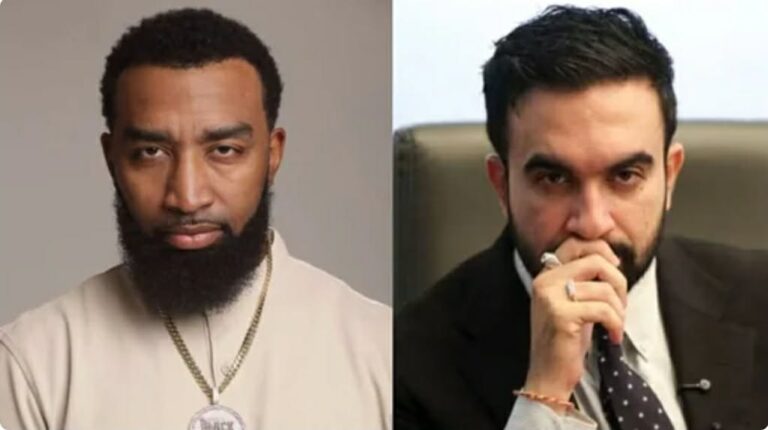
You’re acting like he got appointed Police Commissioner with a machete in his pocket.
Let me tell you what you’re really mad about:
That he didn’t stay broken.
That he didn’t stay in the box you put him in.
That a man who went to prison came back with clarity, credibility, and the kind of conviction most of these career politicians will never know.
From Conviction to Contribution
Mysonne did seven years. SEVEN.
Not seven months in some soft-core Wall Street white-collar holding tank, seven years in a New York prison.
And he came home and didn’t become a statistic.
He became a soldier for justice.
Co-founder of Until Freedom.
Led protests for Breonna Taylor.
Marched through Louisville, Ferguson, Harlem, and the Bronx.
Got cuffed for standing with mothers, not chasing cameras.
Held street vigils.
Organized back-to-school drives.
Educated incarcerated youth about the system they were born into.
You want reform? You want lived experience?
He IS the blueprint.
But you don’t want lived experience, you want lived submission.
You want redemption that whispers.
Mysonne came back and spoke with his chest.
And that scares you.
The Backlash
The same city that locks up Black boys at 16 without a blink got shook when one of them grew up and came back ready to lead.
Let’s talk stats:
Over 76% of formerly incarcerated people are unemployed a year after release.
Black people are 13% of the U.S. population, but nearly 40% of the prison population.
NYPD officers have over 15,000 misconduct complaints in the last decade and yet many get promoted.
But Mysonne gets one seat on one advisory committee, and the whole city starts screaming?
Because it’s not about his past. It’s about his power.
You’ll trust a cop who choked someone on camera before you’ll trust a Black man who changed.
Make that make sense.
The Pain Beneath the Politics
Yes, a widow is grieving.
And that’s real.
But so is this: Pain and progress can coexist.
Nobody’s asking for the past to be erased.
But can we allow the future to breathe?
Mysonne didn’t ask for a pardon.
He’s not on a redemption tour.
He’s been on the ground:
In the streets
In the classrooms
In the boardrooms
In the budget meetings
In the legislation strategy sessions
While you were tweeting, he was teaching.
While you were critiquing, he was building.
He has earned this moment.
Period.
The 4 I’s of Oppression, Yes, We Gotta Go There
Let’s call it what it is.
The reason this hit a nerve is because the system is doing what it was designed to do, and you don’t even see it.
Ideological: You were taught that a convicted Black man can’t lead. That once you’re caged, your credibility expires. That’s the lie.
Institutional: The media calls him an “ex-con” in every headline. But where were the headlines when he helped pass policy? When he fed 500 families during COVID? When he mentored boys who were on the edge of that same system?
Interpersonal: The beefs? The side-eyes? That’s us hurting each other because the system taught us to compete instead of heal.
Internalized: Some of you really believe he shouldn’t be there. Because you’ve been conditioned to see transformation as impossible.
Don’t fall for it.
Don’t become a mouthpiece for your own oppression.
The “Beef” Isn’t the Whole Story
Let’s not act like public tension is new.
We’ve watched entire political campaigns run on shade.
But when it’s two Black men with trauma and platforms, suddenly it’s “unfit to serve”?
No
It’s pain without therapy.
It’s ego without rest.
It’s survival mode spilling into public discourse.
Yes, Mysonne responded.
Yes, he got triggered.
Yes, he clapped back, but he didn’t spiral.
He stood ten toes down.
He said what needed to be said and kept building.
A decade of transformation shouldn’t be erased because of a 90-second YouTube clip.
Let’s not confuse viral for valid.
Mysonne’s not perfect. He’s honest.
He’s not clean-cut. He’s cut from real cloth.
He didn’t go to Yale. He went to Rikers, survived New York State Correctional Facilities, and came back whole.
Eric Adams ran with the Seven Crowns, a crew once feared in these same streets. Now he wears the NYPD’s blessing and the mayoral crown. So let’s not pretend like Mysonne’s path is unprecedented. The difference? Mysonne didn’t trade his past in for power; he brought his pain, his truth, and his people with him.
That’s the kind of leadership our communities actually need.
Because nobody knows how to fix a broken system better than someone who survived it and came back with tools.
And if your version of justice can’t include that? You’re not serious about change.
The system didn’t expect him to come back.
It definitely didn’t expect him to come back ready to lead.
And now that he’s here? They want to discredit, dismiss, and distract.
Online Purchases and Package Deliveries Increase During the Holiday Season, Leaving More Consumers Vulnerable to Package Theft
Secretary Mosley: “While you’re preparing to spread holiday cheer with those gifts, thieves may be trying to steal both from you.”
The New York Department of State’s Division of Consumer Protection is warning consumers about package thefts this holiday season and sharing tips on how they can protect themselves from thieves trying to steal packages from their homes. The National Retail Federation recently reported that during the five-day holiday weekend from Thanksgiving to Cyber Monday, online shopping increased nine percent (9%) compared to last year. This increase in online shopping means more convenience for consumers, but also brings more risks. According to the U.S. Postal Service Office of Inspector General’s 2025 Package Theft in the U.S. Report, at least 58 million packages were stolen nationwide in 2024, leading to approximately $16 billion in financial loss.
“Many consumers have already started or even finished their online holiday shopping for the season and are now waiting for their purchases to be delivered to their doorsteps,” said Secretary of State Walter T. Mosley. “While you’re getting ready to spread holiday cheer, thieves may be trying to take advantage. If you’re expecting deliveries this holiday season, make sure you’re taking added precautions and keeping track of your packages to prevent them from being stolen.”
New York State Police Superintendent Steven G. James said, “Online shopping has become a standard practice, and during the holiday season, package theft is even more prevalent for consumers. Stealing a package takes only seconds and can leave the victim with frustration and unexpected financial difficulty. By using package, order, or logistics “tracking” of packages and using alternative delivery methods (Hub locker, BOPIS), you can better protect your purchases and further ensure that you actually take possession of your delivered items.”
As you check things off your shopping list, be sure to follow these tips to prevent package theft and identity theft:
Keep track of your packages: Package theft peaks during the holiday season, so keeping track of your deliveries is critical to prevent theft.Delivery companies offer real-time tracking and the option to receive customized alerts so you can stay on top of your holiday shipments once they arrive and retrieve your packages as soon as they’re delivered.
Schedule deliveries when someone is home: Many online retailers and delivery companies allow consumers to schedule specific delivery timeframes. Choose a timeframe when someone will be home to avoid potential theft. When you are home, closely monitor delivery progress via tracking links and bring the package inside as soon as possible to limit the window of vulnerability.
Enlist your neighbor’s help: If you’re not going to be home, enlist the help of a trusted neighbor. When possible, have your packages delivered to a location where they can be received in person.
Monitor your front door with a security or doorbell camera: While a camera may not deter thieves, the presence of a camera can help you keep track of when packages are delivered so you can retrieve them quickly. If a package is stolen, the video recording of the theft can also be shared with the police.
Take advantage of the “Ship to Store” option: Many retailers offer a “ship to store” option. This means that you can order items online and have them sent to a local brick-and-mortar store. You can then pick up your purchase at a time convenient for you.
Consider alternative delivery options: Most delivery companies have alternative pickup and delivery options available. Some include redirecting packages to a local merchant partner or holding packages at their location. Do some research by visiting their websites to explore your options and update your delivery preferences. If you know you’re going to be on vacation, request a vacation hold on all shipments.
Opt for other services: If you’re doing most of your shopping online, consider alternative delivery options like a package locker, lockbox, or smart locker. Major retailers and delivery companies are increasing these services in multiple areas throughout New York State. In New York City, the LockerNYC program offers New York City residents access to free delivery lockers.
Require delivery confirmation signature: Consider requesting a signature for packages, especially for high-ticket items. This will ensure your items are not left unattended when delivered. This may require choosing a pricier shipping option.
Find out how a delivery company will communicate with you: Depending on how you signed up for notifications, messages from a delivery company are usually posted within a secure online portal. Delivery companies will never contact you with unsolicited calls or texts. If you receive an unexpected call, hang up and call the company using the official customer service number to verify its legitimacy.
Beware of phishing attempts: Another common scam this time of year is scammers using phishing emails and text messages to impersonate delivery companies (e.g., UPS, USPS, FedEx), banking and credit card companies and other large retailers (e.g., Netflix, PayPal, eBay, Amazon), which often include links to sites attempting to steal your information. Common phishing techniques include:
Suspicious links: These messages often look legitimate, but if you click the link, your usernames and passwords for your online banking, email or social media accounts could be compromised according to the Federal Trade Commission. Always open a browser and type the company’s website address yourself instead of clicking on a link in an email or text message.
Request for personal information: You receive an unexpected text from a delivery driver or a post office asking you to verify your address. If you call a number from an unsolicited message, you will then be asked to confirm your personal information and may be asked to provide your credit card information to pay a delivery fee. If you did not recently order a product, the caller may try to convince you the package is a gift from a friend or family member. In either scenario, the package does not exist. Providing your personal information to a scammer puts you at risk of falling victim to identity theft.
Report stolen packages immediately: Retailers may offer a partial or full refund if your package was stolen, but you must follow up with the retailer as quickly as possible to initiate this process.
About the New York State Division of Consumer Protection
Follow the New York Department of State on Facebook, X, and Instagram, and check in every Tuesday for more practical tips that educate and empower New York consumers on a variety of topics. Sign up to receive consumer alerts directly to your email or phone here.
The New York State Division of Consumer Protection provides voluntary mediation between a consumer and a business when a consumer has been unsuccessful at reaching a resolution on their own. The Consumer Assistance Helpline 1-800-697-1220 is available Monday to Friday from 8:30 am to 4:30 pm, excluding State Holidays, and consumer complaints can be filed at any time at https://dos.ny.gov/consumer-protection. The Division can also be reached via X at @NYSConsumer or Facebook.
The recent Westchester County budget tells a story far more honest than the slogans that dominate New York politics. While some lawmakers in Albany—most notably Assemblyman Zohran Mamdani—continue to push a Democratic-Socialist agenda built on ever-expanding government, Westchester has been forced into a different conversation: reality.
Under this year’s $2.5 billion budget, nearly every county department absorbed an eight-percent cut. Roughly 180 positions were eliminated through attrition, and a hard hiring freeze was imposed. Even with these reductions, the County Executive still had to raise the property-tax levy by 3.7 percent—down from an originally proposed 5.27 percent. These are not the actions of a government pursuing ideological expansion. They are the actions of a government trying to keep the books balanced while the economy tightens and federal support shrinks.
Thomas Sowell famously reminded us that “there are no solutions—only trade-offs.” Westchester’s budget reflects that truth. County officials did not stand at a podium calling for “free everything” or promising the illusion of unlimited public services without consequence. Instead, they confronted what every household and every business already understands: when revenues fall, and costs rise, you must adjust your spending. You cut where you can. You preserve what is essential. And you resist the temptation to pretend fiscal gravity doesn’t apply to you.
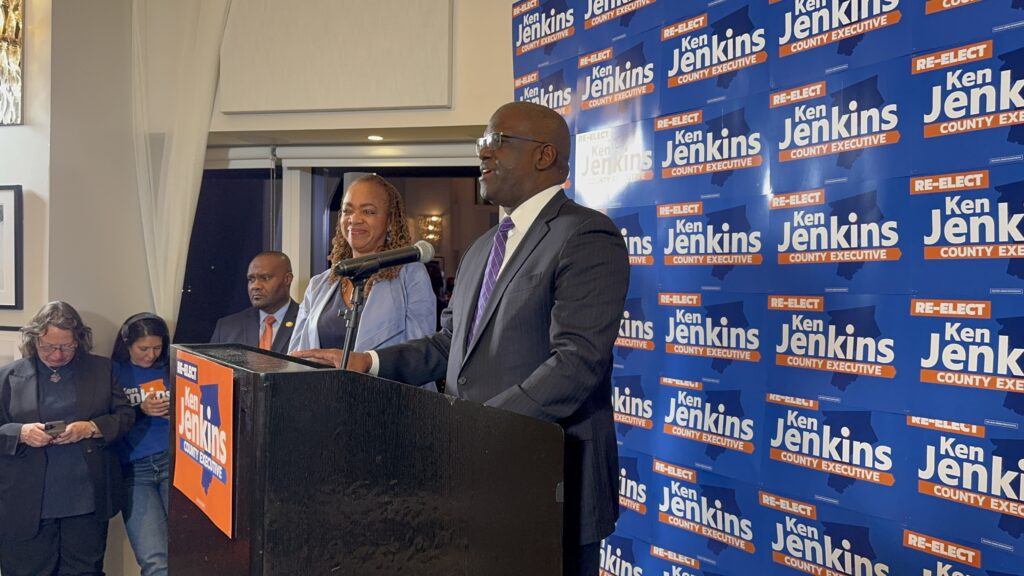
Ken Jenkins’ victory speech made one thing unmistakably clear: leadership is not performance — it is stewardship. When he reminded Westchester that “competent, stable leadership beats chaos and drama every time,” he wasn’t offering a slogan; he was acknowledging the reality of the budget he must now execute. An eight-percent reduction across departments, 180 positions eliminated through attrition, a hiring freeze, and a disciplined 3.7 percent tax levy increase are not the talking points of a politician seeking applause — they are the trade-offs of a leader who understands that governing means making decisions grounded in arithmetic, not ideology. His speech echoed the very structure of the budget: sober, steady, responsible. Where others promise transformation through sweeping rhetoric or redistribution, Jenkins laid out a path rooted in fiscal discipline and institutional stability. His words matched his work. At a time when New York is filled with movement candidates who speak in poetry and govern in slogans, Jenkins is signaling that Westchester will be governed by the math — not the microphone.
Albany offers the clearest example of what happens when political fantasy outruns fiscal restraint. While Westchester is tightening its belt, Albany continues to expand spending even as revenues weaken, businesses close, and residents flee the state. The Legislature has adopted policies that drive up labor costs, restrict police authority, inflate entitlement spending, and treat the taxpayer as an endlessly refillable well. The result is a multibillion-dollar structural deficit, rising debt service, and an economic climate so unstable that even long-standing New York companies are relocating. Albany’s approach mirrors the ideological playbook of its Democratic-Socialist wing: promise more, produce less, and blame external forces when the math no longer works. Westchester, by contrast, is behaving like a county that understands something Albany refuses to confront — arithmetic is not partisan, and outcomes do not bend to political slogans.
Contrast that with the Democratic-Socialist worldview, where the answer to every problem is more government staff, more government programs, and more government spending—funded by higher taxes on the same shrinking tax base. Mamdani and his allies offer sweeping visions of expanded social services, regardless of cost. But visions do not pay bills. Growth in government payrolls does not drive economic growth. And raising taxes in a region already experiencing out-migration does not increase the number of people available to pay them.
What we see in Westchester is not conservatism in a partisan sense—this is economic realism. The county’s approach recognizes that incentives matter, taxpayers respond to burdens, and businesses relocate when operating costs rise beyond reason. Those aren’t ideologies; they are patterns of behavior so consistent that they border on economic law.
The county’s 3.7 percent property-tax increase is already a meaningful adjustment for residents across Westchester, but its effect becomes far more severe in Mount Vernon. Unlike wealthier municipalities with stronger commercial tax bases, Mount Vernon depends heavily on homeowners to fund essential services. When the county raises taxes at the same time the city prepares a 5 percent increase of its own, residents are hit twice in the same fiscal year. Their incomes don’t rise, their services don’t dramatically expand — but their cost of staying in their homes grows significantly. What appears to be a manageable county levy adjustment becomes a compounded burden for families already navigating some of the highest effective tax rates in the region.
But it’s also important to be clear: this is not the county’s fault. Fiscal stress in Mount Vernon is the product of choices made at City Hall, not at the county level. Westchester County has bailed the city out numerous times — most notably with the $10 million allocated for Memorial Field, a project that administration after administration in Mount Vernon failed to complete. The county was eventually forced to take over the entire redevelopment and invest an additional $10 million of county taxpayers’ money just to deliver what the city had promised for more than a decade. So while the combined tax increases hit Mount Vernon residents hardest, the structural problem lies in chronic local mismanagement. The county can absorb eight-percent departmental cuts; many Mount Vernon residents cannot absorb near-double property-tax pressures — especially when past city leadership has repeatedly wasted opportunities for fiscal stability and responsible growth.
Policymakers who ignore these patterns—no matter how noble their intentions—produce predictable outcomes: declining tax bases, rising deficits, and shrinking opportunity. You can see versions of this in parts of New York City that embraced the very policies Mamdani champions. The results have been budget gaps, weakened public safety, deteriorating services, and a political culture more comfortable blaming external villains than correcting internal failures.
Westchester’s budget is a quiet rejection of that mindset. It says, “We cannot spend our way into prosperity.” We cannot tax our way into affordability. And we cannot build a stronger country by refusing to confront fiscal limits.
This is not a radical insight. It is simply an acknowledgment of what Westchester reader must understand: outcomes matter more than intentions. Budgets are moral documents not because they signal virtue, but because they reveal discipline—or lack of it.
This time, like it or not, Westchester chose discipline. Albany still chooses illusion. And the difference between the two will show up not in soundbites, but in the lived reality of the people who call this state home.
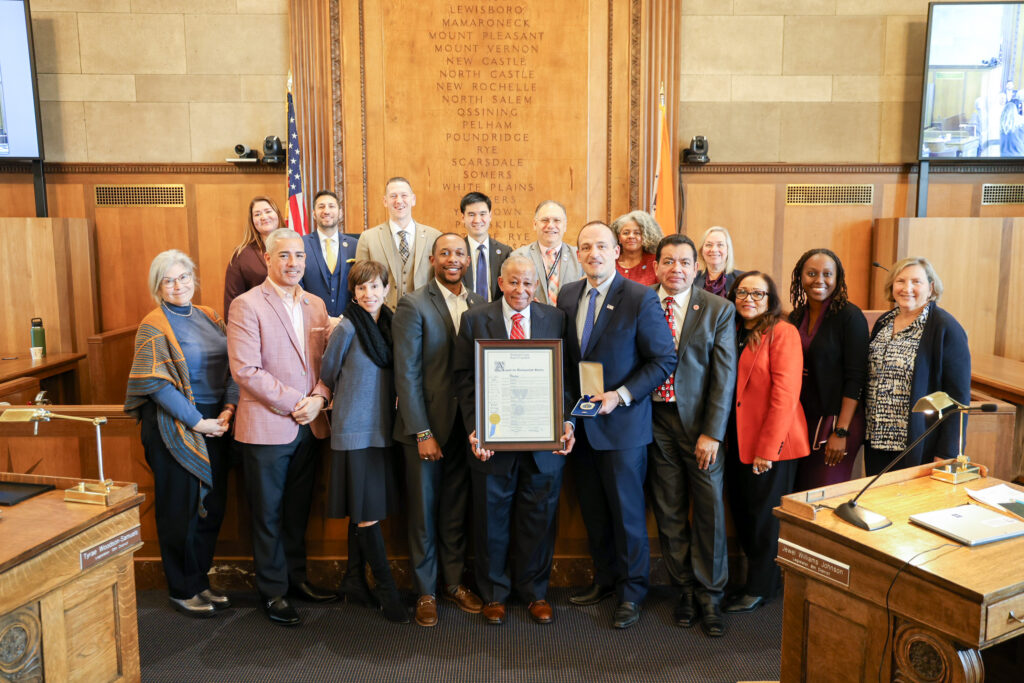
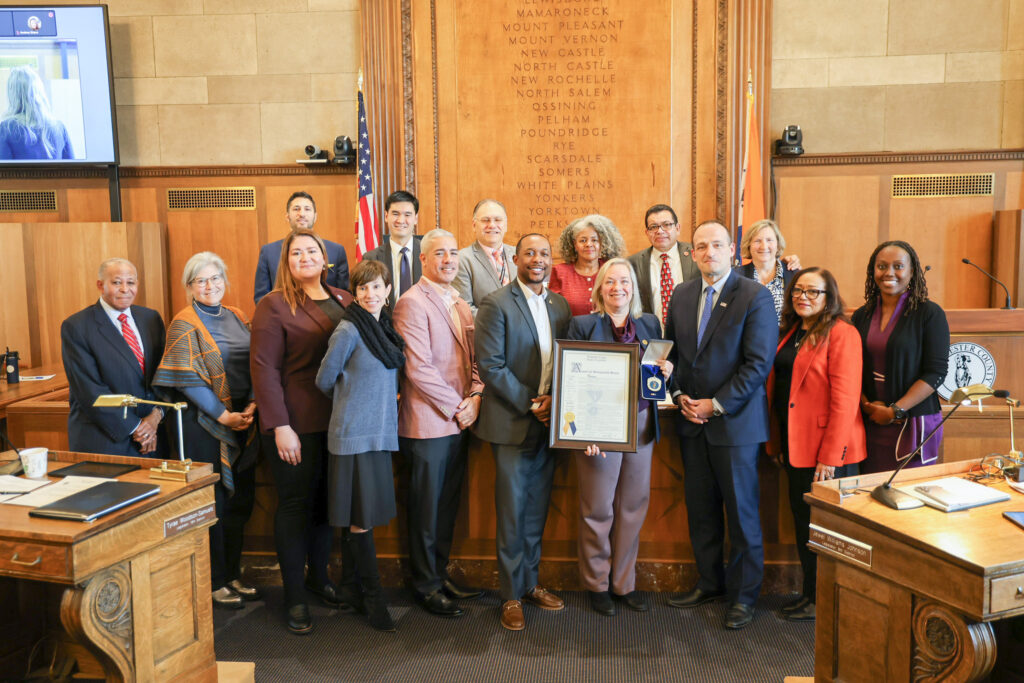
BOARD HONORS LEGISLATORS BOYKIN AND PARKER WITH DISTINGUISHED SERVICE AWARD AT FINAL 2025 MEETING
Both Complete Service on County Board After Six Terms
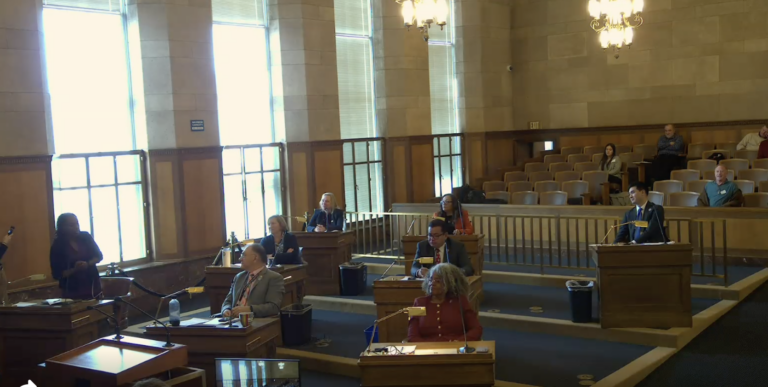
On Monday, the Board of Legislators honored two outgoing legislators with the Westchester County Distinguished Service Award, the highest level of recognition the Board can bestow. The medals are awarded to individuals who have significantly benefited the general welfare and common good of the County through dedicated public service.
The honorees were Legislator Ben Boykin, District 5 (representing most of White Plains, all of Scarsdale, and West Harrison), and Legislator Catherine F. Parker, District 7 (representing Larchmont, Mamaroneck, Rye, and part of Harrison), both of whom will leave office at the end of the month, having reached term limits.
“I would like to extend my most heartfelt congratulations to my friends, Former Chair and Legislator Ben Boykin and Legislator Catherine Parker, on their well-deserved retirement from the Westchester County Board of Legislators. Their years of dedicated service, thoughtful leadership, and commitment to the people of Westchester have left a profound impact on our communities,” County Executive Ken Jenkins shared with Black Westchester.
Board Chairman Vedat Gashi (D–New Castle, Ossining, Somers, Yorktown) said, “Transitions on the Board are always bittersweet, but the departure of these two outstanding legislators seems especially poignant.
Ben’s long service to the public is extraordinary. Serving as NYSAC’s 80th president and completing two terms as Chair of the Board during a period of tremendous change are accomplishments unlikely to be matched. He guided the legislature through the pandemic, ushering in technological advances that kept the Board’s work moving forward. He also led the first Board with majorities of women and people of color, and offered me, personally, invaluable mentorship.
Catherine has dedicated 18 years to public service—six years on Rye City Council, followed by six terms steadfastly representing District 7 on the Board. Her legislative leadership on environmental issues set a high standard for the future, improving quality of life for the Sound Shore towns she represents and all of Westchester—from advancing flood-control measures, to creating a County Office of Sustainability, to stewarding the management of Rye Playland, a cherished County gem.”
“I am humbled and honored to receive this prestigious award from the Westchester County Board of Legislators, the highest honor the Board bestows. My twelve-year tenure here has been historic and transformative in many respects as I led this Board as Chairman for four years from 2018–2021. I have enjoyed working with my colleagues and our outstanding staff to move our County forward. My service has been a labor of love, and I thank my constituents and all the residents of Westchester for allowing me to help make our County a better place to live, work, and enjoy,” Legislator Benjamin Boykin II said.
“It has been the honor and privilege of my life to have served as the County Legislator for the 7th District these last 12 years. So many individuals and local organizations have shown me over my tenure that we can achieve so much when we come together to tackle problems like climate change, affordability, and flooding. I leave office knowing government can be a force for good, and feeling that the legacy I leave shows the next generation that we were thinking of them as we made our policy decisions,” Legislator Catherine F. Parker said.
The legislators’ colleagues included enthusiastic statements of gratitude for the leadership, friendship, and institutional knowledge both legislators freely gave throughout the years, noting in particular their steadfast leadership in County government during the COVID-19 pandemic. Immediately following the celebration, the Board of Legislators convened a special meeting to vote on the 2026 Budget.
Watch the full Regular Meeting below.
“During his tenure, both as legislator and Chair of the Board, Legislator Boykin guided his colleagues through complex budget cycles, COVID, and advanced policies that strengthened County Services. Legislator Parker’s deep commitment to the sound shore communities and strong advocacy on quality-of-life issues made a meaningful difference to the residents she served. As they begin this next chapter, I offer my sincere gratitude for their partnership and tireless effort on behalf of the people of Westchester. We wish them continued success and fulfillment in all that they do,” CE Jenkins shared in closing.
The Westchester County Board of Legislators is the policy-making branch of county government, serving one million residents. The 17-member Board allocates funds, approves the budget, and manages taxes, in addition to passing local laws, acts, and resolutions. It is the longest-running elected body in New York, with a history of over 300 years. Learn more by visiting www.westchesterlegislators.com.
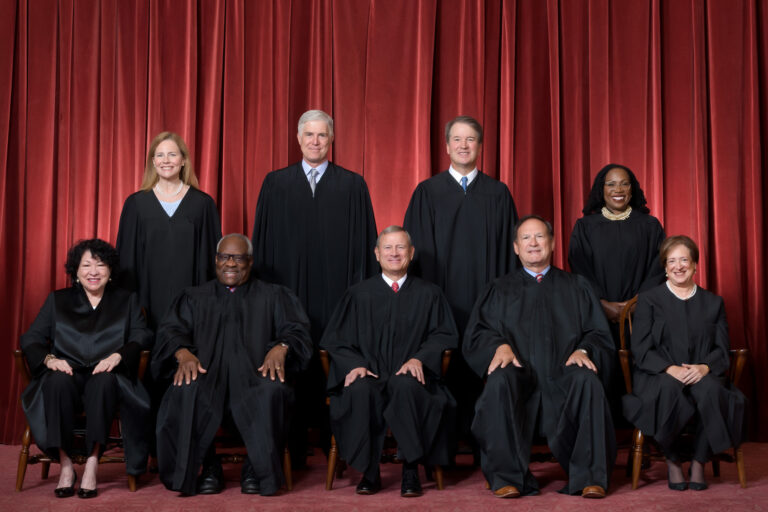
The outrage over the Supreme Court’s latest redistricting ruling misses the most essential truth in the conversation: the Court did not create the political vulnerability Black America is now experiencing. If anything, the verdict exposes a flaw in our own political strategy — one that has gone unchallenged for decades.
The Court’s decision to allow Texas to use a disputed congressional map is being described as an attack on minority voting rights. Critics argue it weakens Black and Latino political power and ignores racial discrimination. But that framing avoids the ruling’s fundamental logic. The Court did not bless race-based gerrymandering. It reaffirmed what it has already said for years: partisan gerrymandering is legal, and federal courts will not referee it.
That single distinction changes the entire analysis. Racial gerrymandering is unconstitutional under the 14th Amendment. But partisan gerrymandering — drawing lines to benefit a political party — is not. So when states claim their maps are designed for partisan advantage, not racial targeting, the Court accepts that explanation unless racial intent can be proven beyond a reasonable doubt.
Here is where the problem becomes ours.
When over 90 percent of Black voterschoose to align with one political party, the political effect becomes indistinguishable from race. Diluting Democratic votes inevitably dilutes Black votes because the two have become nearly identical in practice. The Supreme Court did not engineer that political uniformity. It merely responded to the reality we created.
This is the uncomfortable truth we avoid: predictability is political weakness. A group that consistently gives one party near-automatic support surrenders its bargaining power with both parties. One side assumes your loyalty. The other assumes your hostility. In that environment, gerrymandering becomes mathematically simple. You don’t need to target Black voters by race — targeting them by party accomplishes the same outcome with constitutional cover.
And we reinforce this vulnerability every election cycle.
We treat political loyalty as culture. We mistake party identity for community identity. To change this, Black leaders should promote policies that prioritize community interests over party loyalty, encouraging voters to evaluate candidates based on impact rather than allegiance, thereby increasing leverage.
And as long as we remain politically monolithic, partisan redistricting will continue to undermine our representation while remaining perfectly constitutional. To counter this, Black voters and leaders must prioritize coalition-building, voter education, and advocacy for competitive districts to break the cycle of political uniformity.
The Court’s ruling was not a betrayal. It was a mirror.
The Court’s ruling was not a betrayal. It was a mirror. It shows that political power is not secured through loyalty — it is secured through independence, unpredictability, and a willingness to withhold support until demands are met. Other voter blocs understand this. They negotiate. They extract concessions. They shift when necessary. That is why they are courted instead of taken for granted.
If Black America wants equal political influence, we cannot continue playing a game where everybody else negotiates for power while we negotiate for symbolism. We must reassess our strategy to build real leverage and influence.
The Supreme Court is not our problem.
Our one-sided strategy is.
And until we confront that truth, rulings like this will not be the exception — they will be the new normal.
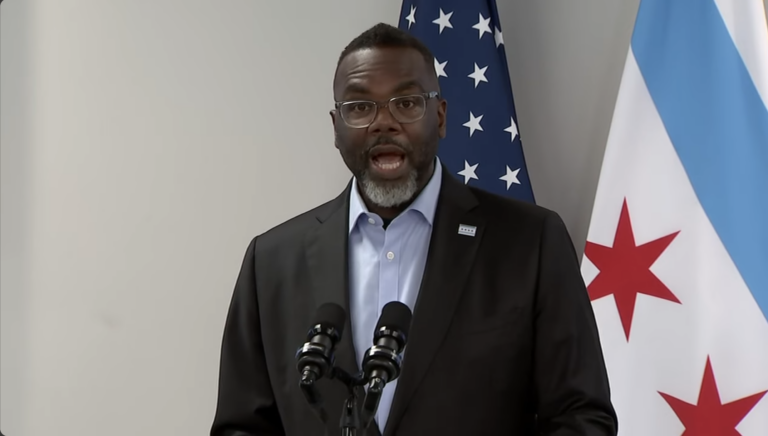
The crisis in Chicago this past week revealed a deeper failure in leadership—when Mayor Brandon Johnson responded with indignation instead of clarity, it exposed a broader problem in political accountability.
The reporter raised a straightforward, factual concern: Why was a Christmas market being treated as a greater public-safety threat than teenagers running through downtown, shooting at people—violence that had just taken a child’s life and injured eight others? Instead of acknowledging the gravity of the moment, the mayor lashed out. He called the question “disgusting and racist,” told Chicagoans to “avoid” the reporter, and then launched into a self-promotional speech about how many employees he hires and how he runs “the biggest corporation in Chicago.” A child was dead. Families were traumatized. And the city’s chief executive chose ego over accountability.
This isn’t just about Chicago; it reflects a national crisis where questioning power is seen as betrayal, and accountability is replaced with defensiveness across Black-led cities.
Crime rates in Chicago remain high compared to most majority-Black cities, with over 1,500 aggravated assaults in a month, yet many Black politicians avoid addressing these facts directly.
And this is where the political dishonesty becomes impossible to ignore. The data is not ambiguous. Some analyses place the share of Black-on-Black homicides between 80 and 90 percent of Black victims being killed by other Black people. Historically, when race is known, around 91 percent of Black homicide victims in single-victim, single-offender cases were killed by Black offenders. These statistics have persisted for decades. Yet when you ask many Black politicians about violence in their own cities, they don’t talk about failed policy decisions, decades of mismanagement, or the leadership vacuum they helped create. They don’t address the conditions they were elected to fix. Instead, they blame racism. They blame Trump. They blame “the white man.” They blame anyone except themselves and the policies in their cities that have failed to keep their own people safe.
This is where the hypocrisy of Black politics becomes undeniable. When violence comes from within our own communities, leaders attack the messenger instead of the problem. They dismiss questions as racist, or if it’s a Black female elected, she will say it’s sexist even when those questions come from Black residents and Black journalists. I have lived this personally. I’ve been told that by raising concerns about political corruption or the high levels of crime and violence in a Black city, “I’m making the city look bad.” Accountability is treated as betrayal. Criticism is treated as an assault on identity. It is easier for them to moralize than to manage, easier to posture than to perform, easier to register indignation than to deliver results.
Mount Vernon, New York, offers one of the clearest examples of how this political culture corrodes Black cities over time. The town has been trapped in a cycle of financial mismanagement, missing funds, broken audits, neglected infrastructure, understaffed police, and persistent violence. Residents see the decline daily. Yet when anyone raises these issues—journalists, activists, taxpayers—the leadership responds with the same defensiveness Chicago saw: blame the critic, deny the problem, and protect the political brand at all costs.
When you compare major Black cities like Memphis, St. Louis, Baltimore, New Orleans, Detroit, and Mount Vernon, one truth becomes unavoidable: crime is not just a cultural issue — it is the direct outcome of policy failure. These cities share the same patterns of high violence, collapsing infrastructure, weak economic development in Black neighborhoods, failing schools, and broken workforce pipelines. Add to that the chronic budget downfalls placed squarely on the backs of Black taxpayers, who pay more and receive less. If the policies were working, the outcomes would reflect it. Instead, the same political class that has governed these cities for decades responds to every concern with the same script: blame racism, blame Republicans, blame anything except their own leadership — even though in many of these cities there are barely any Republicans in elected office at all. It is not a coincidence. It is a pattern and practice of the usual Black politics of deflection, in which accountability is avoided and failure is recycled year after year. Mount Vernon stands as a perfect example: years of mismanagement, broken audits, and neighborhood neglect have produced predictable results that no amount of political spin can hide.
Black communities don’t need more speeches, cultural posturing, or emotional deflection — they need outcome-based governance. That means policies that actually create skilled workers, attract investment into Black neighborhoods, restore vocational and trade programs, rebuild competent city agencies, and produce measurable improvements in safety, education, and opportunity. Cities with strong schools, functioning institutions, and economic mobility have lower crime regardless of race; cities with failing schools, mismanaged budgets, and no path to opportunity have high crime regardless of race. The outcomes don’t lie. Until Black political leadership — from Chicago to Mount Vernon — abandons the politics of blame and embraces policies that deliver real results, Black taxpayers will continue carrying the cost of decisions that have failed them for decades.
This is not a Chicago problem. It is a national problem. From Chicago to Mount Vernon, from Baltimore to St. Louis, too many Black-led cities are governed by leaders who cannot separate public duty from personal pride. Emotion becomes a shield. Accountability becomes the enemy. And the communities that need honest leadership the most are left with excuses, deflection, and decline.
Mayor Johnson didn’t just dodge a tricky question. He exposed the operating system of a political culture that has failed Black America for decades. In this culture, leadership is measured by rhetoric rather than results, transparency is treated as a threat, and protecting the office becomes more important than protecting the people.
But the truth is unavoidable: when leaders defend themselves instead of protecting the public, the people lose every time.
If Black communities are serious about safety and progress, we must demand leaders who face questions honestly and prioritize our well-being over image.
Instead, we got political theatrics.
And until that changes—not just in Chicago but across the nation—our communities will continue to pay the price for leaders who refuse to face the truth.
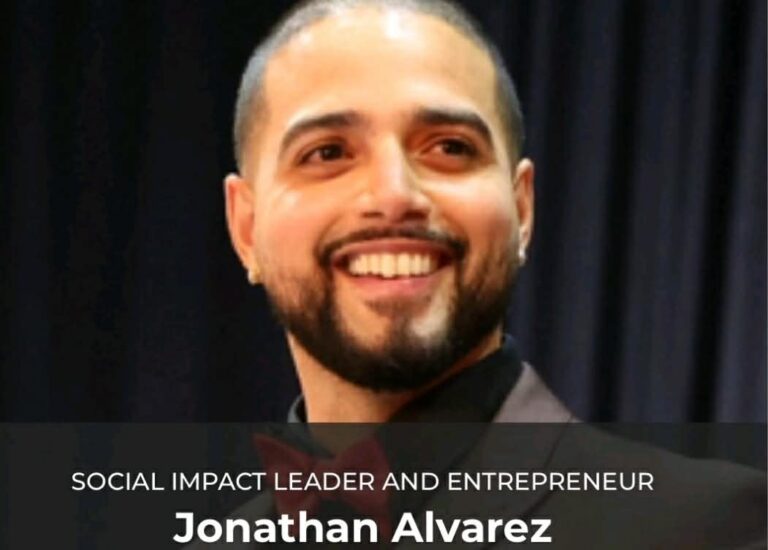
“I earned great wins this year, but this one hits different. - For my community, for my city — this is MAJOR. – Being selected as a W.K. Kellogg Foundation Community Leadership Network Fellow is one for the books. - And I’m proud to say it loud: I’m putting Yonkers on the map.” – Jonathan Alvarez
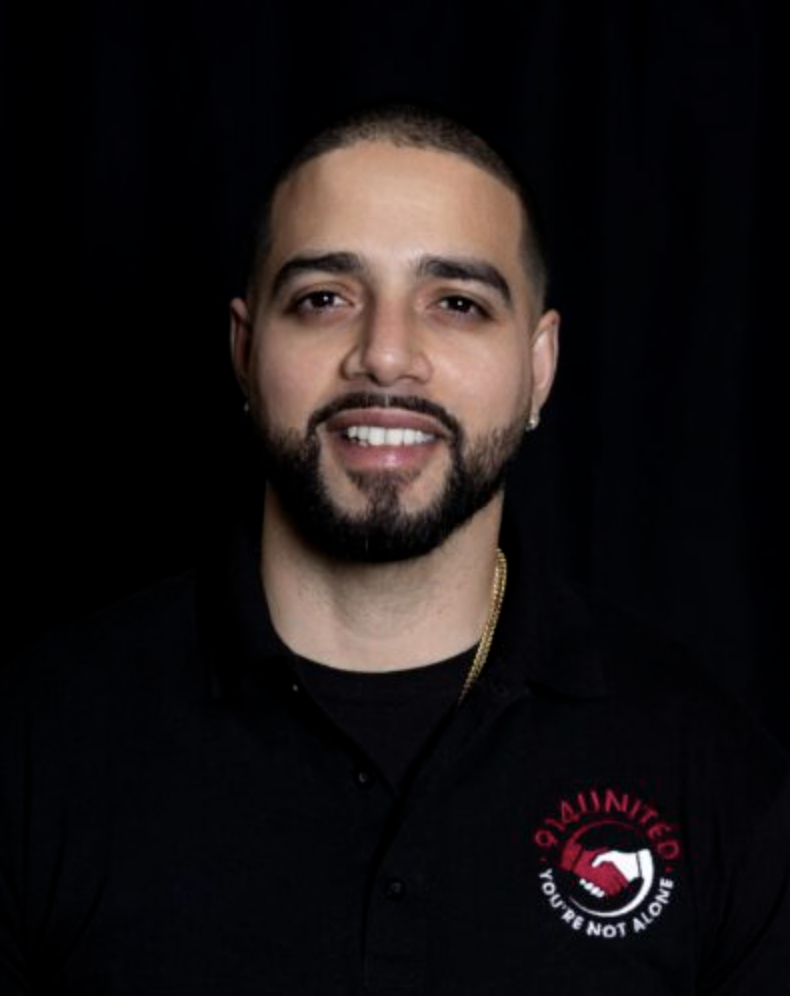
Jonathan Alvarez, Founder & CEO of 914United, was recently selected as one of only 80 fellows nationwide for the W.K. Kellogg Foundation Community Leadership Network with the Center for Creative Leadership—a prestigious 18-month national fellowship that invests in community-rooted leaders working to create conditions where children and families can thrive.
For those who know his story, you know this: Nothing given. Everything earned.
“From prison to purpose. From the block to boardrooms. From cell to CEO. - And now — to a national stage where our voice, our struggle, and our impact will be read far and wide,” Alvarez shared with Black Westchester. “As someone who grew up in this region, spent nearly 15 years incarcerated beginning at age 17, and returned home to build 914United as a movement for second chances and community healing, this opportunity is both deeply personal and a major milestone for our city and county. This opportunity is life-changing — for me, for 914United, and for the young people and families we serve every day.”
The W.K. Kellogg Foundation Community Leadership Network with the Center for Creative Leadership is an innovative fellowship for leaders in local communities and the national child- and family-serving ecosystem to connect, grow, and lead collaborative, transformational change on behalf of children, families, and communities.
The 18-month fellowship prepares leaders to meet the challenges of our time, emphasizing collective leadership as a driver of systems change. Through immersive learning, national collaboration, and advanced leadership development, fellows deepen their understanding of systems transformation and strengthen their ability to navigate differences, build coalitions, and inspire community-based solutions.
Alvarez’s leadership is deeply rooted in lived experience. After serving nearly 15 years of incarceration beginning at age 17, he returned home determined to break cycles of harm and create pathways of opportunity for youth most impacted by the criminal legal and family regulation systems. In 2020, he founded 914United, a Westchester-based nonprofit focused on credible messenger mentorship, violence prevention, civic advocacy, and youth leadership development. His work has led to county- and statewide recognition, including an appointment to the New York State Commission on Prison Education.
“This fellowship is an honor — not just for me, but for my community,” said Alvarez. “My journey shows that it’s not about how you start, but how you finish. The WKKF fellowship will allow me to grow as a leader, expand our impact at 914United, and bring national awareness to the transformative work happening right here in Yonkers. Nothing was given. Everything was earned — and I’m committed to paying that forward for the next generation.”
Class Four of the WKKF Community Leadership Network fellowship will begin in January 2026 and continue for 18 months. Through six in-person and three virtual gatherings, fellows will build relationships, sharpen their leadership practice, and embark on a journey of personal and collective transformation.
Black Westchester celebrates 914United Founder & CEO Jonathan Alvarez, and looks forward as he writes the new chapter in his life. He continues to be a living story of resilience and redemption. He is an example to the next generation that your worst mistake does not have to be the end of your story.
914United is a 501(c)(3) nonprofit dedicated to breaking cycles of justice involvement for at-risk youth and adults in the Lower Hudson Valley. We blend professional case management with authentic mentorship grounded in lived experience to provide resources, safe spaces, and pathways to economic opportunity and leadership.