In 1965, a controversial report warned of a growing crisis in Black families that would hinder racial equality. The so-called Moynihan Report sparked an immediate backlash rather than an honest reckoning. For the next 50 years, the inconvenient truths in the report would be ignored, while Black communities suffered the consequences.
Authored by Daniel Patrick Moynihan, then an assistant secretary of labor under President Johnson, the report aimed to understand why racial inequality persisted even as legal barriers fell. It flagged a startling rise in single-mother households and welfare dependence in African-American communities despite more Black men obtaining jobs. Moynihan hypothesized that the relative lack of stable, two-parent homes in Black neighborhoods would severely hamper children’s development and advancement.
At the time, the outcry drowned out the substance of the report. Critics attacked Moynihan’s focus on family structure as “blaming the victim,” insisting he ignored racism and economic forces. Leading Black scholars and civil rights figures decried notions of crumbling Black families as racist stereotypes. They pushed an alternative narrative of strong, matriarchal family units continuing African traditions. The controversy meant Johnson distanced himself from implementing the report’s recommendations.
While academics and activists argued their perspectives, the tangible trends in low-income Black communities painted a contrasting picture. Over the course of the following five decades, the rate of out-of-wedlock births within the Black community increased significantly, prompting some to view it as a crisis. School dropout, crime, addiction, and delinquency rose markedly through the 1970s, 1980s, 1990s, and 2000s; we see the same trends today in 2024. Most devastatingly, welfare dependency – the problem Moynihan had said would perpetuate the economic marginalization of the Black community became a reality.
However, liberal elites, mainly Democrats, remained unwilling to confront the evidence, choosing ideology over facts. Black single mothers continued to be romanticized as strong pillars of their community. Discussions framed that traditional Black family with a Black man and women as an oppressive white structure to reject. Debates focused narrowly on providing services while refusing to discuss behavioral causes for poverty. With political correctness dominating, the honest discussion Black families needed has been silenced for 50 years.
In the early 1980s, a new conservative critique finally challenged the censorship around family breakdown. Sociologists like Charles Murray, Lawrence Mead and Thomas Sowell directly blamed welfare incentives and ghetto cultural pathologies – not abstract racism or “blaming victims” – for the declines in two-parent homes. Though controversial, they advocated that the Black single-family unit was the face of dysfunctional poverty, where liberals had painted them as heroic.
Let us not forget that Many welfare programs give more excellent benefits to unmarried individuals than to a married couple of otherwise identical income. The resulting marriage penalty discourages marriage and rewards single parenthood.
Their iconoclastic stance shattered the stagnant orthodoxy. News outlets rang the alarm on “The Vanishing Black Family.” The suppressed Moynihan Report was dusted off and revisited during its 20th anniversary, but Black leadership controlled by liberal money did not listen.
William Julius Wilson, a renowned liberal, broke ranks to admit his colleagues had become “confused and defensive”. He agreed social science needed to investigate single parenthood’s impacts on poor children rigorously.
The black social theorist Thomas Sowell, a professor at Stanford University, has extensively written about the decline of the black family. In his article titled “A Legacy of Liberalism,” Sowell dismisses the argument that attributes current black impoverishment to slavery or inherent racism. He criticizes the “legacy of slavery” argument, stating that it discourages critical thinking and reliance on empirical evidence by evoking emotional reactions. Sowell suggests that for a more profound analysis, we should compare the economic status of blacks a century after slavery ended with their status after three decades of the liberal welfare state. He points out that despite the widespread belief that black economic progress started or accelerated with the passage of civil rights laws and “war on poverty” programs in the 1960s, historical data shows that the poverty rate among blacks had already decreased from 87 percent in 1940 to 47 percent by 1960, well before the implementation of those programs.
The evidence is accurate, and they have known it for 50 years.
Sociologist Sara McLanahan began researching the outcomes of single motherhood in the 1990s. Though expecting to prove no real differences from two-parent homes, her analysis uncovered worse results across child wellbeing indicators from income to school performance. Despite initially facing resistance, her findings made academics accept family structure as conclusively necessary.
McLanahan’s research marked a turning point. With the concentrated poverty and social dysfunction in inner cities at a peak, President Clinton – Known for political savviness regarding public sentiment – made marriage promotion a feature of his welfare reform agenda. In his 1994 State of the Union address, he admonished that “more than half of our children will be born into families where there is no marriage.” The numbers simply made denial impossible any longer.
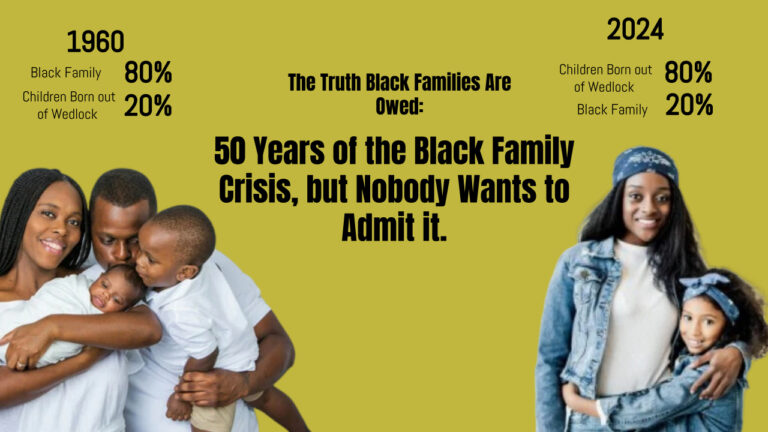
From the 2000s to the present day, the vision of a flawless, strong single Black mother was promoted, and anyone who pushed back on the narrative was labeled sexist. When you deal with facts over feelings, academics today agree with McLanahan’s evidence. Popular Black culture has glamorized unwed pregnancy. Along with a broken view of feminism, it disregarded marriage as an important building block in the Black community. What’s unfortunate is that we are fighting a battle against the disappearing Black family in 2024; in the early 1960s, about 20 percent of black children were born to unmarried mothers, and Black Marriage was at 80 percent; by 2024, 80 percent of Black children are born out of wedlock. But we have yet to see this as a crisis in the Black community.
In another article, Sowell asserted, “The significant expansion of the welfare state in the 1960s had a detrimental impact on the black family structure, causing its decline, even though the black family had persevered through centuries of slavery and generations of racial oppression.”
There are 80 percent of Black children born out of wedlock, and the average single parent earns 55 thousand a year. When will Black leaders, Black pastors, and even so-called liberal white people wake up? The Black community is 50 years trapped in a cycle of fatherless childhoods and teenage parenthood and stuck in ghettos across America when the solution that has been known for 50 years by academics is more two-parent families represented a desperately needed solution.
The Toll of Denial to the Black Community
There was, and there is, planned obstruction of open discussion and obfuscation of facts regarding Black family breakdown exacted a heavy price on Black communities over 50 years.
The Black community has suffered due to those who claimed to champion its interests, as well as the silence of Black political and religious leaders who failed to address the significant policy issues inherent in the American welfare system. Consequently, we have witnessed several generations of young Black individuals who were ill-prepared to establish stable family structures. This situation deprived impoverished Black men and women of the opportunity to make informed choices, as they were exposed to misleading narratives about their available alternatives.
According to a study published in the Journal of Blacks in Higher Education, 54 percent of the White population is married, while only 31.2 percent of the Black population is married. Additionally, 27.5 percent of the White population has never been married, whereas half of the Black population has never been married. An article in Forbes Magazine explores the advantages of being married for families, particularly in terms of achieving middle-class status and generational wealth. Married-parent families typically enjoy higher incomes than single-parent families, meaning they have better access to quality schools, neighborhoods, and job opportunities. Furthermore, married parents are more likely to invest more time and resources into raising their children.
Furthermore, marriage rates in states are closely connected to their economic well-being. States with more married parents tend to have higher incomes, better chances for kids from low-income families to improve their financial situations, less child poverty, and higher family incomes.
For example, when you compare states with the most married-parent families to those with the fewest, the ones with the most married parents have an average $1,451 higher income per person. Kids from low-income families in these states also have a 10.5% better chance of moving up the income ladder, and there’s a 13.2% lower rate of child poverty.
Approximately 80% of Black children are born to unmarried parents, while roughly 38% of Black children continue to live below the poverty line, as revealed by a Pew study analyzing Census data. The stark reality is that Black children are still four times more likely than their white or Asian counterparts to experience poverty. We must recognize that there exists a significant issue within Black families, yet it seems that, as a society, we are either unaware or reluctant to address it. Could it be that our Black leadership fears being labeled as sexist or canceled for advocating Black marriage and the importance of strong Black families led by both men and women?
Apart from the decline in wages of the Black family, particularly Black men, the sudden shift in the American economy’s demand for less-skilled workers has created a disparity for Black males. This disparity is rooted in the disparity between the types of jobs they historically identified with, which were closely linked to their sense of identity, and the present reality of job opportunities available to those with lower levels of education. Notably, the decline in manufacturing jobs, which have historically played a vital role in sustaining Black middle-class families, over the past few decades can be attributed to both a decrease in job prospects for workers with intermediate skill levels and their reluctance to pursue employment in different industries or skill categories.
One of the most tragic aspects of this situation is the disproportionate burden placed on marginalized Black fathers. Black men have been intentionally excluded from discussions about family progress, leading to an inaccurate portrayal of them as increasingly irrelevant. In reality, 51 percent of Black men are single but still in the middle class, and 31 percent are married, underscoring their significance in various family structures. Despite their vital roles, they have been unfairly stigmatized as neglectful or unnecessary.
The media has often portrayed Black women as self-reliant and not in need of a husband while subtly suggesting that being a baby momma is better than being a wife. On the flip side, some Black men have embraced these stereotypes, choosing to baby daddy without marrying, and this cycle continues. These misconceptions, coupled with the unsupported notion that all single Black mothers are heroic figures while excluding Black men, have marginalized many Black men and promoted an unfair narrative.
While there is often an emphasis on Black women’s independence from Black men, studies reveal that for Black men, marriage can significantly influence their economic mobility. Approximately 70% of married Black men attain middle-class status by midlife, in sharp contrast to the 20% of never-married Black men and 44% of divorced Black men who reach a similar economic status. These statistics underscore the crucial role of marriage in offering economic stability and support for Black men as they strive to achieve upward mobility.
The critical issue we must confront is our reluctance to acknowledge the decline of two-parent Black households. Discussions about the state of Black families in the United States and their progress started long before the Moynihan report, but they were often disregarded by Black leadership. This report specifically examined how the structure of Black families impacted various factors that collectively hindered the advancement of social equity.
According to a Harvard report, breaking the cycle of intergenerational poverty among Black Americans necessitates a significant transformation in the economic prospects of Black men, particularly concerning their earnings. One critical aspect to note is the bidirectional relationship between earnings and marriage. Married men tend, all else being equal, to earn more. For instance, one study involving identical twins suggests that marriage can boost earnings by as much as one-fourth. This increase in earnings for married men may be linked to a heightened sense of responsibility to provide financially for their families, especially their children. Consequently, low marriage rates among Black men may have an impact on their earnings.
Recognizing that addressing the profound racial inequalities cannot be achieved solely through upward mobility is crucial. Relatively speaking, Black girls are more likely to escape poverty through their own earnings. However, it’s essential to consider the substantial number of Black children who are initially raised in low-income households. Closing the racial gaps in upward mobility will require comprehensive shifts in economic outcomes, focusing on improving men’s earnings.
Regrettably, many of the social problems highlighted in the Moynihan report have worsened for Black communities in the decades since its publication. Achieving social and economic progress depends on multiple factors, requiring action from policymakers, community leaders, and individuals. Suppose we fail to address these issues and improve social equity and economic opportunities for Black men and families. In that case, we may find ourselves lamenting the lack of progress and stagnation in Black family well-being for another 50 years.
The current state of sociology and the conditions Black families and communities face provide strong support for the enduring relevance of Patrick Moynihan’s insights from over 50 years ago. We can no longer overlook the consequences of out-of-wedlock births, as we have known for years that Black children often find themselves ensnared in an unending cycle of hardship. This harsh reality has been learned the hard way over three generations.
Drawing from my 33 years of experience as a Correction Officer at the Westchester County Department of Corrections, I have witnessed three generations of men, women, and their children entering our correctional system. It was clear that the issue extended beyond mere criminal behavior; it was a systemic failure characterized by symbolism without meaningful substance, and it had never adequately addressed the fundamental needs of Black families. Whether the crisis within Black families will finally receive the attention it deserved decades ago and whether it will serve as a catalyst for the much-needed change we seek remains uncertain.
This article serves as a testament to the failure of intellectual gatekeepers, both within the Black community and among white individuals, who chose to conceal the crisis conditions in low-income neighborhoods to protect their ideologies or avoid facing uncomfortable truths. With the benefit of hindsight, some may feel regret for their actions. This article also criticizes any Black leaders who were either swayed by liberal incentives or too afraid to address these issues from their platforms.
The seriousness and scale of the breakdown of Black families were often sidelined in favor of addressing racism and civil rights, with a lack of awareness that preserving the Black family is, in itself, a civil rights issue.
Today, prevailing sociology supports the insights of Patrick Moynihan, made over 50 years ago. It is clear that being raised by a single parent in Black communities, who usually face a disadvantage of wealth, significantly increases the likelihood that children will remain trapped in a cycle of disadvantage. Two generations have learned this the hard way. Whether Black families will finally receive the honest analysis they should have had decades ago remains uncertain. Still, there is no time to wasted in taking action to save the Black family.