




In 2026, the American classroom looks very different from the one many adults remember. Screens glow where notebooks used to sit. Artificial intelligence helps with homework. Phones buzz in pockets every few minutes. And in the middle of all of this change sits a group of students who have always carried the weight of the system on their backs: Black boys.
Across the country, data continues to show that Black male students face some of the toughest challenges in education. According to recent education reports, Black students are disciplined at higher rates than their peers, even when behavior is similar, and Black boys in particular are overrepresented in suspensions and expulsions compared with their share of enrollment.
That reality shapes how many of them experience school long before they even reach high school.
At the same time, academic gaps remain. Studies show that Black students are less likely to meet grade-level standards in reading and math compared with white students, a gap that has not closed in decades.
Graduation rates for Black male students in several major cities still trail behind other groups, showing that the problem is not just about one classroom or one district, but about a national pattern.
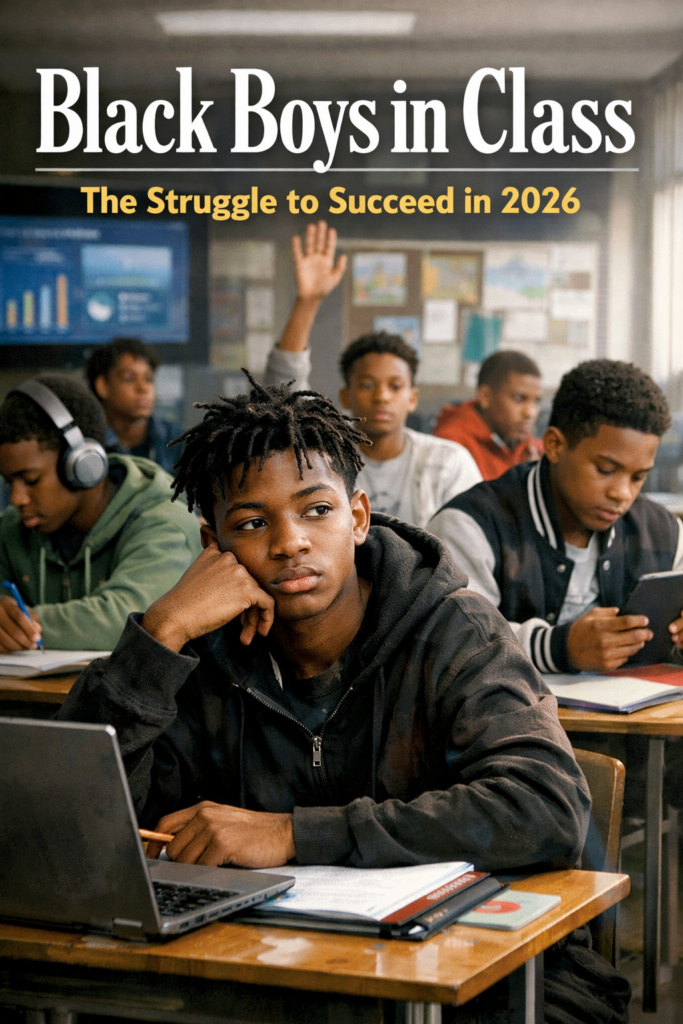
But 2026 adds a new layer to the story. Today’s students belong to Generation Z and Generation Alpha, and their relationship with school is different from any generation before them. Surveys show that many Gen Z students feel pressure about the future, struggle with focus, and are less interested in reading than past generations.
Teachers see this every day. Attention spans are shorter. Motivation comes and goes. And for boys — especially Black boys — school can sometimes feel like a place where they are corrected more often than they are encouraged.
National test scores tell a similar story. Recent results from the Nation’s Report Card show declines in reading and math performance, with struggling students falling even further behind than before the pandemic.
When schools fall behind, the students who were already at risk usually feel it first.
Yet inside classrooms, the picture is not only negative. Many Black boys today are creative, outspoken, funny, and deeply aware of the world around them. They talk about politics, social media, money, and identity in ways that previous generations did not at their age. They want success, but they also want school to feel real.
The challenge for education in 2026 is not simply raising test scores. It is figuring out how to reach a generation that grew up online, while making sure that the students who have historically been left behind — especially Black boys — are not left behind again.
If the classroom is going to work for the future, it has to work for them.
















This brightened my whole week
Thanks for being a bright light 🌟 during these sometimes difficult times
Thanks for being such a consistent source of positivity in our community