



For generations, homeownership has meant more than a roof over your head. It’s been the bedrock of financial security, family stability, and generational wealth. Owning a home meant you had something to leave to your kids, something that could go up in value and something that gave you a financial base outside of your weekly wage. It was one of the main ways the average working person could build wealth without already being wealthy.
But in Westchester County, that American dream is becoming financially impossible for many working-class and middle-class families, particularly Black families who have historically faced barriers to homeownership and wealth accumulation. We continue hearing politicians talk about affordability, economic development, and creating opportunities, but the housing market tells a different story. The question is no longer whether Westchester has a housing affordability problem. The question is whether our elected officials have a serious plan to address it.
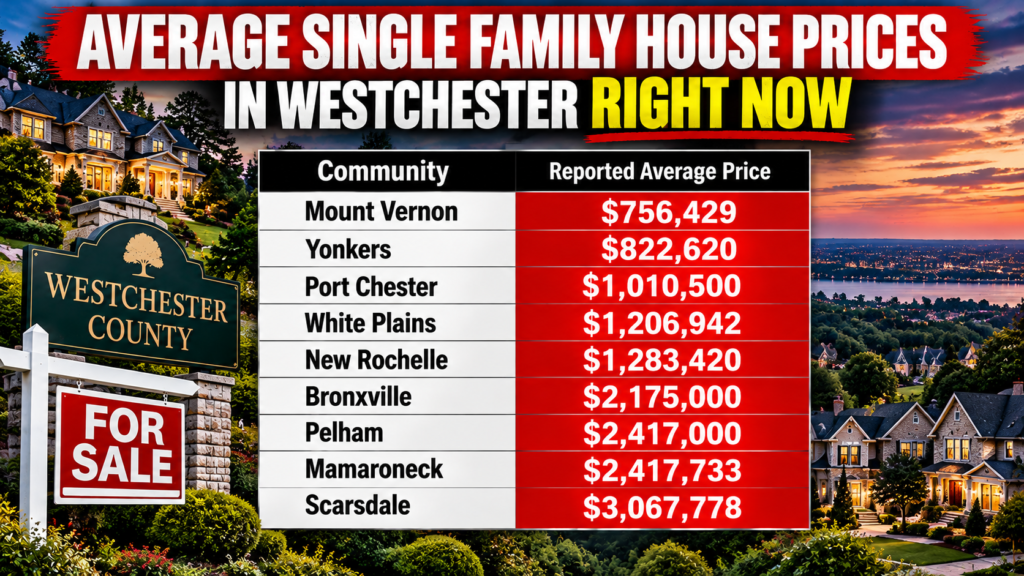
According to housing prices shared by a local real estate professional, citing OneKey MLS data as of October 12, 2026, the average single-family home prices in several Westchester communities have reached levels that should concern every resident and elected official.
Source: October 12, 2026, social media graphic attributed to OneKey MLS. Figures have not been independently verified, and the graphic does not specify whether they represent active listings or completed sales.
These numbers raise questions about the economic future of the Black middle class in Westchester. How in the world does a family making $75k, $100k, or even $125k a year buy a house in Westchester when property taxes here are some of the highest in the country? And how the hell are Black families ever going to build generational wealth when one of the primary ways of doing so is increasingly out of reach?
THE BLACK MIDDLE CLASS IS BEING PRICED OUT
For years, communities like Mount Vernon, Yonkers, New Rochelle, and White Plains have had Black families who worked their tails off to get established. You had correction officers, police officers, teachers, nurses, municipal employees, small business owners, le and all sorts of other working people who bought homes, raised families, es and were part of the community. They weren’t necessarily rich people. They were hardworking families who believed that if you worked steadily, spent responsibly, and stayed disciplined with your finances, you could eventually get a home.
Today, even a household with two working adults can’t afford that same opportunity. You can do absolutely everything that society tells you to do (get an education, have a job, build your credit, save money) and still be locked out of the housing market. We have to stop pretending that this is just a case of people not working hard enough or not being good with their money.
Take Mount Vernon, where the reported average single-family home price is $756,429. A 10% down payment would require approximately $75,643. That’s before you even get to the closing costs, inspections, moving costs, repairs, or the savings you’d need for emergencies. With a hypothetical 30-year mortgage at 6.5% interest, the principal and interest payment would be approximately $4,300 per month. Add property taxes, homeowners insurance, and mortgage insurance, and the total monthly payment would be substantially higher.
For a household making $100k a year, that’s an absolutely massive financial burden before you even get to the cost of groceries, transport, utilities, health care, childcare, and all the other basics. We can’t continue to label people as middle class when the reality is that middle-class incomes are simply not going to allow you to afford a middle-class home.
THE NUMBERS TELL AN EVEN BIGGER STORY
From the U.S. CensusBurea’ ’ss 2020–2024 estimate,s we have MountVerno’ ‘ss median household income at $78,77,9 and only about 43% of the occupied housing units are owner-occupied. Put that income in comparison to asingle-familyy home priced at over 756k. The average home price is nearly 10x thecit’ ‘ss median household income, which is a clear illustration of how out of touch housing costs have become from the incomes of the average resident.
Thesefigures reflectr the community as a whole, nota singlek household incomespecifically (which would warrant its own full analysis). They d,o howeve,r clearly illustrate a very real affordability gap thatcan’tn be brushed off as a simple case of poor personal financial management. If people earning fairly decentmiddle-class incomes can’tt afford to live in the communities where they work and where they raise their childre,n then we have a structural economic proble, and it’ss one that deserves far more than just somesoundingg campaign promises.
PROPERTY TAXES: THE SILENT KILLER OF GENERATIONAL WEALTH
One of the biggest hurdles to home ownership in Westchester is the continuing burden of property taxes. You can have afamily that’ss saved up for a down payment,meetss all the criteria to get a mortgage, and still find the monthly payment unaffordable because of property taxeshat’ssss true even of a family that bought their home decades ago. The cost of housing is just too high.
The problemoesn’ttt go away when the mortgage is paid off. The retired homeowner stillhase to pay property taxes.That’s truee for the retired homeownerwho’ss spent their life working and raising a family. For Black families in particular who have worked so hard to get a home,that’ss another threat to generational wealth in that the homeyou’ree intending to pass on to your kids and grandkids can become a financial liability for the next generation.
Westchester County needs to have a serious conversation about property tax reform, assessment practices, protections for senior homeowner,s and the impact of local government spending onlong-termm housing affordability. Wesimply can’tt keencelebrating risingn property values whileignoringe familiee being priced out of their homes. Property appreciation means nothing to the homeowner who is forced to sell because the cost of owning has become too great.
AFFORDABLE HOUSING IS NOT ALWAYS AFFORDABLE HOMEOWNERSHIP
Whenever housing affordability becomes a political issu,e the standard response frompoliticianss is to announce yet anotheraffordablee housing development. We have to be clea,r thoug,h about the difference between affordable rental housing and affordable homeownershi,p as theyservee very differenteconomic functionsn. Rental housing is absolutely essential, particularly for families who are not yet ready or able to buy. Itdoesn’tt follow that ifyou’re renting, you’ree automatically in a position to build up equity in your home.
If government housing policy is all about rental development and provides no viable route to ownershi,p thenwe’ree going to end up with a generation of people who can live in their community but whodon’tt build anyproperty-basedd wealth in that community.hey’llll be there for 30, 40 years paying rent and not have an asset to pass on to their kids. The people who own the propertywill reapg the benefits oflong-termm appreciation.
Where are the programmes to assist working families in buying their first home? Where are the incentives for developers to build affordable starter homes? Where are the real property tax reforms that would allow existing homeowners to stay in their homes? Those are the questionsinvestorss shouldaskg themselves every time theyrolle out another housing initiative.
THE NEXT GENERATION MAY HAVE TO LEAVE WESTCHESTER
Perhaps the most troubling aspect ofestchester’sss housing crisis is what it means for our kids. A young adult who grew up in Mount Vernon, Yonkers, New Rochelle or wherever else in Westchester may find themselves simply unable to buy a home in the community where their parents raised them. Even if they go to college, get a good jo,b andearne a decent salar,y they may find that buying a homemeans movinge out of the community where they grew up.
This has consequences that go well beyond thepropertyy itsel:s you lose younger homeowners, you lose potential customers for local businesse,s and youpulle familiesapartt. The older generation may find themselves with fewer relatives around to look after them in later lif,e and the next generationlosese the chance to own the communities that have been instrumental in their own development.
Families who alreadyowne property in the area will obviously benefit from any appreciation in value, whereas families trying toentero the marketfaceg ever greater financial obstacles. That gap betweenexisting homeownersr andwould-be homeowners needss to be addressed, particularly in communities where homeownership has long been a key step in the journey to economic independence.
WHERE IS THE POLITICAL PLAN?
Westchester County has more than its fair share of elected officials who campaign on affordability, economic opportunit,y and protecting working families. Housing costsare a major issue for residents throughout the count,y and the discussion tends to be limited to announcing new developments, celebrating the completion of new constructio,n and promising thatrelieff is on the way.It’sIt’s
It’s time to demand real policies that will increase the supply of affordable homes, support genuine first-time buyers, remove unnecessary development impediments, and address the property tax issue. That means reviewing zoning, promoting well-designed starter homes and townhouses, expanding down payment assistance, and creating ownership opportunities through community land trusts and other mechanisms.
The government simplyan’ttt say that homes should cost less. Housing prices resultfromf supply and demand, financing costs, land cost,s and construction costs. The only wayton have an effective policy is toaddressh those realities and ensure economic developmentdoesn’tt become another tool for excluding the very people whobuiltd these communities.
For Black Westchester resident,s these are particularly pertinent question,s as the historical racial wealth gap means that many families find it very difficult to fall back on assets passed down from previous generations or on financial assistance from previous generations. Any serious housingagenda musto take those economic realities into accountand offerr practical solutions that enable families to move from renting to owning.
HOMEOWNERSHIP MUST REMAIN PART OF THE BLACK ECONOMIC AGENDA
Black political conversations are very much about elections,partiesy,representation,n and who we should vote for. Those are all valid conversations. The issue is that political representation has to have an economic consequence. If we have elected officials who look like us and the next generationstilln’tt afford to buy a house in the community they grew up i,n then what good is that?
What good is celebrating economic development if the people who have lived in the area for decadesaren’t inn any position to benefit from the wealthbeingg generated? What good is all the talk about generational wealth if our housing policies are such that theydon’ty create the opportunity for families to build generational assets? We need tomeasureg political successbyf real economic outcomes rather thanpoliticall connections, party politic,s or campaign speeches.
Black families need access to financial education, affordable credit, the ability to start and run a business, investment opportunities, and a pathway to property ownership. Those goals must be at the heart of any serious Black economic agenda because you cannot achieve political representation alone and expect economic independence.
THE BOTTOM LINE: WHO WILL BE ABLE TO AFFORD WESTCHESTER?Westchester’s
Westchester’s housing crisis is not going to go away through political rhetoric or another round of campaign promises. The numbers should be of concern to every working family irrespective of race or political stripe, but for Black families who are still trying to close the decades long gap in wealth, the impact is particularly acute.We’re
We’re looking at a housing market where property valuescontinueg to ris,ewhile opportunities for the average working person to get intothe propertyeconomy areg increasingly constrained.hat’sss not a sustainable basis for a strong middle class and it most certainlysn’ttt a viable path to building Black generational wealth.
The question beforeestchester’sss political leadership is simple: are you crafting policies that actually enable working families to become homeowners or are you just managing a housing market that is increasingly excluding them? If Black familiesan’ttt afford to buy homes,an’ttt afford the taxes on the homes they do own andan’ttt pass those homes on to the next generation then we are not creating generational wealth. We are simply watching the opportunity to do so disappear.
Black familieshouldn’ttt have to get rich just to be able to afford a home in the communities that they helped build. Every elected official who claims to represent the Black middle class should be required to explain precisely what they intend to do about that.