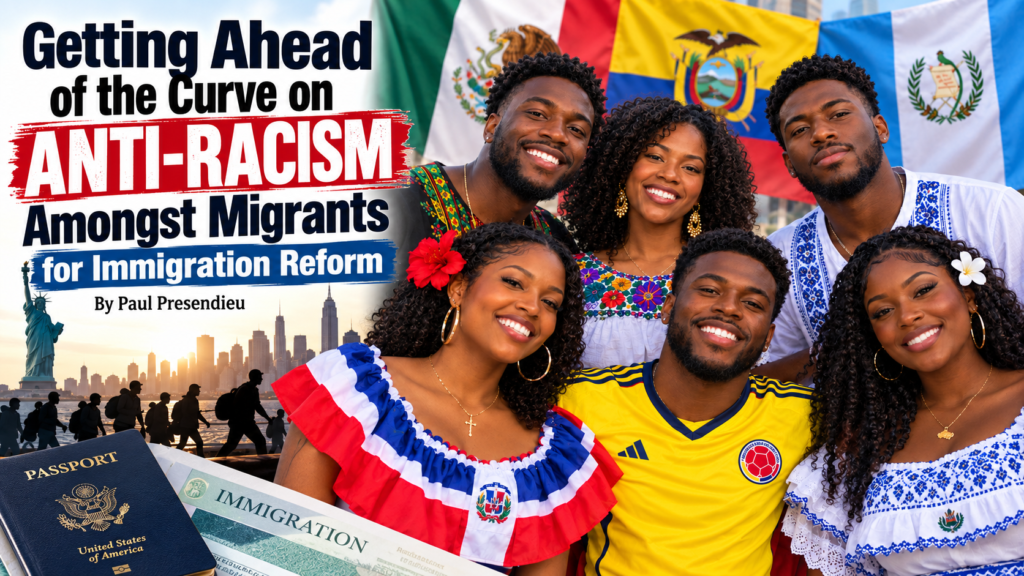




Five of the five countries that send the most undocumented residents to New York have documented records of anti-Black racism. No immigration reform plan accounts for what that means for Black communities here.
Every immigration reform debate in this country asks the same questions. Who gets status? Who gets work permits? How long is the wait?
One question is never on the list: what did people learn about Black people before they got here?
It is an uncomfortable question, and it is easy to ask badly. But the record behind it is not opinion. United Nations experts, national governments, and regional economists have documented anti-Black racism across the Latin American countries that send the most people to New York. U.S. researchers have found that those attitudes do not always stay behind.
Black New Yorkers are still pressing claims that date to the colonial era, on housing, wealth, policing and schools. A reform that adds neighbors without adding understanding leaves both communities to work it out alone.
Who is here
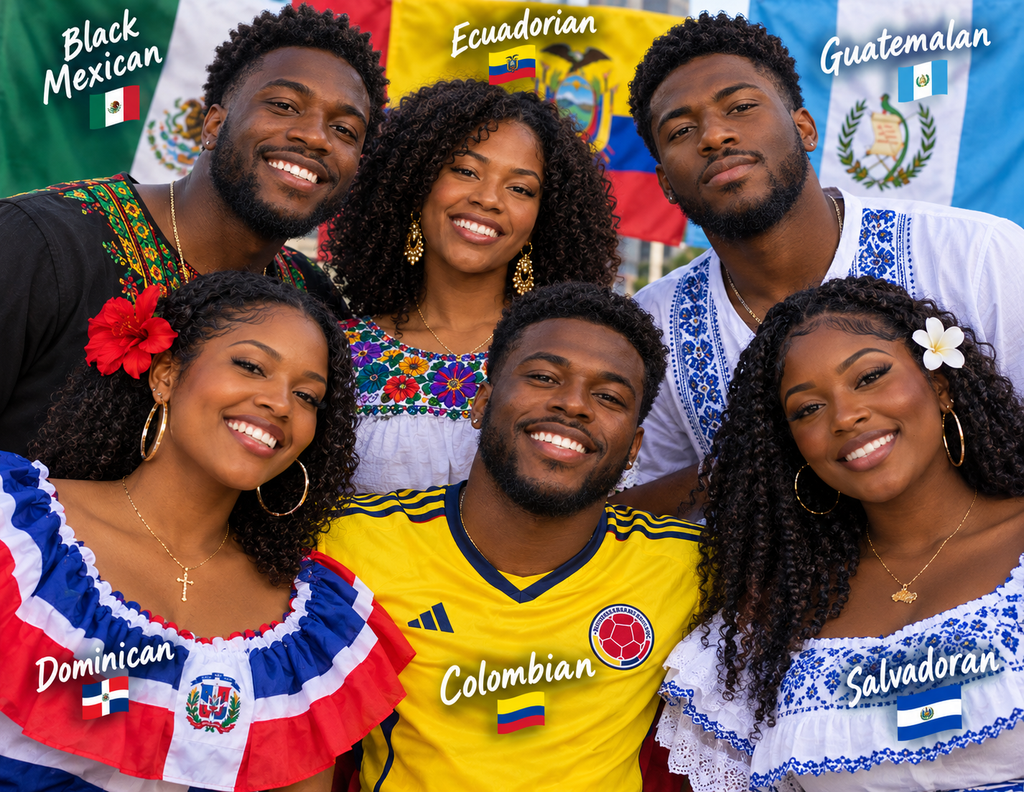
During the Biden Administration, New York was home to an estimated 836,000 undocumented residents, according to the Migration Policy Institute’s 2023 figures. Two in three spoke Spanish at home. Five countries account for about half of the total.
| Country of birth | Undocumented New Yorkers | Share | Documented record on anti-Black racism |
|---|---|---|---|
| Mexico | 135,000 | 16% | In a 2022 national survey, 24.3% of adults would not rent a room to an Afro-descendant person |
| Ecuador | 89,000 | 11% | Discrimination in jobs, schools, housing, and media coverage |
| Guatemala | 71,000 | 8% | Afro-descendant peoples lack legal recognition; discrimination cases are misclassified |
| Dominican Republic | 70,000 | 8% | Profiling of darker-skinned people; a 2013 ruling stripped citizenship from tens of thousands of Haitian descent |
| El Salvador | 68,000 | 8% | The United Nations Committee on the Elimination of Racial Discrimination explicitly raised concerns about the conditions of Afro-descendant Salvadorans |
The newest arrivals follow the same map. Of the roughly 107,000 asylum-seekers who reached New York City between spring 2022 and July 2023, 41% came from Venezuela, 18% from Ecuador and 13% from Colombia, City Hall data showed.
One caution belongs here. These are not all newcomers. MPI estimates that 42% of undocumented New Yorkers have lived in the United States for 20 years or more.
What people grew up with
About 134 million people of African descent live in Latin America, roughly 21% of the region, by the count of the UN’s Economic Commission for Latin America and the Caribbean. The commission calls racial inequality a structural feature of those societies, visible in poverty, schooling, jobs, and exposure to violence.
The details differ by country.
In Mexico, the government’s own 2022 discrimination survey found that 26.4% of adults had little or no desire to see an Afro-descendant person elected president. Mexico did not recognize Afro-Mexicans in its constitution until 2019.
In Colombia, a UN working group visited for ten days in May 2024 and described centuries of systemic and institutional racism. It cited state neglect, displacement, and land loss in Afro-Colombian communities.
In the Dominican Republic, the U.S. State Department’s 2023 human rights report documented discrimination by security forces against darker-skinned people, especially Haitians and Dominicans of Haitian descent.
In Honduras, Garifuna communities face eviction threats on ancestral land. In Ecuador, the State Department reported a news outlet portraying an Afro-Ecuadorian schoolboy as a suspected criminal as he walked home. In Venezuela, the Inter-American Commission on Human Rights said public data on Afro-descendant people was lacking.
The common thread is silence. Many of these nations long taught that racial mixture had dissolved racism. A child can finish school there without one honest lesson on slavery’s afterlife at home.
I recall when Paraguayan Senator Celeste Amarilla labeled racist remarks to Black French Soccer Team Captain, Kylian Mbappe, during the 2026 World Cup, saying, “The brute didn’t even learn to write; instead of mother’s milk, he sucked on coconuts, and the most educated thing he heard was chimpanzees.” Many members of the Hispanic and Latino Community rallied to her cause online, similar to how we see white supremacists execute digital organizing in the United States of America. Despite statements condemning Senator Celeste Amarilla from the United Nations Human Rights Commission, the President of Paraguay, the President of France, and the Paraguay Senate through a formal vote, people still rallied to her side while she refused to immediately issue an apology during the World Cup.
Senator Amarilla shared that she comes from a generation when “gays were beaten up and calling someone a little black shit was common”.
Does it travel?
The research says it can.
The most cited study comes from Duke University political scientist Paula McClain. Her team surveyed 500 Black, white and Latino residents of Durham, North Carolina, in 2003. Nearly 59% of Latino immigrants said few or almost no Black people are hard-working. About 57% said few or none could be trusted. Most said they had more in common with white residents, who did not return the feeling.
Fordham law professor Tanya Katerí Hernández reached a similar conclusion from a different direction. Her 2022 book Racial Innocence draws on discrimination case files from 1964 to 2021. She argues that negative attitudes toward Blackness form long before immigrants land in the United States. She also documents how a belief that Latinos cannot be racist keeps the problem out of view.
The Pew Research Center put numbers to it in a March 2021 survey of 3,375 Latino adults. Sixty-two percent said darker skin hurts a Latino’s chances of getting ahead. Among darker-skinned Latinos, 41% said another Latino had discriminated against them, compared with 25% of lighter-skinned Latinos. About half said race and skin color rarely or never came up at home.
That last finding matters most. A bias nobody discusses is a bias nobody corrects.
Westchester’s stake
The county’s numbers show how fast the ground is shifting. The 2020 Census counted 269,334 Hispanic residents in Westchester, 26.8% of the county and up 30.1% in a decade. It counted 131,010 Black residents, 13.0% and up 3.5%.
The two communities share blocks, schools, job sites, and union halls in Mount Vernon, New Rochelle, Yonkers, Port Chester, and Peekskill. They also compete for the same scarce things: affordable apartments, entry-level work, and the attention of local government.
Black residents arrive at that competition with an unpaid bill. Slavery was legal in New York until 1827. Redlining, exclusionary zoning, and school segregation shaped Westchester well into living memory, and the wealth gap they produced has not closed.
A newcomer who was taught that Black people are untrustworthy, and who was never taught any of that history, may read a reparations hearing or a fair-housing fight as special pleading. That is where friction starts. It shows up in who gets hired on a crew, who gets shown an apartment, and who is believed when police arrive.
What education can do, and what it cannot
The honest case for anti-racism education starts with its limits.
In 2021, Princeton psychologist Elizabeth Levy Paluck and colleagues reviewed 418 experiments on reducing prejudice. They found that 76% tested brief, light-touch interventions whose long-term effect is unclear. A one-hour workshop or a slide in an orientation packet is unlikely to change much.
So the education has to be real social science, taught over time, and built into systems that already exist. Five steps would do that.
- Put it in civic integration. Any federal or state path to legal status should fund civics instruction that covers slavery, Jim Crow, redlining and the civil rights movement, including the 1965 immigration law that movement made possible.
- Teach both histories. The same curriculum should cover Afro-Latin America: the Garifuna, Afro-Colombians, Afro-Mexicans and Dominicans of Haitian descent. Black Americans have as much to learn there as anyone.
- Use the classrooms New York already pays for. Adult literacy and English programs, worker centers and the state Office for New Americans reach immigrants every week.
- Fund Black and Afro-Latino organizations to teach it. Pew estimates about 6 million U.S. adults identify as Afro-Latino. They live on both sides of this line.
- Measure it. Track outcomes for years, not hours, and publish the results.
None of this should be a test that only immigrants must pass. Anti-Black bias is homegrown too, and U.S. institutions built the conditions both groups now live in. Education offered as a condition of belonging will fail. Offered as a shared account of how this place came to be, it has a chance.
What this reporting does not show
The evidence has gaps, and readers should know them.
- No study isolates undocumented immigrants. The U.S. research covers Latino immigrants or Latino adults broadly. Nothing here shows that legal status predicts racial attitudes.
- A country’s record is not a person’s belief. Many migrants are Black, Afro-Indigenous or Indigenous, and left because of the racism described above.
- The Durham survey is one city, 23 years ago. The same study found that a sense of shared fate among Latinos softened negative views.
- Conflict is a risk, not a forecast. No data reviewed here measures Black-Latino conflict in Westchester, and the two communities have a long record of joint organizing.
- El Salvador is missing. It ranks fifth among origin countries in New York and was outside the research this article draws on.
- No one was interviewed. This draft rests on documents. It needs voices from Westchester before publication.
About the contributor
Paul Presendieu is a proud Black man who is the son of Colombian and Haitian immigrants. His mother immigrated to the United States of America specifically to escape systemic racism preventing black women from advancing in the financial sector in Colombia. In her wisdom, she knew she had a better chance to succeed in the United States of America as a multilingual member of the Black community than remaining in Cali, Colombia.
Sources
- Migration Policy Institute, Profile of the Unauthorized Population: New York, 2023 data
- City & State New York, Venezuela, Ecuador and Colombia are top countries of origin for NYC asylum-seekers, August 2023
- Westchester County Department of Planning, Race and Hispanic Origin by Municipality, 2020 Census
- McClain et al., Racial Distancing in a Southern City, Journal of Politics, 2006; percentages as reported by Diverse: Issues in Higher Education
- Pew Research Center, Majority of Latinos Say Skin Color Impacts Opportunity in America and Shapes Daily Life, November 2021
- Pew Research Center, About 6 million U.S. adults identify as Afro-Latino, May 2022
- Tanya Katerí Hernández, Racial Innocence, Beacon Press, 2022
- Paluck, Porat, Clark and Green, Prejudice Reduction: Progress and Challenges, Annual Review of Psychology, 2021
- Country findings come from the research report supplied for this article, dated October 11, 2026. It cites ECLAC and UNFPA, the UN Working Group of Experts on People of African Descent, CONAPRED and INEGI (ENADIS 2022), the UN Committee on the Elimination of Racial Discrimination, the U.S. State Department’s 2023 human rights reports, the Inter-American Commission on Human Rights, and Human Rights Watch.