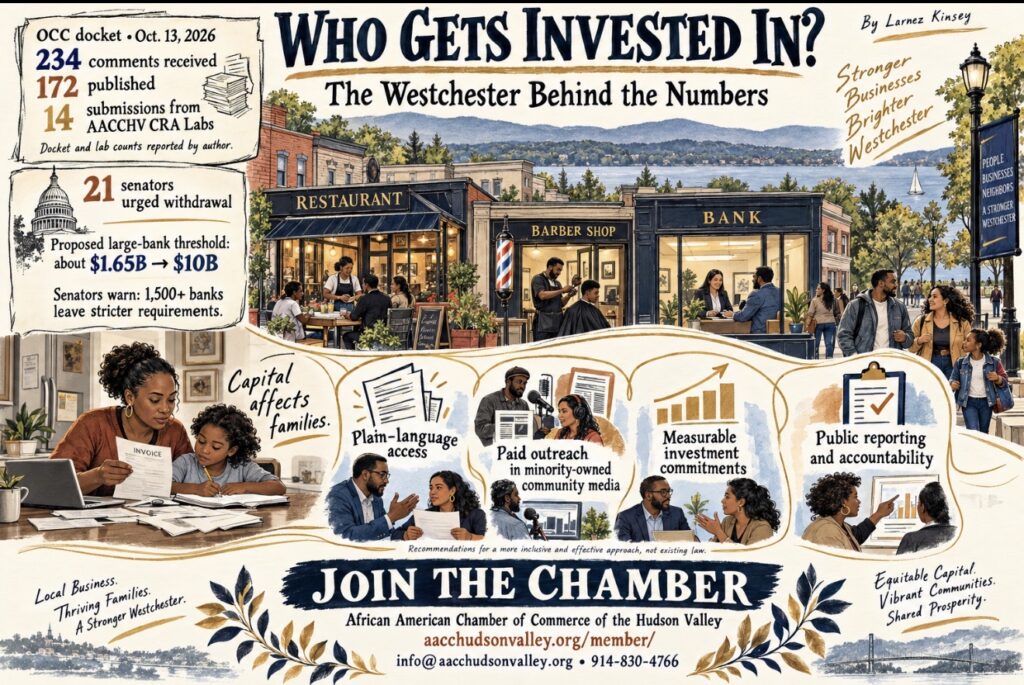




As of the morning of October 13, 2026, Regulations.gov showed 234 comments received and 172 published on the OCC’s proposed Community Reinvestment Act rule, according to the docket figures reviewed by the author. The African American Chamber of Commerce of the Hudson Valley reports that its CRA Comment Labs generated 14 of those submissions. These are comment counts, rather than necessarily distinct individuals, and represent a snapshot while the comment period remained open. Readers can follow OCC Docket OCC-2026-0694.
On October 9, Senator Elizabeth Warren and twenty Senate colleagues, including New York Senator Kirsten Gillibrand, urged the Office of the Comptroller of the Currency and the Federal Deposit Insurance Corporation to withdraw the proposal. According to the senators, raising the large-bank asset threshold from approximately $1.65 billion to $10 billion would remove more than 1,500 banks, representing 36 percent of banks nationwide, from more rigorous CRA examination, reporting, and community development requirements. Their analysis appears in the Senate Banking Committee’s official release and linked letter.
Those institutions would move out of stricter requirements, rather than all becoming entirely exempt from the CRA. The concern is whether communities would retain enough information and oversight to assess how banks serve them.
Comments are due October 13, 2026, under the official proposed rule. The OCC describes the CRA as encouraging covered banks to help meet their communities’ credit needs, including those of low- and moderate-income neighborhoods, consistent with safe and sound banking.
Here in Westchester, our Chamber’s needs assessment revealed a gap between concern and confidence. Fourteen of fifteen registrants rated financial access at the highest level of importance. Twelve reported low confidence in understanding the CRA and the comment process. Of fourteen respondents to the prior-participation question, twelve had never submitted a federal public comment. These findings describe our respondents, not the county as a whole.
That distinction deserves care because Westchester is often spoken about as though one reputation explains everyone’s life. Say the county’s name and someone pictures a comfortable commute, a landscaped property, a household with room to absorb an unexpected expense. That picture leaves out the owner counting the day’s receipts before catching the bus home, the worker paying for childcare before taking an extra shift, and the family deciding which bill can wait until Friday.
We live in the same county. We do not all have the same financial cushion.
For an entrepreneur in Yonkers or Mount Vernon, a lending decision can enter the most private part of the household. Imagine the kitchen table after closing: invoices beside a child’s homework, a calculator within reach, dinner reheated for the second time. The business needs equipment. Payroll is approaching. The owner is trying to protect both the work they have built and the people who depend on it.
A delayed answer has a cost, even before anyone says no.
Businesses owned by people from minority or marginalized communities also hold pieces of Westchester’s everyday culture. A restaurant carries a family’s recipes into another generation. A salon becomes a place where someone learns about an apartment, a job opening, or a reliable childcare provider. In a barbershop, a young person may hear an adult ask about school and stay long enough to listen to the answer.
These relationships develop through years of attention. When an owner seeks financing, the institution across the desk should take that person’s needs seriously.

Chamber President Tamika Cunningham and I co-created our CRA Comment Labs through my work with BlackGate Consulting Group LLC to help residents bring those experiences into federal rulemaking. Our structured worksheet separated personal accounts, verifiable facts, and recommendations. It gave participants a way to explain a problem and propose a change in language they could stand behind.
At the September 24 session, Greenburgh Councilwoman Gina Jackson joined a discussion about banking relationships and researching institutions that serve underserved communities. Participants explored how knowing whom to ask can influence whether an entrepreneur receives useful guidance.
That raises a question banks should be prepared to answer: how do you serve the person who walks in without an introduction?
An applicant should be able to find understandable requirements, receive meaningful follow-up, and learn whether a different financing option might fit. The first conversation matters. So does what happens after someone leaves the branch and waits for the promised call.
The Chamber’s prepared comment asks the OCC and FDIC to make participation accessible, establish measurable investment commitments, assess eligible partnerships through their outcomes, and preserve public reporting.
We also call for banks to dedicate meaningful paid advertising resources to newspapers and community media owned by people from minority or marginalized communities.
Local media help Westchester recognize itself. They cover the school board meeting after a long workday, the neighborhood business celebrating its first year, the scholarship recipient whose family fills a row of chairs, and the residents asking why a decision was made without them. Their value comes from sustained attention to people and places.
Banks seeking those audiences should pay for that reach. Financial advertisements should explain eligibility, required documents, deadlines, and a direct contact for assistance. A reader checking the news between work and school pickup should leave with something they can act on.
Outreach spending should be reported alongside lending and community development results. Investment commitments need funding amounts, intended beneficiaries, timelines, and an explanation of how shortfalls will be addressed.
Eligible partnerships with Community Development Financial Institutions and community organizations should show whether referrals lead to financing and sustained assistance. The people helping residents navigate those pathways should have an opportunity to explain where they work and where they fail.
The senators’ request for withdrawal and the Chamber’s recommendations are distinct responses to the proposal. Our position centers on residents’ ability to participate, understand what institutions promise, and assess what they deliver.
That work belongs to a larger responsibility: helping the businesses and households within this county’s celebrated prosperity gain a fair opportunity to build stability of their own.
If you own a business, lead an organization, or want to strengthen economic opportunity across the Hudson Valley, join the African American Chamber of Commerce of the Hudson Valley. Visit our membership page, email info@aacchudsonvalley.org, or call 914-830-4766 to learn about joining.
Bring your questions, your experience, and your stake in this community. Westchester’s future is being shaped in decisions large and small. The people opening the shops, raising the children, and keeping the neighborhoods connected deserve a voice in where the investment goes.
National policy facts are supported by official sources. The docket counts and lab submissions reflect your update.