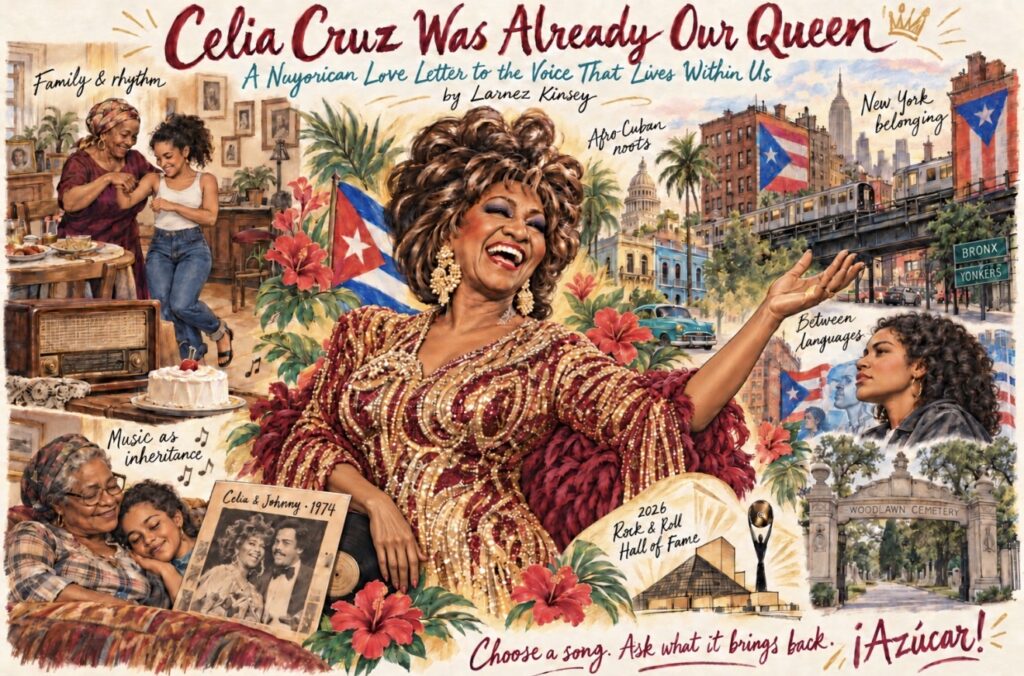




As a proud Nuyorican, I hear Celia Cruz and feel something settle into place. Her voice reaches the part of me that lives between languages, that understands how New York can be home while Puerto Rico remains an intimate part of who I am. Before I have considered the lyrics, the rhythm has my attention. Then she enters, unmistakable.
Picture a family gathering when the right song comes on. A chair scrapes against the floor. Someone puts down a plate. An elder takes a younger person’s hand, correcting the steps with a gentle pull and a look that says, follow me. The children see a different version of the adults they know. The person who is always working, cooking, or worrying becomes the person who knows how to dance. That transformation is part of what we pass down.
Celia Cruz’s inclusion in the Rock & Roll Hall of Fame’s Class of 2026 gives public recognition to an influence already woven into countless lives. The Hall honors her in its Musical Influence category. For listeners who have long loved her, the announcement invites us to consider how much a family playlist can teach before a museum puts a name on the wall. rockhall.com
Before the world knew the Queen of Salsa, Celia Cruz won her first radio singing contest and received a merengue cake as her prize. I love that detail. It brings the legend close enough to imagine as a young woman, still at the beginning, with a voice people wanted to hear. Between that modest reward and her international career were years of work that the grandeur of her image can make easy to overlook.
Celia was Cuban. Honoring her as a Nuyorican means respecting the history she carried while recognizing the place she holds in our cultural lives. New York brought Caribbean people into contact through neighborhoods, workplaces, bandstands, and dance floors. Those encounters made room for musical exchange across distinct identities. Her collaborations with Johnny Pacheco, including the landmark 1974 album Celia & Johnny and its recording of “Quimbara,” belong to that larger story of artists creating together. rockfall.com
Nuyorican identity holds its own complicated relationship to place. There is the Spanish you understand immediately but may hesitate to speak. The relative who hears New York in your pronunciation. The stranger who asks where you are really from after you have already answered. Belonging can become something other people expect you to prove. Music offers a less guarded space. You can enter through recognition, curiosity, movement, or affection.
That is where Celia reaches me. I can appreciate her voice without flattening the differences between her journey and mine. She gives me another Caribbean life to listen to closely, another way to understand what people preserve when they build a home somewhere new.
She left Cuba in 1960 and never returned. The Smithsonian’s account of her life places that separation at the heart of her story. Knowing it makes the brilliance of her performances more moving. A woman could carry the absence of home while giving audiences an extraordinary experience of joy. americanhistory.si.edu
I want us to hold both truths with care. Her exuberance should never become an excuse to suggest that grief is easy to overcome, or that people owe the world a smile through their suffering. The stage showed us what she created. It could not reveal everything she endured.
Her Blackness also demands our attention. Celia was an Afro-Cuban woman, and the African heritage within her artistry belongs in any honest account of her influence. The Smithsonian’s National Museum of African American History and Culture includes her in its exploration of Black Latin identity. Her legacy gives Nuyorican families an opportunity to examine how we speak about race among ourselves, including whose complexion we praise, whose features we criticize, and what children learn from those comments. nmaahc.si.edu
Celebrating her requires more than admiring the gowns. Still, I love the gowns. I love the towering wigs, the saturated color, the sheer scale of her presence. Watching her perform, I see a woman whose appearance and voice meet in a powerful expression of authority. She offers a particularly satisfying image for anyone who has been taught to make herself smaller before entering a room.
Here in Westchester, these questions of inheritance are close to home. A family’s move from the Bronx to Yonkers can change its address without changing the music played while dinner is being prepared. Children in New Rochelle or White Plains may know a song through a grandparent before they know the artist’s name. Culture continues through those ordinary encounters, but familiarity alone cannot preserve the whole story. Someone has to tell it.
Celia rests at Woodlawn Cemetery in the Bronx, near Westchester’s southern border. Woodlawn recognizes her as a notable figure in its Hispanic heritage programming. Her resting place offers a tangible connection to a woman whose recordings can otherwise make her seem larger than life and far away. woodlawn.org
We can use this moment of recognition to bring her history closer. Our libraries and schools can invite musicians to explain the rhythms, collaborations, and traditions behind the songs. Families can introduce young listeners to a full recording, then leave enough quiet afterward for a question or a memory—an elder’s account of where they first heard her may tell us something no award announcement can.
That is the tribute I want to offer as a Nuyorican: attention to the woman, respect for her Cuban roots, and a willingness to pass on more than the chorus.
Choose a Celia song. Sit with someone you love. Ask what it brings back, and let them take their time.
¡Azúcar!