




A psychiatrist and minister on why Black men carry their health alone, and the three questions that change it.
Patient stories are composites; identifying details have been changed.
Sunday morning service is in full swing. John is in his usual seat. Head bowed, eyes closed, hands raised, body swaying. He feels different this morning, less tense and less tight than he did at home. His blood pressure on waking was the usual, 167/98. And, as usual, he was dragging around, feeling anxious and downcast for no reason. But now in church, he feels much better, more alert, energized by the praise and worship. He senses that his prayer is finally being answered and that healing is happening for him. What the worshipper cannot see is the rest of it. John, a 45-year-old entrepreneur, has been putting off medication and following up with any provider for months, preferring to tough it out and trust that the Lord will heal his high blood pressure.
But when he got home that afternoon, he began feeling lousy again. Sad. Tired. Anxious. Withdrawn. His wife took his blood pressure: 164/97. When she asked him about getting help, he gave his usual answer. “I’ll think about it.”
John is by no means alone. In my practice, I see lots of Black men who fit this profile. They have a medical condition or a mental health issue that is inadequately addressed or treated. These men are not negligent or cavalier in my view. Quite the opposite. For the most part, they are acutely aware of their vulnerability but find it challenging to make sense of and override generations of social messaging, cultural conditioning, and historical mistreatment. It does not surprise me, as a Black male psychiatrist, ordained minister, and mental performance consultant to professional sports teams, that men like John choose self-protection and autonomy first, even when it potentially compromises their clinical care.
There is nothing inherently wrong with the choices these men make, and they are not making them alone. The systems around them shape the decision, too. I have spoken to plenty of men like John who lean on prayer the way they were taught to, in places of worship that were, for generations, the one place in their lives that never turned them away. That matters. A man does not choose faith over medicine in a vacuum. He chooses the institution that has always received him over the ones that have not. Others have told me of their disdain for mental health services after a negative therapy experience that had no cultural fit, or how they avoid medical care because of treatment atrocities and disparities, current and historical. And there is real value in the religious practice itself. A 2022 study published in the Journal of the American Heart Association found that Black Americans with higher levels of religious involvement tended to have better cardiovascular health behaviors, including diet, smoking, and blood pressure. Other research suggests that spiritual practice can also ease anxiety and depression, though that is a separate body of work from the heart findings.
So when men like John go with one of these systems, or none of them, here is what they may be leaving on the table.
What the church is doing for John
Faith is doing real work in that sanctuary, and I would never tell him otherwise. The music, the room full of people moving together, the permission to close his eyes and stop performing for a couple of hours, his body reads all of it. His shoulders come down. His breathing settles. The dread that trailed him out of the house in the morning loosens its grip. None of that is imaginary. Hope has a chemistry, and when a man believes healing is on the way, his body can begin behaving as though it is.
The trouble shows up later, in the parking lot, when the feeling becomes the whole plan. John walked out lighter, but the disease was still at work the whole time, his pressure still sitting at 164 over 97. The relief he felt was true, but so was the number. Nobody had ever shown him how to address both.
Getting a man to want care is half the work. The other half is whether the care is there when he turns to look for it.
I have seen faith carry men through diagnoses that no medicine could comfort, hold a man steady through a prognosis no prescription could soften, and give him a reason to keep showing up. I have also seen the same faith become the reason a man puts off the appointment that would have caught something while it was still small. It is the same asset working two very different ways, and what separates them is usually whether anyone ever gave the man permission to pray and follow up in the same week.
The story under the story
Beneath the faith, there is a quieter layer, and in my experience, it does more damage than it gets blamed for. It is the story a man tells himself about what his body is even capable of. Medicine has a clumsy pair of words for this: placebo and nocebo, the idea that belief alone can move real things like dopamine, pain, blood pressure, and immune responses. We like to talk about the hopeful direction, but I worry more about the other one. When a man has heard his whole life that stress is just part of being a Black man, and he repeats it often enough, it stops sounding like a complaint and starts working like an instruction. And the body, which has been listening for months and years, tends to oblige.
The athletes I work with taught me how literal this can be. Everything physical they do sits on top of a belief about who they are, and the body delivers, more often than not, what the identity expects of it. So when a man has spent forty-five years braced for endurance, with recovery never once offered to him as something he was allowed to expect, that bracing can become its own kind of ceiling. The shift I am after with men like John is small to say and enormous to live. It is moving from just getting ready for the next blow to genuinely expecting to get better.
Why the distrust makes sense
Then there is medicine, which John keeps at arm’s length, and his reasons are good. Tuskegee is not ancient history to a man whose grandfather was alive for it, and the distrust it seeded is not a relic either. Hard to imagine but Black patients are still undertreated for pain today and given less medication than white patients for the same injuries— a pattern researchers have traced in part to false beliefs about biological differences that some medical trainees still hold. So, when John thinks of the cousin who got waved out of an emergency room, or the one therapist he tried who had clearly never sat with anyone who looked like him, he is not reaching back into history but describing the present reality. The numbers support his instinct. Researchers estimate that only about one in four Black men seek treatment when they are dealing with anxiety or depression. His guardedness is earned.
The hard part is that the very thing protecting him, keeping the system at a distance, is also what keeps him from the version of that system that has finally learned to treat him well. Culturally competent, integrated care exists now, where a man can find it and afford it.
The men who need it most are often the last through its door.
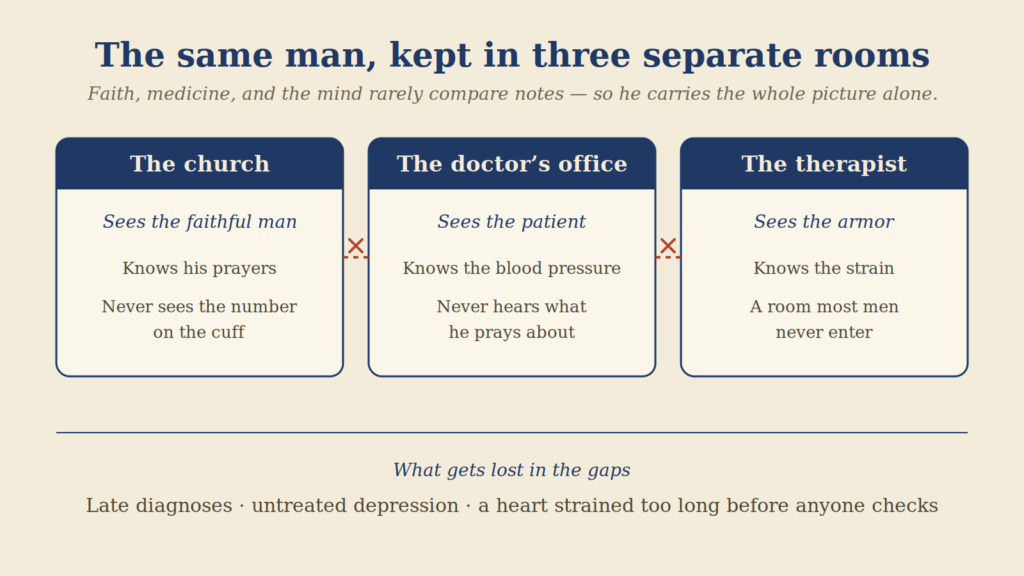
Three rooms that don’t talk
Here is the piece that troubles me most, because it is structural— and nobody built it on purpose. I like to call it the three rooms do not talk to each other. John’s pastor has no idea what his blood pressure is. His doctor has no idea what he prays about on Sunday. And the therapist, if he ever saw one, never met either of the other two. So John does what most of us do when the rooms are kept separate. He brings a different version of himself into each one: the faithful man on Sunday, the capable provider at work, the one who never lets a doctor see him sweat. We have a name for the figure he is performing. The Strong Black Man has saved a great many lives and quietly cost a great many, too.
The cost is rarely dramatic.
It looks like a diagnosis arriving a few years late, a depression nobody ever said out loud, a heart that had been working too hard for too long before anyone thought to check.
How it usually goes
The John I am describing is a composite, details changed and privacy protected, but the arc is one I have watched play out more times than I can count, and it tends to move in an order that surprises people.
Faith moved first. It did not move by getting smaller. It moved when a deacon John trusted, a man who had been through his own version of it, told him plainly that asking for help was one of the truest uses of his faith, never a betrayal of it. That gave John permission to be honest in his own body for the first time in years.
The mindset shifted next, and more slowly. We spent real time on the story he was telling himself. The day it cracked open was the day he stopped describing his blood pressure as a sentence he was serving and started calling it something that could change.
Medicine came last, which is almost always the order. By the time John let me reconnect him to his PCP, he had already done the harder work. The medication brought the pressure down. The harder thing, the low mood that had trailed him for years, eased more slowly, but it eased. What he noticed first was not the number on the cuff. It was that he had stopped bracing, that the mornings he used to dread were much lighter–and he liked that new feeling a lot.
When yes isn’t enough
I want to be honest about this—not every man who gets to yes finds a door. I have watched men do the hard inside work, decide they were ready to be helped, and then run into a six-month waitlist, a provider an hour and a half away, a practice that took everyone’s insurance but theirs. I have come to understand that wanting care is only half of it. Whether the care is actually there when a man turns to look for it is the other half, and for too many men it still is not.
Three questions to ask yourself
If you are a man reading this, or you love one, here are three questions. I would rather you sit with them than rush them.
The first is about your faith. What do I really believe is possible for my body? Not what I hope for out loud. What I expect when no one is listening.
The second is about our story. What am I telling myself about needing help, and where did I learn it? This one usually has a face attached, a father, a coach, a pulpit.
The last is the simplest but might be the hardest. When did I last let a professional help me at all, and what would it take to do it once more?
None of these are accusations. For a lot of Black men, asking them out loud is already an act of courage, because needing support is the one thing many of us were raised to treat as a liability. Myself included.
June is Men’s Health Month, which feels like the right time to say this plainly. The men I have watched get well did not out-hustle their conditions. They stopped keeping faith, mindset, and medicine in separate rooms. The faith gave them a reason to want to be here for it. The work on their own minds turned that wanting into something they expected. And medicine, once they let it in, gave the expectation something to stand on. Pull any one of the three, and the other two start to wobble.
None of this is as simple as deciding to. So if you are a man who gets to yes and does not know where to turn, one place to start is findahealthcenter.hrsa.gov, which lists community health centers that serve patients regardless of ability to pay. It is a door. The rest of the work, building enough of these doors that no man has to drive ninety minutes to one, belongs to all of us. I have seen it happen. Black men everywhere deserve all three, and they deserve to stop being asked to choose. What John noticed first was that he had set the weight down. That is the plain, unfamiliar relief I want for every man still carrying it: the chance to do the same.

Derek H. Suite, M.D., is a board-certified psychiatrist who specializes in sports psychiatry and consults with major sports franchises in basketball, football, hockey, and soccer. Dr. Suite is the founder of Full Circle Health, host of The SuiteSpot podcast, and is currently at work on a book titled Sleep as Performance Medicine. His clinical work integrates mindfulness, sleep medicine, and performance psychiatry.
Dr. Suite is a regular contributor to Black Westchester Magazine.