



If you want honesty? This wasn’t a “nice youth arts event.”
This was a room full of young people refusing to be underestimated, in real time, under pressure, with receipts.
On Monday, May 4th, 2026, inside the Apollo Theater, the stage didn’t feel historic because of who had stood there before.
It felt historic because of who was standing there now.
The Lie We Tell About Youth
There’s this narrative adults love to run:
“That young people are the future.”
And it sounds supportive, but if we’re being real? It’s also dismissive. Because it quietly suggests: you’re not fully formed yet…you’re not ready yet…you matter later.
But what I witnessed that night?
Was a room full of young people saying without asking permission:
“We are not in rehearsal for our lives.”
The Details Don’t Lie
You can always tell when something is real by the details.
Not the big applause moments, the in-between ones.
Like when Isaiah Hyde stepped into his monologue, “Happier” and somewhere in the middle of it, he paused.
Not a forgotten-line pause.
Not a nervous stumble.
A choice.
He looked out into the audience, really looked, and for a split second, it felt like the room exhaled with him. And then he continued, not louder, not more dramatic, just truer.
That’s the moment everything clicked.
This wasn’t performance.
This was ownership.
Or the performer who let a line sit, didn’t rush it, didn’t chase the next beat. Just let it land, heavy, honest. And the audience didn’t clap right away because we were too busy processing what had just been handed to us.
That’s not beginner work.
That’s presence.
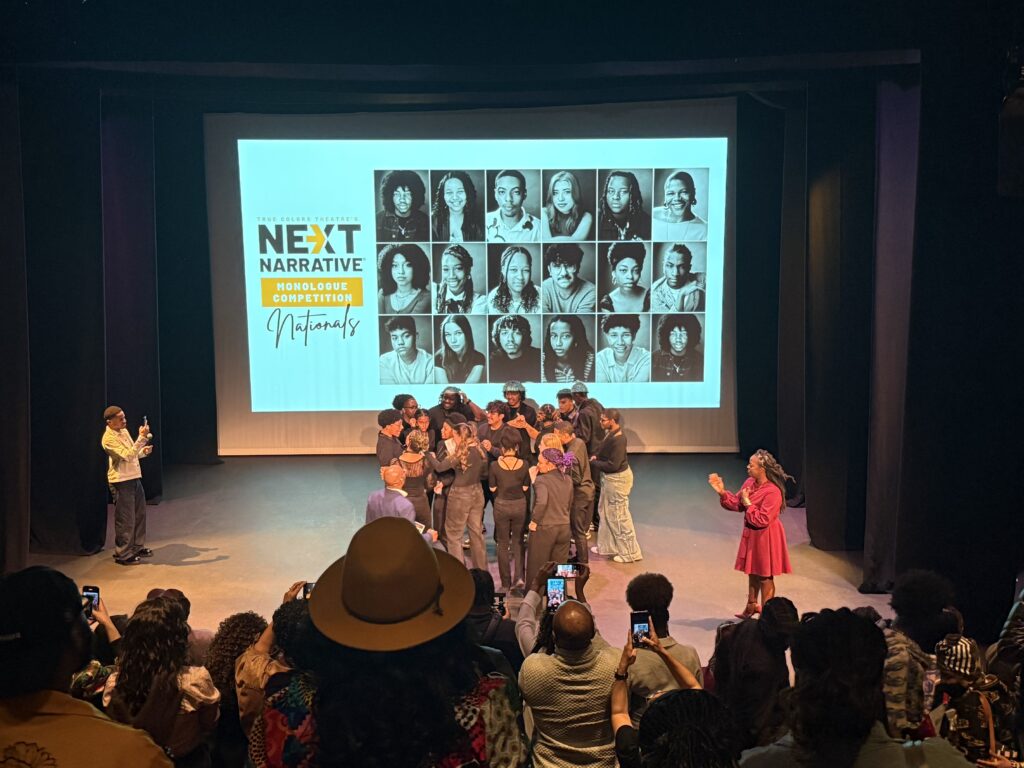
Inside the Night: The Program That Held the Room
Because what made the night land wasn’t just the performances, it was the intention behind every moment.
From the very beginning, the evening was anchored by voices guiding the experience:
- Welcoming Remarks — Jamil Jude
- Introduction of Sponsors — Chandra Stephens-Albright
- Introduction of Judges / Co-Host — Justen Ross
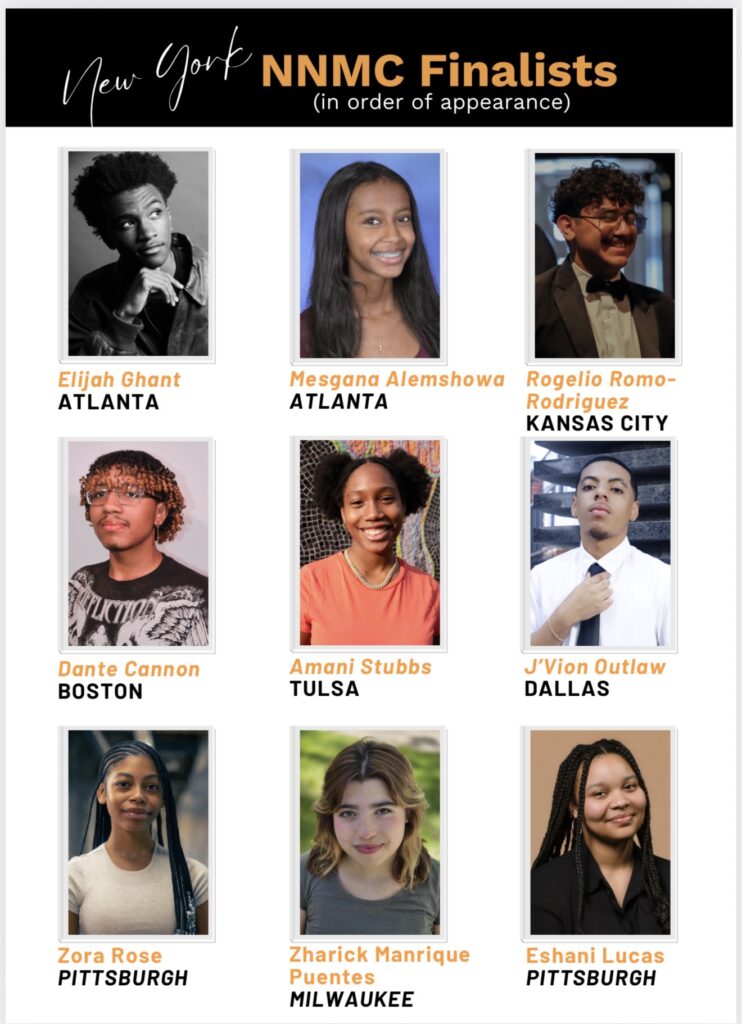
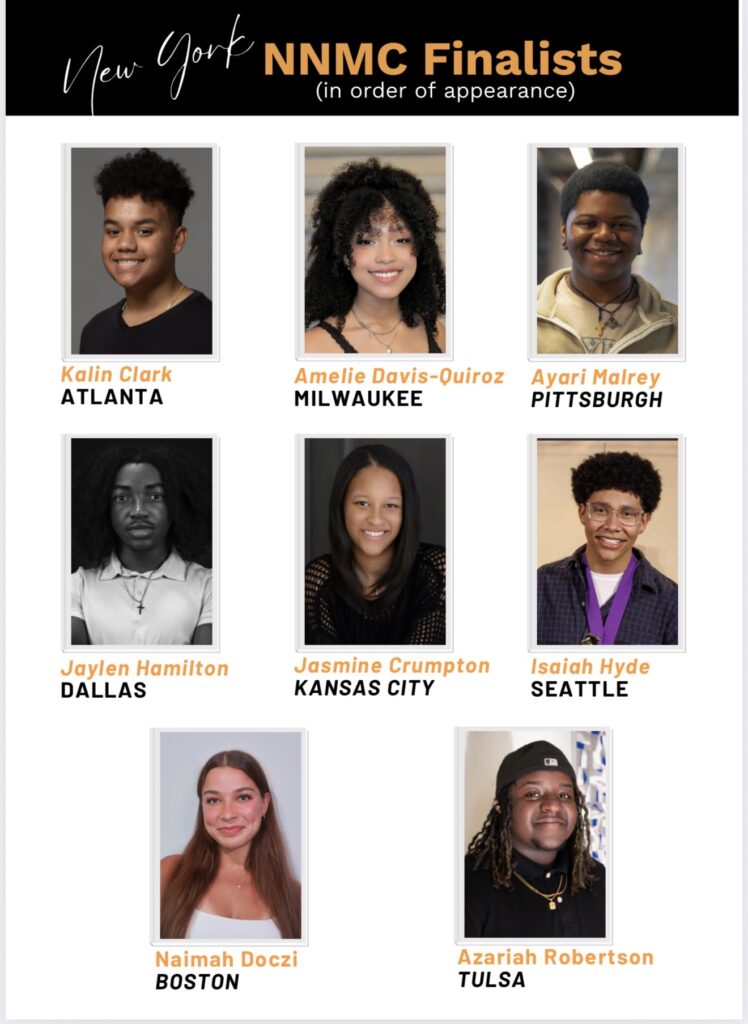
And then, one by one, the finalists stepped into the light:
National Finalists & Performances
- Elijah Ghant — “Icons of Black History Want Snacks” by Idris Goodwin
- Mesgana Alemshowa — “I Don’t Want to Be Another First Story” by Alayna Jacqueline
- Rogelio Romo-Rodriguez — “Broken Apology” by K.W. Jackson
- Dante Cannon — “Happier” by Rachel Lynett
- Amani Stubbs — “Boys Will Be Boys” by Nubia Monks
- J’Vion Outlaw — “The Hunt” by Star Finch
- Zora Rose — “Sparking Joy” by Francisca Da Silveira
- Zharick Manrique Puentes — “I Want You to Know” by Alayna Jacqueline
- Eshani Lucas — “The Recurring Dream, or Small Baby Hands” by Psalmayene 24
- Kalin Clark — “Chuck” by Jonathan Norton
- Amelie Davis-Quiroz — “Daddy’s Blues” by Parker
- Ayari Malrey — “Queer Black Creative License” by Nick Hadikwa Mwaluko
- Jaylen Hamilton — “Not Supposed To” by Donnetta Lavinia Grays
- Jasmine Crumpton — “I Want You to Know” by Alayna Jacqueline
- Isaiah Hyde — “Happier” by Rachel Lynett
- Naimah Doczi — “What’s Left” by Imani Vaughn-Jones
- Azariah Robertson — “I’m Magic Man” by Josh Wilder
Alumni Performances
Khylee McBryde
Ndeye Niang
Tyrik Iman-Washington Jr.
Benne’ McCants
Seine Young
Closing Moment
Presentation of Winners
And behind every name on that list was a moment the room won’t forget.
They Are Fluent in Complexity
Let’s talk about what these young people are carrying.
Because the material? It’s not light.
Identity.
Queerness.
Mental health.
Family expectations.
Cultural pride.
The quiet, constant negotiation of existing in systems that weren’t built with you in mind.
And here’s what stood out:
They didn’t flatten those experiences into something digestible.
They let them be messy.
One moment you’re laughing, like real laughter, the kind that catches you off guard and then two seconds later you’re like, “Oh…that’s not funny. That’s real.”
This generation understands something a lot of people older than them are still avoiding:
Two things can be true at once.
The Courage Was the Headliner
Yes, the technique was there. Absolutely.
But technique isn’t what made the room lean forward.
It was courage.
Because it takes something to stand on a stage like the Apollo and say:
- “This is how I feel.”
- “This is what I’ve experienced.”
- “This is who I am becoming.”
Without softening it.
Without translating it for comfort.
Without asking, “Is this okay to say?”
And what made it even more powerful?
They weren’t doing it alone.
Community Was the Real Win
You could feel it, backstage, in the audience, in the way they watched each other.
No weird competitive energy. No silent comparison.
Just:
- “You got this.”
- “I see you.”
- “We’re all up here together.”
That kind of support doesn’t just make better performers.
It makes healthier artists.
And let’s be clear, we need more of those.
The Apollo Didn’t Make Them, They Met It
People love to talk about the Apollo like it’s the thing that validates you.
But here’s what I saw:
These young people didn’t shrink to meet the legacy.
They matched it.
And in some moments? They expanded it.
Because legacy isn’t something you protect by keeping it frozen.
It’s something you honor by letting it evolve.
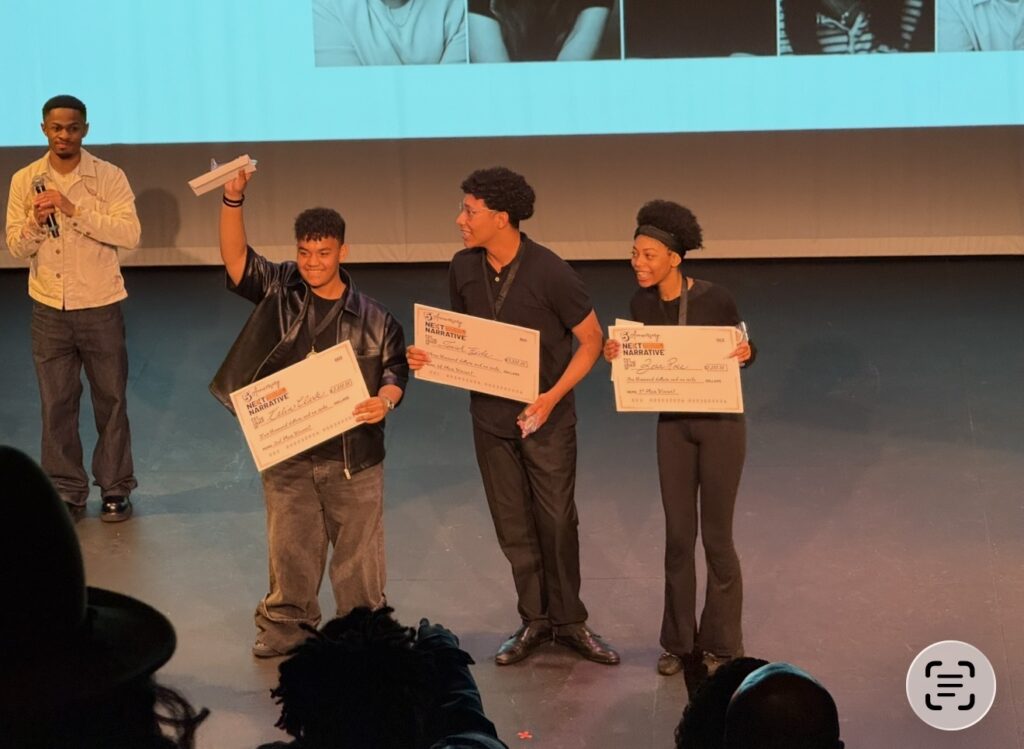
About Those Winners…
Third place: Zora Rose
Second place: Kalin Clark
First place: Isaiah Hyde
And yes, celebrate them. That matters.
But if all you take away from this night is who placed, you missed it.
Because what actually happened is this:
A group of young people walked onto that stage as participants…
and walked off as people who now understand the power of their own voice.
Isaiah Hyde’s win felt earned. Grounded. And if that moment in his performance was any indication, it’s only the beginning.
But so did everyone else’s moment.
Because not everybody gets a trophy, but everybody got transformed.
Watch It, But Don’t Just Consume It
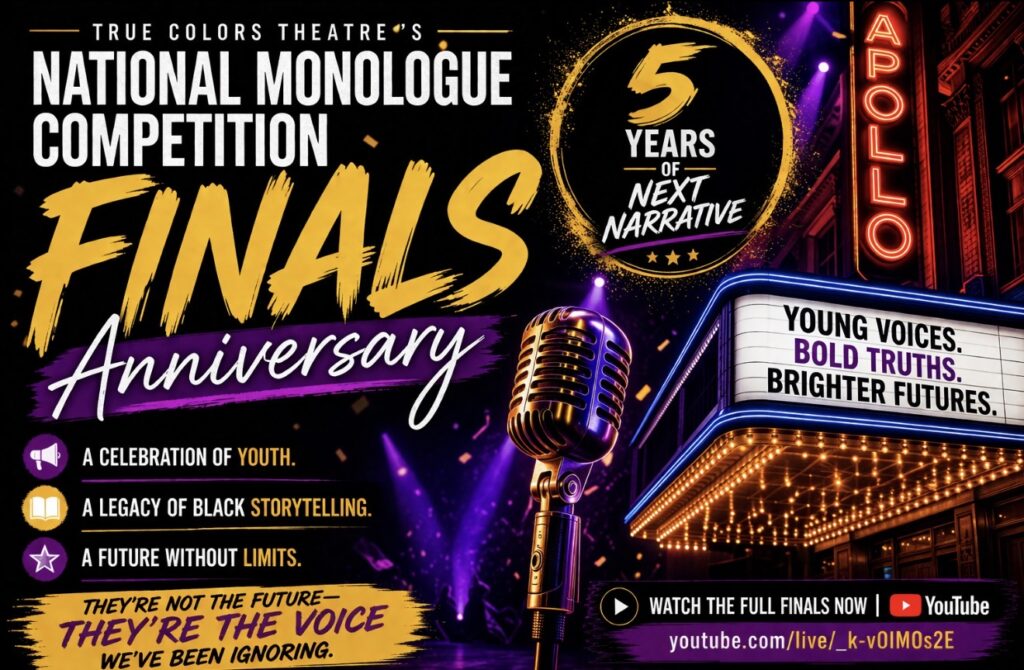
You can watch the full National Finals here:
And you should.
But don’t treat it like background noise.
Watch how they pause.
Watch how they listen to each other.
Watch the moments where they choose honesty over perfection.
Because that’s the part people can’t teach.
What This Night Actually Proved
We don’t have a “youth problem.”
We have an adult listening problem.
Because these young people are already:
- thinking deeply
- feeling fully
- questioning systems
- creating meaning
And when you give them the tools and more importantly, the space, they don’t just rise to the occasion.
They redefine it.
So no, this wasn’t about “the next generation.”
This was about right now.
And if we’re smart?
We’ll stop asking them to wait and start catching up.









I love it Larnez, now I will watch the video to capture the present leaders speak to us so we can hear.
I really appreciate you Johnathan, for taking the time to sit with it like that. There’s something special about actually hearing people speak in real time, it brings a kind of closeness and clarity that words alone can’t always carry. And the youth involved were amazing, there’s a real energy and sincerity there that stayed with me. Grateful you’re engaging with it so thoughtfully, truly.
Simply put: this year’s Monologue was EPIC!
The participants were focused and it was difficult to choose.
Larnez, you captured and positively exposed each moment so vividly- even the blind could see it!
I relieved the evening through your article! This is your calling! I loved every line! Lois!
Lois, thank you so much for this beautiful message. Your words truly mean a lot to me. It was an honor to capture such a powerful evening filled with so much talent, passion, and purpose. I’m grateful the article allowed you to relive those moments all over again. Comments like yours remind me why I love telling these stories. Deeply appreciated! ❤️