



The recent Westchester County budget tells a story far more honest than the slogans that dominate New York politics. While some lawmakers in Albany—most notably Assemblyman Zohran Mamdani—continue to push a Democratic-Socialist agenda built on ever-expanding government, Westchester has been forced into a different conversation: reality.
Under this year’s $2.5 billion budget, nearly every county department absorbed an eight-percent cut. Roughly 180 positions were eliminated through attrition, and a hard hiring freeze was imposed. Even with these reductions, the County Executive still had to raise the property-tax levy by 3.7 percent—down from an originally proposed 5.27 percent. These are not the actions of a government pursuing ideological expansion. They are the actions of a government trying to keep the books balanced while the economy tightens and federal support shrinks.
Thomas Sowell famously reminded us that “there are no solutions—only trade-offs.” Westchester’s budget reflects that truth. County officials did not stand at a podium calling for “free everything” or promising the illusion of unlimited public services without consequence. Instead, they confronted what every household and every business already understands: when revenues fall, and costs rise, you must adjust your spending. You cut where you can. You preserve what is essential. And you resist the temptation to pretend fiscal gravity doesn’t apply to you.
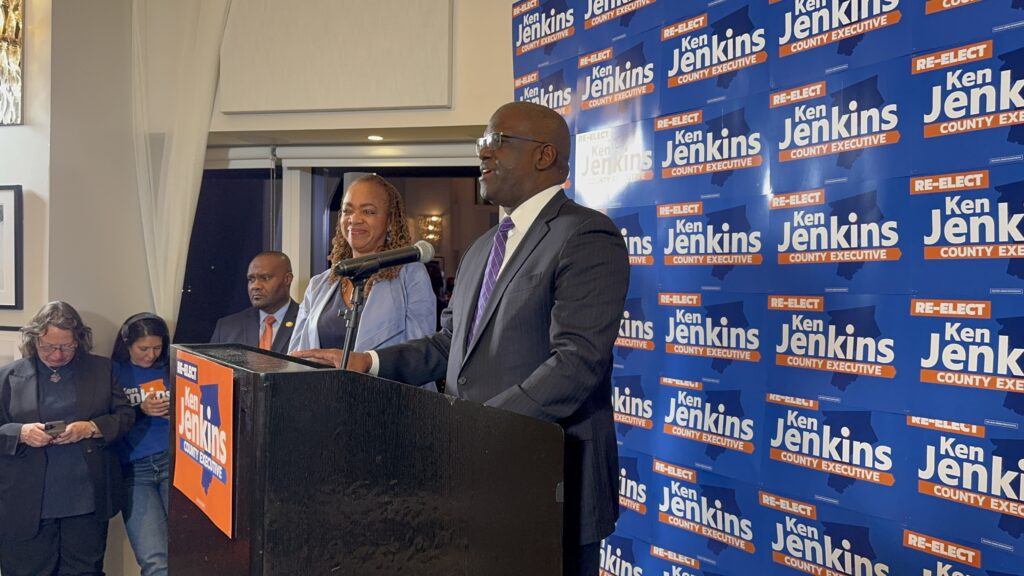
Ken Jenkins’ victory speech made one thing unmistakably clear: leadership is not performance — it is stewardship. When he reminded Westchester that “competent, stable leadership beats chaos and drama every time,” he wasn’t offering a slogan; he was acknowledging the reality of the budget he must now execute. An eight-percent reduction across departments, 180 positions eliminated through attrition, a hiring freeze, and a disciplined 3.7 percent tax levy increase are not the talking points of a politician seeking applause — they are the trade-offs of a leader who understands that governing means making decisions grounded in arithmetic, not ideology. His speech echoed the very structure of the budget: sober, steady, responsible. Where others promise transformation through sweeping rhetoric or redistribution, Jenkins laid out a path rooted in fiscal discipline and institutional stability. His words matched his work. At a time when New York is filled with movement candidates who speak in poetry and govern in slogans, Jenkins is signaling that Westchester will be governed by the math — not the microphone.
Albany offers the clearest example of what happens when political fantasy outruns fiscal restraint. While Westchester is tightening its belt, Albany continues to expand spending even as revenues weaken, businesses close, and residents flee the state. The Legislature has adopted policies that drive up labor costs, restrict police authority, inflate entitlement spending, and treat the taxpayer as an endlessly refillable well. The result is a multibillion-dollar structural deficit, rising debt service, and an economic climate so unstable that even long-standing New York companies are relocating. Albany’s approach mirrors the ideological playbook of its Democratic-Socialist wing: promise more, produce less, and blame external forces when the math no longer works. Westchester, by contrast, is behaving like a county that understands something Albany refuses to confront — arithmetic is not partisan, and outcomes do not bend to political slogans.
Contrast that with the Democratic-Socialist worldview, where the answer to every problem is more government staff, more government programs, and more government spending—funded by higher taxes on the same shrinking tax base. Mamdani and his allies offer sweeping visions of expanded social services, regardless of cost. But visions do not pay bills. Growth in government payrolls does not drive economic growth. And raising taxes in a region already experiencing out-migration does not increase the number of people available to pay them.
What we see in Westchester is not conservatism in a partisan sense—this is economic realism. The county’s approach recognizes that incentives matter, taxpayers respond to burdens, and businesses relocate when operating costs rise beyond reason. Those aren’t ideologies; they are patterns of behavior so consistent that they border on economic law.
The county’s 3.7 percent property-tax increase is already a meaningful adjustment for residents across Westchester, but its effect becomes far more severe in Mount Vernon. Unlike wealthier municipalities with stronger commercial tax bases, Mount Vernon depends heavily on homeowners to fund essential services. When the county raises taxes at the same time the city prepares a 5 percent increase of its own, residents are hit twice in the same fiscal year. Their incomes don’t rise, their services don’t dramatically expand — but their cost of staying in their homes grows significantly. What appears to be a manageable county levy adjustment becomes a compounded burden for families already navigating some of the highest effective tax rates in the region.
But it’s also important to be clear: this is not the county’s fault. Fiscal stress in Mount Vernon is the product of choices made at City Hall, not at the county level. Westchester County has bailed the city out numerous times — most notably with the $10 million allocated for Memorial Field, a project that administration after administration in Mount Vernon failed to complete. The county was eventually forced to take over the entire redevelopment and invest an additional $10 million of county taxpayers’ money just to deliver what the city had promised for more than a decade. So while the combined tax increases hit Mount Vernon residents hardest, the structural problem lies in chronic local mismanagement. The county can absorb eight-percent departmental cuts; many Mount Vernon residents cannot absorb near-double property-tax pressures — especially when past city leadership has repeatedly wasted opportunities for fiscal stability and responsible growth.
Policymakers who ignore these patterns—no matter how noble their intentions—produce predictable outcomes: declining tax bases, rising deficits, and shrinking opportunity. You can see versions of this in parts of New York City that embraced the very policies Mamdani champions. The results have been budget gaps, weakened public safety, deteriorating services, and a political culture more comfortable blaming external villains than correcting internal failures.
Westchester’s budget is a quiet rejection of that mindset. It says, “We cannot spend our way into prosperity.” We cannot tax our way into affordability. And we cannot build a stronger country by refusing to confront fiscal limits.
This is not a radical insight. It is simply an acknowledgment of what Westchester reader must understand: outcomes matter more than intentions. Budgets are moral documents not because they signal virtue, but because they reveal discipline—or lack of it.
This time, like it or not, Westchester chose discipline. Albany still chooses illusion. And the difference between the two will show up not in soundbites, but in the lived reality of the people who call this state home.