




Brandon Tatum’s declaration that he is a “proud Christian Zionist” is not simply a disagreement over doctrine. It is a collision of incompatible ideas — ideas that cannot be reconciled through enthusiasm, wordplay, or social-media branding. The contradiction is not emotional; it is structural. It exists at the level of Scripture, at the level of history, and at the level of incentives.
Brandon Tatum is one of the most visible Black conservative influencers in the country — a former police officer turned commentator whose platform reaches millions. That is precisely what makes his public embrace of Christian Zionism so dangerous. When a figure with his reach begins echoing talking points that conflict with both Scripture and Black historical reality, it creates a blueprint for younger, impressionable followers to imitate. Too many Black influencers with large platforms have begun shaping their content around external political incentives rather than grounded truth or genuine conviction. The result is a kind of performative loyalty that serves outside interests while undermining the very communities they claim to represent. Tatum’s posture is not just his own contradiction — it reflects a larger pattern of Black voices being redirected away from their own heritage, history, and moral clarity in order to validate someone else’s agenda.
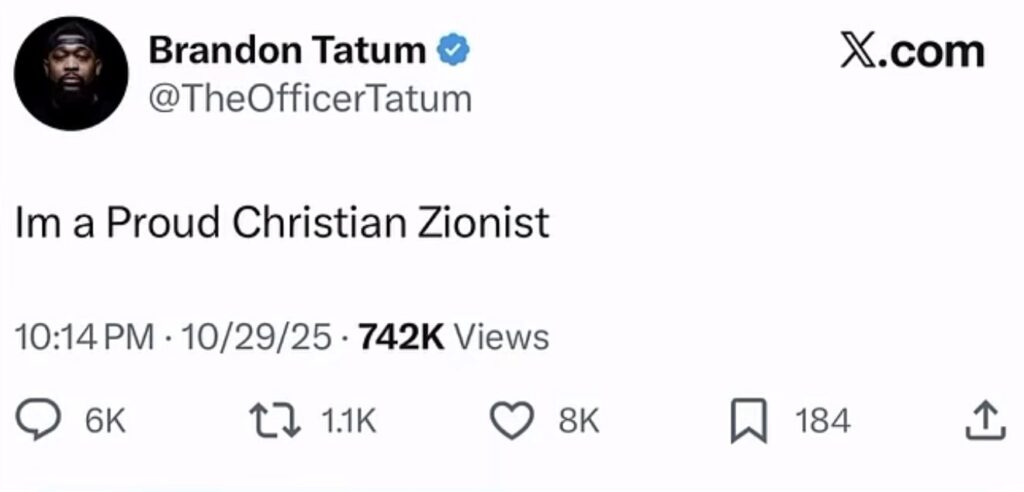
Zionism and Christianity do not serve the same purpose. Christianity asserts that Christ fulfills the covenant and becomes the foundation for salvation, unity, and moral judgment. Zionism, on the other hand, is a twentieth-century nationalist ideology built around the political goals of a modern state. One calls for allegiance to Christ; the other, to a government. Treating these as mutually reinforcing is not faith — it is confusion.
Christianity asserts that Christ fulfills the covenant, which should inspire the audience to reflect critically on Zionist claims. Zionism, by assigning divine status to a nation, creates a contradiction that challenges the integrity of political and theological narratives.
The contradiction continues with ethics. In the biblical tradition, ancient Israel was judged frequently and severely for injustice. Christ confronted corruption wherever it appeared. Yet modern Christian Zionism demands unconditional defense of the State of Israel, regardless of its actions. A Christian cannot claim moral clarity while granting political immunity to any nation. The moment you create an exception, you step outside the model Christ provided.
For a Black man, the conflict is even deeper. Christian Zionism in the United States rests heavily on a Eurocentric reconstruction of Scripture that stripped Africa of its rightful place in biblical history. Archaeology, geography, and anthropology all point to the early Israelites emerging from an Afro-Asiatic world. Yet Zionist-aligned theology rewrote the story in European terms. A Black man endorsing that framework endorses the erasure of people who look like him from the biblical narrative.
Selective justice adds yet another contradiction. Black Americans understand, better than most, what happens when one group receives moral exemptions while others receive moral scrutiny. Yet Christian Zionism demands that very exemption for Israel. Tatum holds no such standard for any other nation, including African countries or the United States. Christ preached universal justice; selective morality belongs to politics.
There is also the undeniable reality that the Zionist political movement openly supports — and often rationalizes — the ongoing killing of Palestinians, who are the indigenous descendants of the region Christ lived in. These are not distant outsiders. Genetically, culturally, and geographically, they are closer to the historical Jesus than any modern Western population. Supporting or excusing their suffering while claiming fidelity to Christ creates a contradiction that no theological creativity can resolve. One cannot follow Christ while endorsing harm toward the people most directly tied to His own earthly lineage.
The incentive structure behind Tatum’s public loyalty only further clarifies the situation. His declaration resembles the well-known performance of ideological allegiance often used to signal usefulness to Zionist-aligned donors and political networks. To be clear, there is no confirmed evidence that Tatum personally receives such payments. But his public posture fits the observable pattern. And the pattern itself is not in dispute. Influencers across multiple political spheres openly acknowledge that pro-Zionist funders — particularly those connected to Netanyahu’s orbit — routinely pay as much as $7,000 per post for messaging that supports their narrative. When the reward for expressing a particular viewpoint increases, the supply of that viewpoint rises with it. This is how markets work. But economic incentives do not turn contradictions into doctrines, nor do they transform political allegiance into theological fact.
Understanding the historical context should foster awareness of how Christian Zionism has historically diverted Black political energy. Recognizing this helps the audience feel responsible for supporting narratives that align with genuine liberation and justice.
At the bottom, the conflict Tatum presents is unavoidable. Christianity requires moral universality. Zionism requires moral exception. Christianity affirms that Christ is the fulfillment of the covenant. Zionism elevates a modern state into that position. Christianity recognizes Africa’s central place in biblical origins. Zionist theology historically erased it. Christianity demands care for the oppressed. Zionism demands silence when the oppressed are Palestinians.
You can choose Christ.
You can choose Zionism.
But you cannot logically choose both.
No social media declarations, no performance of loyalty, and no financial incentives can make incompatible ideas coexist.
And when a Black man attempts to merge them, he does not reconcile anything — he reveals which authority he is actually following.
REFERENCES TO SUPPORT THE STATEMENTS
1. Christ Fulfilled the Covenant (No Modern Nation Holds Divine Status)
Biblical References:
- Hebrews 8:6–13 — Christ establishes a “better covenant,” rendering the old one obsolete.
- 1 Peter 2:9 — The Church, not a state, is called the “holy nation.”
- Galatians 3:16 — The promise was to Christ, not a geopolitical entity.
- John 18:36 — Jesus declares His Kingdom “is not of this world.”
These passages show no modern nation — including Israel — carries divine mandate in the New Testament era.
2. Zionism Is a Secular Political Movement, Not a Religious One
Historical References:
- Theodor Herzl, The Jewish State (1896) — Herzl’s vision was political, not religious.
- Max Nordau, Zionist Congress speeches — also emphasized nationalism over theology.
- Benny Morris, Righteous Victims — outlines Zionism as a secular nationalist project.
- Encyclopedia Britannica (Zionism entry) — cites the movement as secular and nationalist, not spiritual.
Nearly all early Zionist architects were secular Europeans, many openly rejecting religious Judaism.
3. Afro-Asiatic Identity of the Biblical World
Academic References:
- William Dever, Who Were the Early Israelites and Where Did They Come From?
- Israel Finkelstein & Neil Asher Silberman, The Bible Unearthed
- Roland de Vaux, Ancient Israel
- Edward Lipiński, Semitic Languages and the Afro-Asiatic Family
- Oxford Ancient Near East Studies — cultural and linguistic ties between Africa and Semitic peoples.
These works confirm the biblical world was Afro-Asiatic, not European.
4. Palestinians as Indigenous Descendants of the Region Christ Lived In
Historical & Anthropological Sources:
- Ilan Pappé, The Modern History of Palestine
- Rashid Khalidi, Palestinian Identity
- Genetic studies published in the American Journal of Human Genetics showing continuity of Levantine populations.
- DNA research (Haber et al., 2017) — Palestinians share direct genetic continuity with ancient Levantines.
This establishes that Palestinians are the indigenous population most directly connected to 1st-century Judea and Galilee.
5. Killing of Palestinians and International Documentation of the Conflict
Human Rights Documentation:
- Human Rights Watch, A Threshold Crossed (2021)
- Amnesty International, Israel’s Apartheid Against Palestinians (2022)
- UN OCHA Reports on Gaza and the West Bank (UN Office for the Coordination of Humanitarian Affairs)
These reports document large-scale killings, displacement, and civilian harm.
6. Christian Zionism Demanding Moral Exemption for Israel
Theological References:
- Stephen Sizer, Christian Zionism: Roadmap to Armageddon?
- Gary Burge, Whose Land? Whose Promise?
- Don Wagner, Anxious for Armageddon
These authors show how Christian Zionism shifts moral evaluation from Christ’s standards to political allegiance.
7. Influencers Being Paid for Pro-Zionist Messaging
Publicly Documented Reports:
- The New York Times (David Halbfinger, 2019) — On Israel’s global influencer strategy.
- Haaretz (2023) — Reports on paid digital advocacy networks linked to Netanyahu’s political machine.
- Forbes & Business Insider articles on political influencer markets — documenting payments ranging from $2k–$10k per sponsored political post.
- Public statements from creators on social media explaining rates for political content funded by pro-Israel groups.
We clearly state we do not know whether Tatum receives money — only that the behavior matches the incentive pattern.
8. Christian Zionism Being Used Historically to Undermine Black Liberation Theology and Politics
Scholarly References:
- Edward J. Blum & Paul Harvey, The Color of Christ
- Gerald Horne, The End of Empires
- James Cone, Black Theology and Black Power (critiques imperialist readings of Scripture)
- Walter Brueggemann, Chosen? Reading the Bible Amid the Israeli-Palestinian Conflict
- Articles in the Journal of Africana Religions on U.S. evangelical foreign-policy alignment.
These works show how Christian Zionism was used to redirect Black religious and political energy away from liberation movements.













You’re so awesome! I don’t believe I have read a single thing like that before. So great to find someone with some original thoughts on this topic. Really.. thank you for starting this up. This website is something that is needed on the internet, someone with a little originality!
I truly appreciate your technique of writing a blog. I added it to my bookmark site list and will
This is my first time pay a quick visit at here and i am really happy to read everthing at one place