



In a healthy democracy, the press is supposed to hold the powerful accountable — not protect them. The goal of a newspaper, whether local or national, is to tell the truth as it is, not as we wish it to be. That means reporting facts, even when they make people uncomfortable.
As a Black newspaper, Black Westchester Magazine has a duty to hold our elected officials to the same standards that we hold white officials. Integrity does not change based on race or party. But because we do that, we get attacked from both sides — called “conservative” by white readers and labeled “coons” or “sellouts” by some in our own community. That’s fine, because our integrity goes farther than our feelings. In the end, outcomes matter more than placating party loyalty. Truth is not partisan; it’s a principle.
That belief has guided Black Westchester from day one. Over the past several weeks, we’ve reported on the federal indictment of New York Attorney General Letitia James — a case centered on the Norfolk, Virginia, home she purchased in 2020 and the terms of the loan she obtained. We’ve sat down with financial whistleblower Sam Antar, defense attorneys, and legal analysts to break down the filings and what they actually mean. What we’ve presented is not rumor or spin — it’s documentation straight from court records.
The Facts the Public Deserves to Know
According to federal filings, in 2020, James bought a Norfolk house for roughly $137,000. Prosecutors allege she obtained favorable loan terms by declaring it a second home — a designation that, under Fannie Mae rules, means the property must be personally occupied and cannot be rented out. Yet testimony and disclosures show that her grand-niece lived in the home rent-free and that James, at one point, described the property as an investment while reporting some rental income.
Those are the contradictions that form the basis of the indictment. They may not make for dramatic headlines, but they’re simple issues of paperwork, intent, and truth on federal documents.
How The New York Times Changed the Frame
The New York Times, in its widely shared feature on the case, didn’t dispute those facts. In fact, it confirmed them — noting the rent-free occupancy, the investment classification, and the rental income. But instead of centering those points, the story opened with the color of the house, the children who lived there, and the emotional imagery of a“modest yellow home.”
By paragraph five, the article had shifted from the legal contradictions to a broader story about Trump’s Justice Department and political retaliation. The focus wasn’t on whether the Attorney General violated mortgage law; it was on how she felt as a target. The tone turned the case from a matter of public accountability into a parable of persecution.
Sympathy Over Substance — and What the Documents Really Show
That framing — sympathy over substance — is how major outlets sanitize stories that would otherwise challenge their own political allies. But the irony is that even as the Times tried to soften the blow, its reporting still supported the underlying federal case. The very evidence it described aligns with the elements of bank fraud: misrepresentation to a lender and inconsistent use of the property.
Yet many readers, especially within our own community, are now pointing to that same Times article as proof that independent Black outlets like ours are “misleading” the public — when the facts we’ve printed are the same ones buried inside their piece.
Financial investigator Sam Antar, who has appeared on our platforms, responded directly to the New York Times ‘ portrayal of the indictment as “weak.” His analysis cuts through the spin with facts drawn directly from the public record:
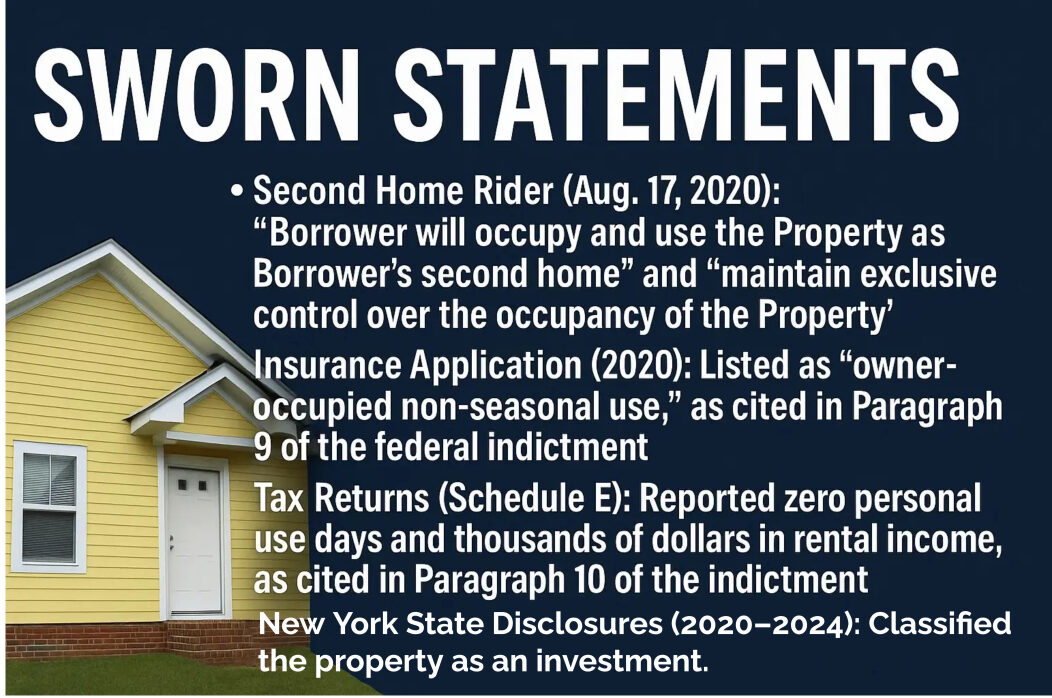
These four statements cannot all be true. You cannot occupy a property as a second home while reporting zero personal use days to the IRS, while telling insurance it’s owner-occupied, and while classifying it as an investment property to the state. At least three of these sworn statements must be false.
This isn’t about unclear guidelines — this is systematic fraud: telling four different government entities four different stories about the same property, all under penalty of perjury. When prosecutors have four contradictory sworn statements about the same property made to other institutions, it’s not just a weak indictment; it’s a clear indication of documented fraud. This level of deception and manipulation of the system is a serious breach of trust and integrity.
Every one of those documents is publicly available — from Virginia land records to the federal indictment and New York State ethics disclosures. The evidence is in plain sight. What the Times downplays as “political” or “minor” is, in fact, the pattern of contradictions that federal prosecutors look for in every financial fraud case. This pattern involves inconsistencies in the information provided to different government entities, which can indicate an attempt to deceive or manipulate the system.
What We Actually Reported
In our many coverages and YouTube discussions, Black Westchester never denied that this case could be political retaliation — in fact, it very well might be. But that doesn’t excuse the paperwork James signed, the way she filed her taxes, or the questions about her mortgages. The possibility of political motivation doesn’t erase the paper trail.
My mother always said, “When you live in a glass house, you shouldn’t throw stones.” Letitia James threw a lot of stones at Donald Trump. Now Trump is throwing them back, and the cracks in her own house are starting to show. That’s not bias — that’s balance. It’s a reminder that accountability is not a one-way street, and it’s essential for maintaining the integrity of our political and media institutions.
The Real Taboo
Let’s be honest: there is an unspoken rule in Black politics — we can challenge power when it’s white, but not when it’s ours. That double standard is precisely what weakens our collective integrity. But it’s the courage of Black journalists who tell uncomfortable truths that strengthens it. Accountability is not betrayal. It’s love of truth over loyalty to personality. If we silence these truth tellers, we aren’t protecting progress — we’re protecting power.
Why It Matters
This isn’t just about Letitia James. It’s about the pivotal role of independent Black media in shaping the narrative and holding power accountable. When we report facts — especially about our own — we prove that we take justice seriously, no matter who’s in the hot seat. That’s the very essence of equality under the law, and it’s a testament to the power of our voices in the fight for justice and equality.
Truth doesn’t need soft edges.
The Norfolk house isn’t a political weapon — it’s a case study in how media framing can shape perception and how fear of criticism can silence truth tellers.