



What exhausted people need to know before reaching for melatonin,
gummies, or “natural” sleep aids
It is almost 10 p.m., and you are standing in the supplement aisle, phone in one hand, reading glasses sliding down your nose. You have not felt like yourself in weeks. The fatigue is constant, your mind races at night and feels sluggish during the day, and you keep catching colds. Your body feels heavy in a way that sleep does not seem to fix.
So here you are, trying to solve it yourself. And there on the shelf is a gummy blend that promises to do it all. Immune support, detox, and deep restful sleep in one bottle. One product, one purchase, and maybe you finally start feeling like yourself again.
The packaging is reassuring. Soft colors, leaves and herbs, words like “natural,” “gentle,” and “restorative.” Everything about this bottle signals safety, wellness, and relief.
But here is what the label will not tell you. Supplements are not regulated the way prescription medications are. In the United States, they are regulated more like foods, which means most products are not tested for safety or effectiveness before they reach the shelf. Independent testing organizations have repeatedly found that what is listed on the bottle does not match what is inside. Sometimes significantly more or less is inside the bottle than labeled. You may not be aware that when a label says, “proprietary blend,” it means the specific amounts of each ingredient are hidden. And “natural” does not mean the same thing as “safe for your body” or “right for your situation,” because many “natural substances” can still cause side effects or interact with medications.
A note before we continue: This article offers general information, not medical advice. Your situation is yours, and a healthcare professional can help you think through it. What follows is meant to help you ask better questions, not to replace that conversation.
Standing in that aisle late at night, hoping one bottle might fix months of exhaustion, makes complete sense. It is a reasonable response to a healthcare system that has not made it easy to get real answers. A fifteen-minute appointment does not leave much room for exploring why someone has not felt right in months. That instinct calls for better information than most labels provide.

A Closer Look at Who Is Reaching for the Bottle
Research shows that Black adults are less likely than white adults to use dietary supplements overall. But that changes in specific categories. Products marketed most aggressively during vulnerable moments, such as immune boosters, detox formulas, and weight-loss aids, are often the ones with the least evidence behind them. And that marketing frequently targets communities already navigating barriers to traditional care.
The reasons behind that pattern have less to do with health literacy than with healthcare access and trust. When appointments are short and hard to get, when cost, insurance barriers, or past experiences, personal or historical, have made caution reasonable, finding alternative solutions can start to feel like self-preservation. The supplement aisle is open at any hour, no appointment needed, no insurance questions asked. Better information can help make sure that accessibility does not come at the cost of safety.
What We Know, and What We Don’t
That bottle in your hand probably contains one of a few common ingredients, and each one comes with its own questions. Melatonin is everywhere. It is in gummies, capsules, teas, and chocolate squares. Most people think of it as a gentle nudge toward sleep, something the body already makes. That part is true. But the doses sold over the counter are often many times higher than what sleep specialists typically recommend, with many products at 5–10 mg when 0.5–3 mg is usually sufficient, if it helps at all.
When the body gets flooded with more melatonin than it needs, sleep can become more fragmented, not less, and some people wake up groggy, irritable, or with headaches they did not have before. Because these products are not routinely checked before they hit the shelf, what the bottle says and what is inside can be two very different things.
Timing also matters. Taking melatonin too late or too early can shift sleep patterns in unintended directions and make schedule problems worse instead of better. Most sleep specialists suggest taking it 30 minutes to an hour before your intended sleep time, though this varies depending on your natural rhythm.
CBD has become a popular option for relaxation and sleep, though it has no U.S. Food and Drug Administration approval for either insomnia or routine sleep problems. (The one FDA-approved CBD product, Epidiolex, is for certain seizure disorders, not sleep.) Quality varies enormously depending on the source, and CBD can interfere with how the liver processes certain medications, including some blood thinners, seizure medicines, and antidepressants. Anyone taking prescriptions should check with a pharmacist or clinician before adding it in.
Magnesium has more evidence behind it than many other sleep supplements, especially for people who are low in it to begin with. Low magnesium intake is common, and in people who are deficient or borderline, certain forms may modestly help with relaxation and insomnia symptoms. But not all magnesium is the same, and taking more does not necessarily mean sleeping better; higher doses and certain forms can cause diarrhea or other side effects.
Proprietary blends deserve extra scrutiny. When a label uses that phrase, it means the company has chosen not to disclose how much of each ingredient is in the product. A bottle might list twelve herbs and extracts, but without knowing the amounts, there is no way to know whether any of them are present at levels that matter or whether the combination has ever been studied at all.
The theme here is consistent: the label gives you a starting point, but not the full picture. And the person standing in that aisle at night is often left to figure out the rest alone. Some people work with integrative or naturopathic practitioners for more individualized guidance around supplements. For those who prefer that approach, the same questions are worth discussing with any practitioner. If you are pregnant, breastfeeding, or considering giving a supplement to a child, talk with a clinician first; dosing and safety can be very different in kids and during pregnancy.
Ten Questions to Ask Before You Buy
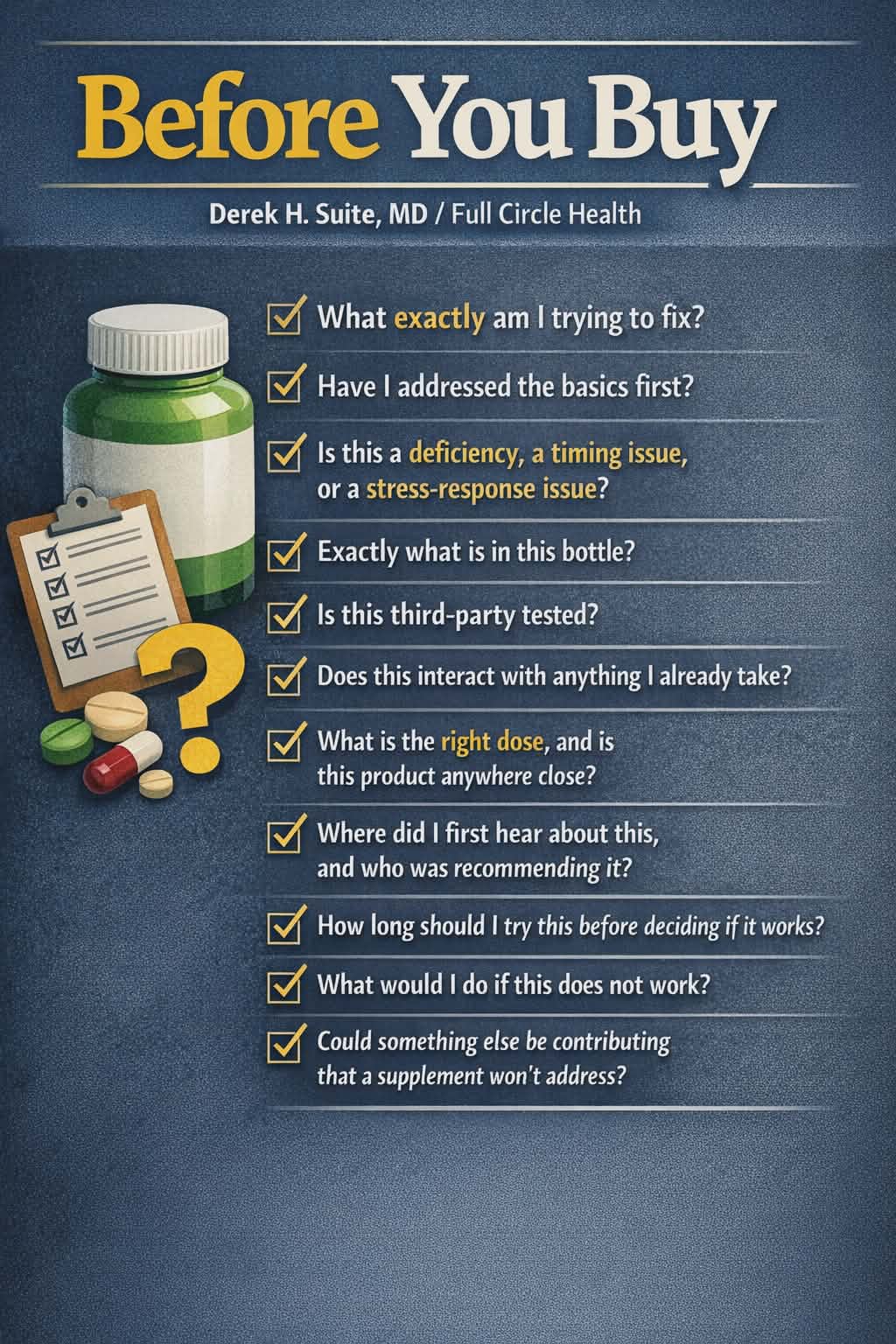
The supplement aisle is not going to ask these questions for you. Neither is the packaging. So, before anything goes in the cart, and eventually into your digestive system, it helps to slow down long enough to ask them yourself.
What exactly am I trying to fix? Trouble falling asleep, waking at 3 a.m., dragging through the day, feeling wired at night—these are different problems with different causes. Getting specific about the actual problem makes it easier to know whether a supplement even makes sense.
Have I addressed the basics first? A consistent bedtime, morning light, caffeine cutoff by early afternoon, limited alcohol, a quiet sleep environment, correct room temperature, and screens dimming before bed all shape sleep in ways a supplement cannot override. If those foundations are shaky, a pill is unlikely to compensate.
Exactly what is in this bottle? If the label says “proprietary blend,” that means the amounts are hidden. If it lists fifteen ingredients, ask whether any of them have been studied at those levels or in that combination, and where these ingredients came from.
Is this third-party tested? Look for a seal from NSF, USP, or ConsumerLab. These organizations independently verify that what the label says matches what is inside and check for certain contaminants, although they do not guarantee that a product is safe or effective for you.
Without that verification, there is no way to know for sure. Does this interact with anything I already take? This includes prescriptions, other supplements, foods like grapefruit, other over-the-counter medications, and even alcohol. A pharmacist can run an interaction check in minutes, and most will do it for free, even if you do not buy anything, and no appointment is needed.
What is the right dose, and is this product anywhere close? Different medications, including supplements, can have different effects at different doses. Many products contain far more than research supports. Melatonin is one example where common doses often exceed what most adults need. More is not always better, and in some cases, more is worse. Where did I first hear about this, and who was recommending it? If the answer is a podcast ad, a social media post, or a celebrity endorsement, that is marketing designed to sell a product.
A recommendation from someone with clinical training carries a different weight than an influencer testimonial with a discount code. How long should I try this before deciding if it works? Going in with a defined window helps avoid the slow drift into taking something indefinitely without ever knowing whether it helped. Decide up front how long you will try it and take a moment to look up the long-term effects of the product, including any safety concerns, before you start.
What would I do if this does not work? Having a backup plan, including the option of seeing a doctor or sleep specialist, keeps one bottle from turning into five.
Could something else be contributing that a supplement would not address? Persistent fatigue, unrefreshing sleep, and waking up exhausted can sometimes point to conditions like sleep apnea or restless legs syndrome. Loud snoring, gasping at night, or waking with morning headaches are all clues that need medical evaluation. A supplement is unlikely to address those, but a clinician can.
When to Skip the Aisle Entirely
Sometimes the supplement aisle is not the right stop at all. If the fatigue has been going on for months and nothing seems to help, that is worth a conversation with a nurse practitioner, pharmacist, or doctor rather than another bottle. If sleep feels broken in a way that rest does not fix, there may be something underneath it that no supplement can reach.
Conditions like sleep apnea and restless legs syndrome are common and often go undiagnosed for years. They can leave a person feeling exhausted, no matter how many hours they spend in bed. A supplement might take the edge off temporarily, but it will not address what is happening. The same is true when mood is shifting alongside sleep. Persistent fatigue, irritability, and difficulty concentrating can sometimes signal something that benefits from clinical attention rather than self-treatment.
Trying to solve a problem yourself is reasonable. But there are moments when the most useful thing a person can do is stop buying and start asking for help. A pharmacist can answer quick questions at no cost, even if you do not end up buying anything. A doctor can look deeper. And a sleep specialist can evaluate patterns that are difficult to see from the inside.
For those without a regular doctor, community health centers—including Federally Qualified Health Centers—often offer appointments on a sliding scale. You can find one at findahealthcenter.hrsa.gov. Many now offer telehealth visits for sleep and fatigue concerns, and in many states, telehealth for sleep issues is covered by Medicaid.
That bottle on the shelf is not the enemy.
Supplements can play a supporting role when they are matched to a real problem, used at the right dose, and given a defined window before reassessing. The issue lies in the gap between what the label promises and what the person holding it needs to know to decide safely.
Standing in that aisle, exhausted and looking for relief, is a reasonable response to a healthcare system that has not made it easy to get real answers. Short appointments, limited access, and a lifetime of being told to figure it out can make self-treatment feel like the only option. But reaching for a bottle without the right information is a gamble, and the stakes include time, money, and health. The ten questions in this article are meant to help with making an informed decision.
Sleep matters. So does protecting the body that carries you through each day. The next time you find yourself in that aisle, phone in hand, take a breath. Ask the questions. And trust that the answers exist, even if the label was never designed to provide them.
Learn More
The National Institutes of Health Office of Dietary Supplements (ods.od.nih.gov) offers guidance on evaluating supplement safety and quality, including how to read labels and understand claims. ConsumerLab, USP, and NSF also provide independent testing and reporting on supplement quality, contamination, and whether products contain what they claim. To find a community health center near you, visit findahealthcenter.hrsa.gov.

Derek H. Suite, MD, is a board-certified psychiatrist who works at the intersection of psychiatry, performance, and recovery across professional sport and leadership. He is the CEO and Founder of Full Circle Health and has served as an adjunct professor of Clinical Psychopharmacology at Teachers College, Columbia University, for ten years. His current focus is on sleep, recovery, and what allows performance to hold up when it matters most, including a forthcoming book, “Sleep As Performance Medicine.” He is also the host of The SuiteSpot, a daily podcast exploring science, spirituality, and human performance.
This article is educational content and not a substitute for individualized medical advice. It is not intended to diagnose, treat, cure, or prevent any disease. Readers should consult their own healthcare professionals before starting, changing, or stopping any supplement or medication. The author has no financial relationships with any supplement manufacturers.