




When the United States organizes the world, it rarely does so through charters or ceremonial rooms. It organizes through leverage — economic, military, and consumer power — and then builds institutions around that leverage. That is not conjecture. That is how world orders actually form.
Declarations do not create world orders. They emerge when enough nations choose to coordinate their interests around a leading power because doing so produces tangible outcomes. After World War II, the United States built an international framework — including the United Nations, NATO, and the Bretton Woods institutions — not because it sought world government, but because cooperation under U.S. leadership was cheaper than conflict. Alignment offered access to markets, security guarantees, and stability. Resistance offered isolation.
Trump’s Board of Peace must be understood in that lineage.
This is not an attempt to replace the United Nations. It is a response to the reality that the postwar institutional architecture no longer functions as designed. Today’s global landscape is fragmented. Veto politics reward paralysis. Legacy structures issue moral statements but struggle to produce results. In that vacuum, powerful states do what they have always done: they organize around issues instead of within fixed institutions.
If countries choose to manage wars, mediations, ceasefires, and reconstruction through U.S.-led frameworks — formal or informal — then an order already exists, regardless of whether it has an acronym or a charter.
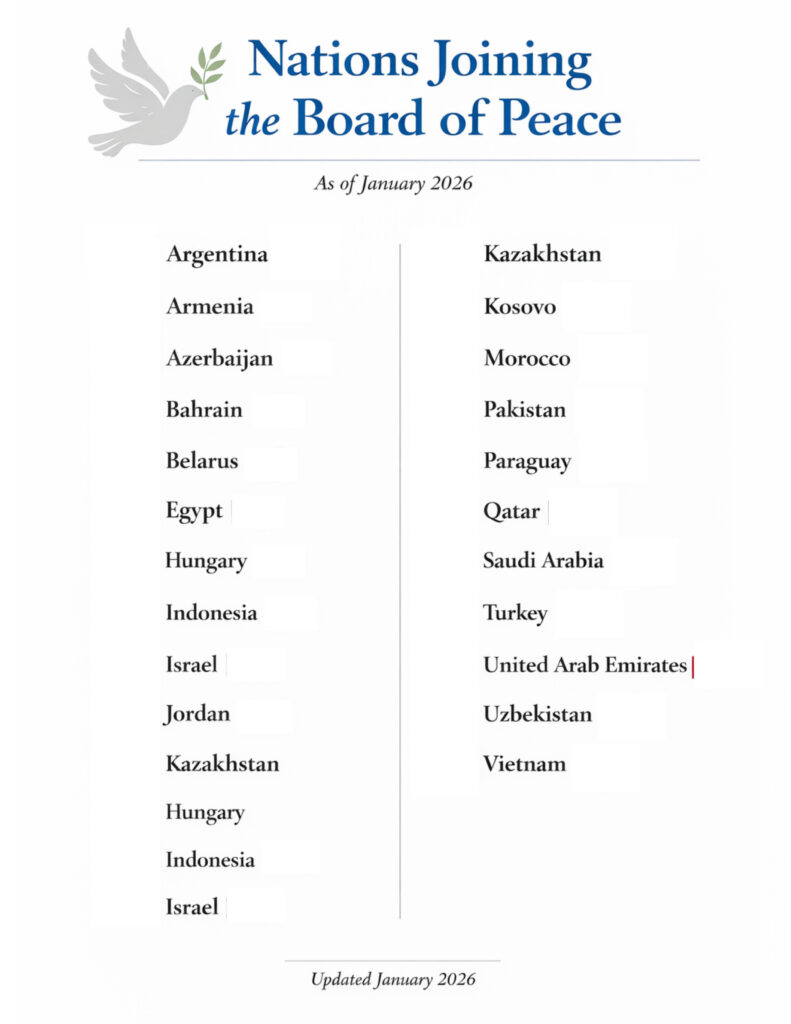
That is what makes the list of participating countries significant.
The nations that have agreed to join the Board of Peace are not random or symbolic. They include energy powers such as Saudi Arabia, Qatar, and the United Arab Emirates; manufacturing and trade hubs such as Turkey and Vietnam; strategic middle states such as Pakistan, Kazakhstan, and Uzbekistan; and politically independent actors such as Hungary, Morocco, and Argentina. These are countries accustomed to operating between power blocs rather than subordinating themselves to ideological consensus.
This matters because global power is not consolidated through unanimity. It is consolidated through coalitions that control resources, trade routes, labor markets, and consumption flows. Western Europe’s hesitation does not halt this alignment because Europe’s influence today is primarily regulatory, not productive. The participating countries understand leverage. That is why they matter.
If this initiative points to a “new world order,” it is not one of centralized authority or global bureaucracy. It is about transactional alignment and pragmatic coalitions, where effectiveness matters more than tradition, and outcomes matter more than process. Those who can deliver results — not merely craft declarations — will set the terms.
For Black Americans, this international shift is not just about diplomacy or geopolitics in the abstract. It is about how our collective power is deployed and who benefits from its outcomes. Recognizing this can inspire a sense of agency and responsibility.
The same American power that organizes peace coalitions abroad has too often failed to deliver economic justice, safety, and opportunity at home. Understanding this connection can motivate a sense of control and possibility.
The Board of Peace may succeed or fail. It may expand or stagnate. But none of that will materially matter to Black America unless we absorb the central lesson being demonstrated in real time: power is defined by results, not rhetoric.
Trump is not influencing foreign policy solely through speeches. He is leveraging American consumption and access— markets, energy demand, security guarantees, reconstruction dollars — to shape behavior abroad. Nations align because exclusion is costly.
Black America possesses a similar form of power, yet rarely organizes it.
Black consumers represent over $1.6 trillion in annual spending, but that spending is fragmented, undisciplined, and detached from policy outcomes. It flows into municipalities and corporations that return poor schools, weak infrastructure, predatory zoning, and political neglect. The spending exists. The leverage our collective economic influence. does not. Understanding this connection is crucial for Black Americans seeking tangible change.
Imagine if Black America applied the same logic domestically that the United States applies internationally.
Imagine if Black America applied the same logic domestically that the United States applies internationally. Not symbolic boycotts, but coordinated purchasing coalitions tied to precise local policy demands. Not emotional appeals, but organized economic pressure — zoning approvals, minority contracting, school funding priorities, public safety accountability. Cities respond when revenue is organized. Corporations comply when demand is disciplined. These are concrete strategies for building economic influence.
Power does not begin with outrage. It starts with withholding access.
The sharp warning is this: the world is moving away from moral appeals and toward transactional alignment. Those who cannot organize their economic behavior will be managed by those who can. Internationally, the United States understands this. Domestically, Black leadership too often does not.
Black America should pay attention — not out of fear, but out of clarity. The real question is not whether the world is being reorganized, but whether we understand how power actually operates and whether we intend to build it at home.
Peace abroad is desirable.
Power at home is essential.
And confusing the two has never served us well.









thanks for info.