




Black History Month often frames the Negro spiritual as a monument of faith. The melodies of “Swing Low, Sweet Chariot” or “Go Down Moses” carry the weight of history. But there is a deeper story hidden within those notes, a story of biological brilliance wrapped inside the sanctity. Long before modern medicine understood the Polyvagal Theory or neuroplasticity, our ancestors were already using the Negro spiritual as a sophisticated biotechnology, a biologically active cultural practice that changed the body from the inside out. They were intuitively using sound to rewire their brains and regulate their hearts under a system designed to destroy both. From today’s lens, the Negro spiritual functioned like a medical intervention disguised as a song, one that created resilience, the physiological ability of the body to bounce back from the unthinkable.
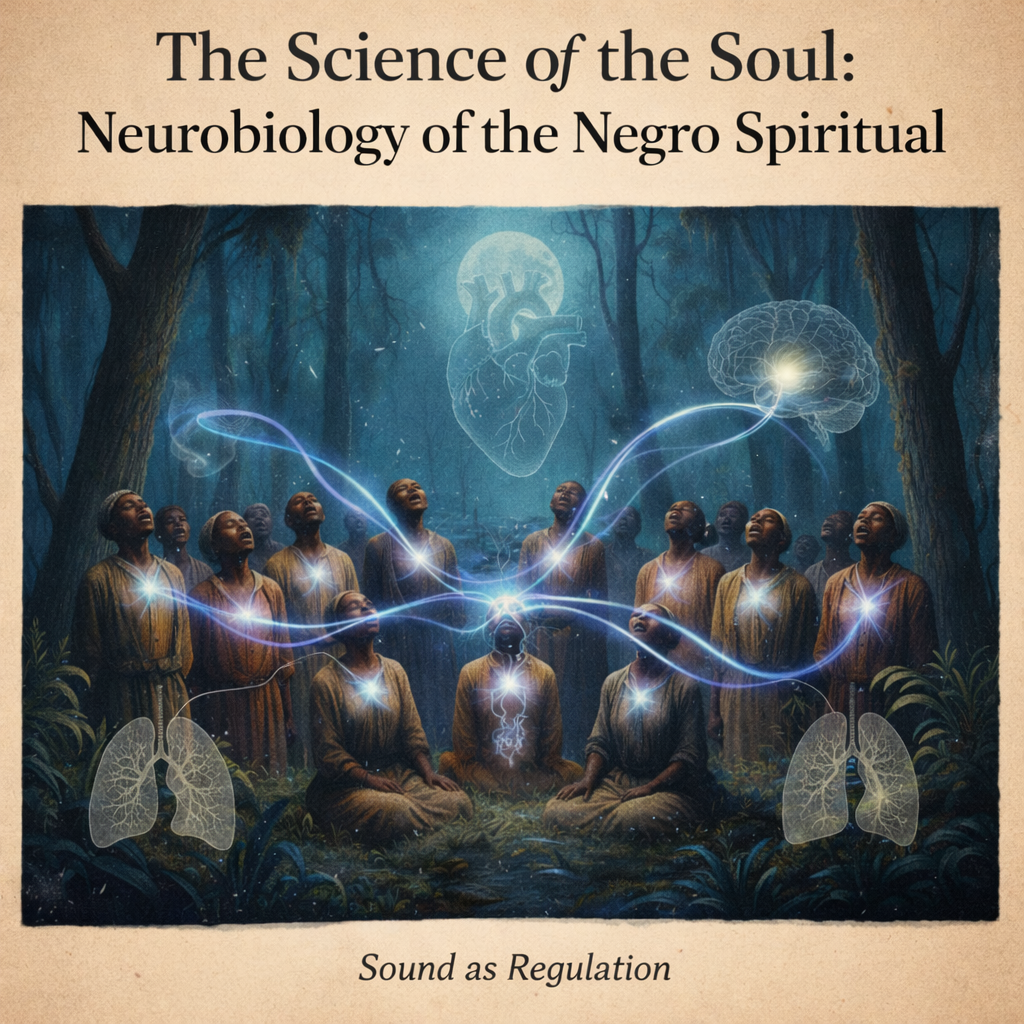
To understand how these songs saved lives, it helps to look at what scientists call Respiratory Sinus Arrhythmia, or “RSA.” While the word “arrhythmia” often sounds like a heart problem, in this case, it describes the rhythm of resilience. In its simplest terms, RSA is the healthy dance between breath and heart. When a person breathes in, the heart rate speeds up slightly to get oxygen to the brain, and when a person breathes out, it slows down to let the body rest. The more in sync these two are, the more resilient the body is against stress. In the medical world, a heart that beats like a rigid machine can signify a heart at risk. A heart that can dance with the breath is typically a heart that can survive.
In the fields of the South, and wherever enslaved people gathered in secret, they carved out spaces known as “Hush Harbors.” These were woods, gullies, or swamps hidden from the world. Practices varied by region, denomination, and community, but across the South, enslaved Africans carved out similar hidden spaces of sonic refuge, drawing on West and Central African traditions of call-and-response, polyrhythm, and communal healing that had crossed the Atlantic with them. When a leader started a spiritual with a long, drawn-out exhale (“I got a home in-a dat rock, don’t you see…”), they were, in essence, training their cardiovascular systems.
By controlling the breath through long musical phrases, they forced their heart rates to follow a healthy, predictable pattern. This kind of breathing pattern is now known to be associated with healthier blood pressure regulation and less wear on the cardiovascular system over time. They were tuning their bodies like instruments, ensuring they would not break under the pressure of forced labor.
What happens inside the body when thirty people moan together in a cramped, hidden clearing?
That deep, wordless moan anchors the Black musical tradition. From a neurobiological perspective, the moan is a natural activator of the vagus nerve, the body’s internal control center. It acts like a brake. When the stress response is racing like a car with a stuck gas pedal, a state of hyper-vigilance, the vagus nerve can slow the heart down and start the healing process. The low-frequency vibrations of a moan engage vagal pathways through prolonged exhalation, laryngeal vibration, and respiratory control, helping the body shift out of constant fight-or-flight.
When our ancestors moaned, they were, in effect, self-administering a biological reset.
They were signaling their brains to slow the chronic release of cortisol, a stress hormone that, when elevated over time, contributes to inflammation and cellular aging. With that burden eased, the body could begin to repair, and the ribcage itself became a resonance chamber of healing.
And then there was the silence between the phrases.
That pause, that collective inhale, was doing something too. Under constant trauma, the human brain can get stuck in a dark loop of negative thoughts. This happens in a part of the brain called the “Default Mode Network,” or DMN. Think of it as the internal narrator of the brain, the voice in the head when everything is quiet. In a state of enslavement, that narrator could be filled with the terror of the past and the uncertainty of the future. The Negro spiritual allowed our ancestors to break the loop. When a congregation sang together, they entered a state of focused attention that likely helped quiet the DMN. By calming that internal narrator through rhythmic, repetitive songs, they gave their brains a mental vacation. This protected their cognitive health, allowing them to remain sharp, strategic, and mentally free even while physically bound.
But that internal protection could only work if the body felt safe enough to receive it. This is where the Hush Harbors mattered most. Neurobiologically, psychological safety is a prerequisite for the vagus nerve to relax. A person cannot regulate the nervous system if the threat is standing right in front of them. In these hidden spaces, our ancestors created zones where their biology could finally shift out of defense mode. This was one of the earliest forms of community-generated, trauma-informed care in the Americas. Every time they gathered and sang, they were not only finding reassurance in each other but also physically repairing the damage done to their bodies during the workday.
What happens when those thirty people start to move?
The Ring Shout was a collective repair in motion. Synchronized movement and sound is one of the oldest mammalian regulation strategies; what our ancestors did was apply that universal capacity with extraordinary ingenuity under inhuman conditions. A communal circle of call and response movement that powerfully engaged the brain’s reward and bonding systems, likely involving dopamine and oxytocin. Dopamine drives the brain’s reward and motivation circuits. It is the chemical that makes a person want to keep going. By singing about the Promised Land, our ancestors were actively engaging their reward circuits, keeping the hope for freedom biologically alive.
The physical closeness and synchronized movement of the Ring Shout are also associated with oxytocin release, a hormone that strengthens social bonds and trust between people. Oxytocin also dampens inflammatory pathways and supports the body’s rest-and-repair systems. When people sing and move in rhythm together, their heartbeats synchronize. Researchers call this physiological synchronization, and it means that a group of people singing together begins to function, biologically, as a single connected system.
What enslaved communities built in the Hush Harbors is now recognized in clinical settings as music therapy, a discipline with over seventy years of peer-reviewed research confirming that structured musical engagement regulates autonomic function, reduces cortisol, and supports emotional processing. The ancestors were already doing the work.
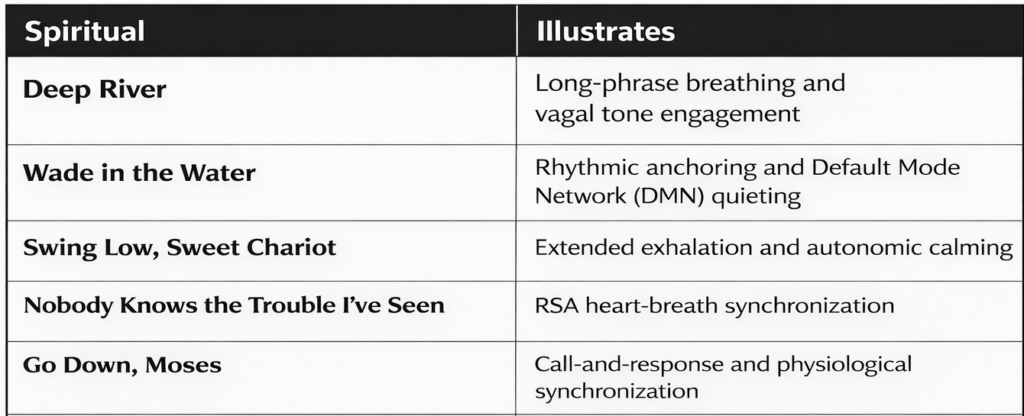
You can read about RSA and vagal tone all day, but put on “Deep River,” and the body will show you what the science means. Here are five foundational Negro Spirituals that illustrate different aspects of these principles. Each one activates the body differently, and while precise neuroscience labels cannot be assigned to individual songs with certainty, each one engages the systems described above. These songs illustrate principles, not prescriptions; their power lives in communal context, not isolated consumption:
Public health researcher Dr. Arline Geronimus calls the toll of chronic, systemic stress on Black bodies “Weathering,” a process where inequality itself accelerates aging at the cellular level. The Weathering our ancestors fought has not disappeared; it has changed shape. Today, many Black Americans still face stressors that over-activate the amygdala, the brain’s threat-detection center, and strain the heart. The message is often to “just be strong,” but strength without regulation leads to burnout and disease. Our ancestors did not wait for permission to heal; they took agency over their own biology. Moving forward means reclaiming these bioacoustics of resistance and resilience: the vocalization of the moan to lower blood pressure, and collective rhythm to stay anchored when everything says break.
It would be easy to read this history and conclude that our ancestors were simply built to endure. But nobody is built for that. What happened in those clearings was ingenuity under duress, people finding ways to keep their bodies alive because no one else was going to do it for them. What they created was extraordinary, but it should never be used to justify the systems that made such survival necessary. Resilience is a practice, not a personality trait. And it was forced by circumstance, not chosen by nature.
Nestled within the stories of remarkable resilience and pioneering achievement that will be celebrated during Black History Month, the Negro spiritual quietly remains one of the most overlooked. What our ancestors built in those hidden clearings meets the modern definition of trauma-informed care in almost every respect: they created safety, they led as peers, they restored agency through participation, and they rooted every practice in shared cultural memory. They did not have the language of neuroscience, but through repetition and necessity, they arrived at practices whose mechanisms modern research would later confirm. They turned their voices into a pharmacy and their ribcages into resonance chambers of survival.
This resilience was a hard-won victory of the Black intellect, and it must never be used to justify the systemic burdens placed upon Black bodies then or now. The ancestors already knew. Nobody had to teach them. The practice worked, and it is still working. Every time someone hums a spiritual in a church pew, or a barber’s chair, or a car on the west side highway, the vagus nerve responds the same way it did two hundred years ago. The songs remember, even when we forget.
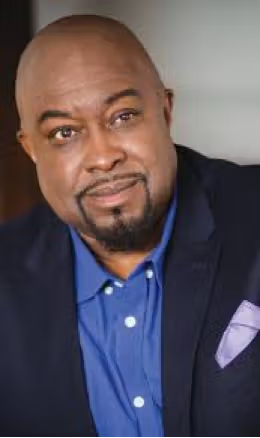
Derek H. Suite, MD, is a board-certified psychiatrist and Founder and CEO of Full Circle Health. He works at the intersection of performance, recovery, and resilience across professional sport and leadership, drawing on a decade of teaching Clinical Psychopharmacology at Teachers College, Columbia University. He is the author of the forthcoming book Sleep as Performance Medicine and host of The SuiteSpot, a daily podcast exploring science, spirituality, and human performance. He is a guest contributor to Black Westchester Magazine











Excellent article that echoed the ancestors’ spiritual understanding of the universe and the body! My grandmother was enslaved, and many called her “Earth Woman” because she had a deep understanding of soil, water, and the wind! She sang with the heavenly choir in her last days on earth and would tell you that when they stopped singing to her, she was going home to glory!
I consider something genuinely special in this site.