



One of the strangest habits in modern American politics is watching parties choose to fight the public on issues where the public already agrees with itself.
Voter identification laws are a perfect example.
For years, the debate has been framed as a moral struggle — security versus suppression, access versus discrimination. But polling has quietly exposed something far less dramatic and far more politically consequential: overwhelming agreement. According to CNN’s own polling analysis, roughly 83% of Americans favor photo ID for voting — including 95% of Republicans, 71% of Democrats, 85% of White voters, 82% of Hispanic voters, and 76% of Black voters.
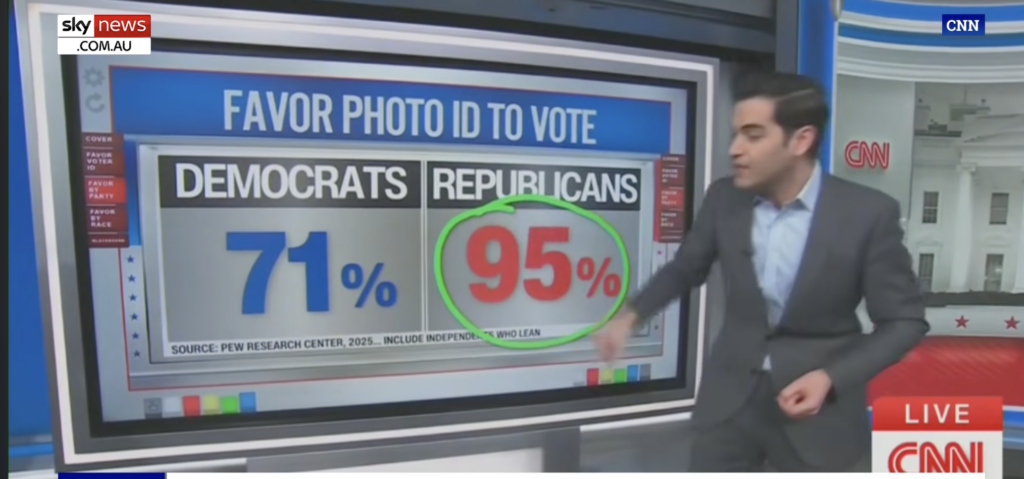
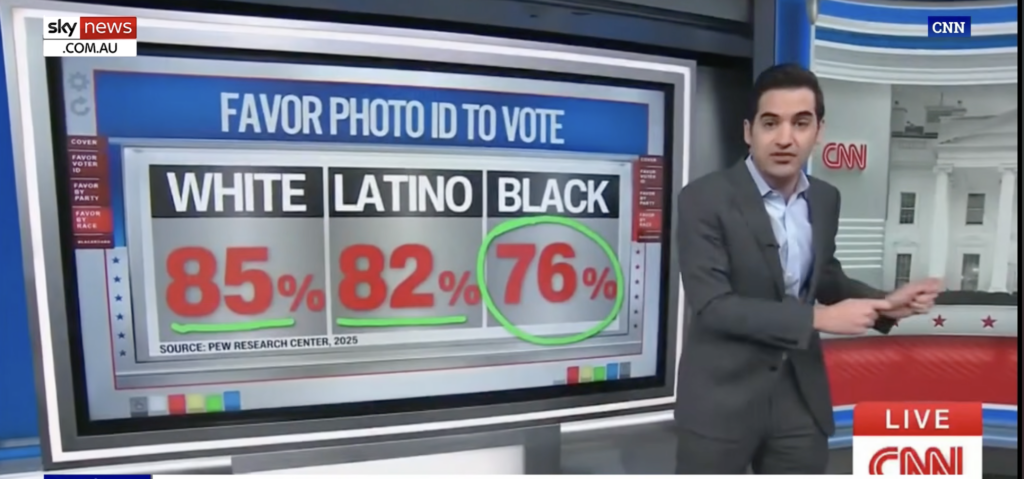
As the CNN data analyst summarized on air, “A photo ID to vote is not controversial in this country — not by party and not by race.”
When a policy attracts that cross-racial and cross-party support, it stops being an ideological issue and becomes a matter of public trust. The question is no longer whether the rule is conservative or liberal. The question becomes: why do political leaders insist on opposing what voters intuitively consider standard civic procedure?
Showing ID is routine in American life-people do it to board planes, pick up prescriptions, open bank accounts, and enter secure buildings. When voters see elections requiring fewer ID checks than everyday activities, they interpret this as incoherence, not compassion.
The most revealing contradiction is not partisan but narrative. For years the public has been told that voter ID laws uniquely harm Black Americans, yet the polling shows a clear majority of Black voters support the requirement. That does not mean every individual experience is identical, but it does mean political messaging is describing Black voters differently than they describe themselves. When leaders insist a group is broadly disadvantaged by a rule the group itself largely accepts, voters begin to question whether they are being represented or interpreted. The gap between predicted suffering and expressed opinion does not strengthen trust; it weakens it.
This is an “80/20 issue” That quietly shapes trust because voters have already decided. When parties repeatedly oppose such widely supported issues, they risk appearing to ignore common sense or prioritize internal debates over public understanding.
The argument often offered is that even broadly supported rules may affect a small subset of citizens differently. That is a serious discussion in administrative law. But politics operates on perception as much as policy. When the public sees a rule they experience as routine framed as discriminatory, the credibility cost exceeds the procedural concern. Voters conclude that leaders are describing a country they themselves do not live in.
The long-term danger is not about voter ID itself. It is about institutional trust. A party that disputes apparent public consensus on straightforward matters risks losing authority on complicated ones. If voters feel they must choose between their lived experience and a political explanation, they rarely abandon their expertise.
Convincing voters does not win elections; they misunderstand reality. They are won by demonstrating you understand the same reality they do.
The lesson of voter ID is therefore larger than election law. It is a reminder that political success depends less on moral intensity than on practical alignment. Parties that continually fight the electorate on common-sense expectations eventually discover the electorate stops listening — not only on that issue, but on every issue that follows.
And in politics, losing credibility is far harder to recover than losing a single argument. Maintaining trust is essential for long-term influence and effectiveness.