




Every Black History Month, we celebrate firsts. First elected, first hired, first promoted. But history is not actually changed by firsts alone. History changes when someone demonstrates that a standard can be upheld once they arrive.
That is why Commissioner Norwood E. Jackson mattered.
The Norwood E. Jackson Correctional Center is not simply named after the first Black commissioner in Westchester County corrections. It is named after a man who demonstrated that Black authority could exist within an institution without apology, without compromise, and without lowering standards to make anyone comfortable.
Born in Washington, D.C., in 1934, Jackson’s path did not follow the modern idea of leadership through rhetoric. At Central State University, he excelled academically and athletically, dominating football, discus, and shot put before a brief stint with the Cleveland Browns. But the real shaping of his leadership came in the military. Fifteen years of active duty as an Airborne Ranger, service in Vietnam, Area Provost Marshal in West Germany responsible for tens of thousands of soldiers and their families, earning the Legion of Merit, and retiring as a Lieutenant Colonel. That kind of background does not produce a man searching for approval. It produces a man trained to establish order.
When he entered the Westchester County Department of Correction in 1972 as a cross-complex security warden, he entered one of the few professions in which theory immediately dies. A jail does not respond to political language. It responds to command credibility. Staff survival and inmate behavior depend on predictability. Either the administration controls the building or the building controls itself.
By the time he became commissioner in 1989, he did not symbolize authority—he already embodied it.
Modern conversations treat representation as progress, but inside corrections, representation means nothing if rules fluctuate. Jackson understood something many administrators forget: you cannot rehabilitate chaos. Stability comes first. Only after that can fairness exist. Officers knew policy meant something. Inmates knew that lines did not move in response to pressure or mood. Violence drops when expectations stop changing. That is not ideology. That is cause and effect.
Affectionately called “Big Jack,” he believed in rehabilitation, education, and mental health programs, but he also understood that those things only work inside a structure. Under his leadership, the county confronted overcrowding and built the modern facility, which opened in 1992. Not reform by slogan — reform by function.
For Black officers, however, his impact extended beyond policy.
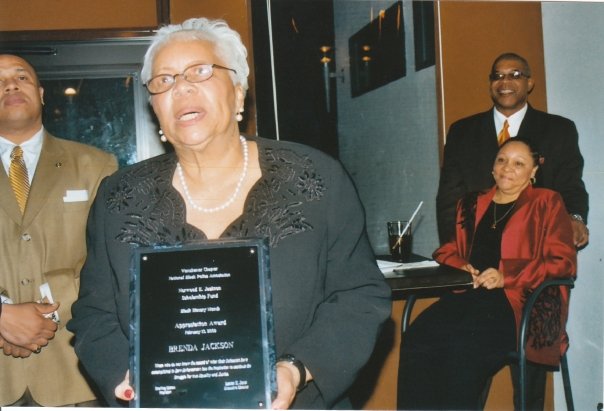
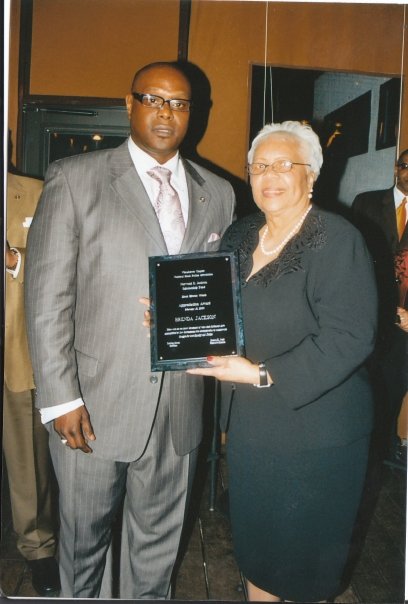
Damon K. Jones, Publisher of Black Westchester and New York Representative for Blacks in Law Enforcement of America, presents an appreciation award to the widow of Norwood E. Jackson in honor of her husband’s service, leadership, and example as a Black man in law enforcement.
A baby lion learns to become a lion by watching a grown lion. Jackson was that lion. When I started, he was the only Black commissioner in any law enforcement agency in the county, and his presence alone changed how you carried yourself. Many Black officers today have never seen leadership like that — a man who kept his dignity intact while working in an era of racism far worse than what officers face now. His example made us see it wasn’t about a paycheck, overtime, or fitting in with white officers. It was about representing and protecting our community while maintaining authority inside the institution. He always treated everyone equally, regardless of their ethnic background. He did not teach victimhood or hostility. He promoted professionalism backed by confidence. He treated everyone fairly and demanded excellence, and for Black officers, he represented something we rarely saw — institutional authority that did not need permission to exist.
He didn’t open doors by asking. He walked through them and showed you how to walk through them without shrinking.
Jackson’s legacy was not a Black face in a place. He was a Black man, proud of who he was, who changed the system rather than managed it for a paycheck. He exercised authority instead of borrowing it. That stands in sharp contrast to too many moments in public safety history where leadership became about maintaining position rather than improving the institution. Jackson didn’t sit in the chair — he defined the chair.
His Black excellence did more than affect corrections. It reset expectations across the county. After Westchester saw a Black man successfully run one of its largest and most difficult law enforcement agencies with discipline, integrity, and control, it became harder to argue that Black leadership was a risk. Other appointments followed over time because competence had already been demonstrated. The barrier had been psychologically broken before it was politically broken.
If you are Black and hold a commissioner or command-level position in law enforcement in this county today, you did not arrive in a vacuum. The road was cleared before you. Jackson showed Westchester that a Black man could run a major public safety institution with excellence, integrity, and respect. That proof mattered more than any diversity statement ever could.
That is what Black power originally meant. Not symbolism, not slogans, not emotional unity. Control of institutions that affect daily life and the discipline to run them correctly once you have them. Jackson didn’t protest the system. He ran it effectively, and that effectiveness forced respect.
He never denied his Blackness to advance, but he never used it as an excuse either. Racism existed — everyone knew it — yet he answered it the old way: mastery. Excellence that removed arguments. Authority grounded in competence instead of volume.
That is why his legacy still resonates with officers decades later. Not nostalgia. Memory of stability. When leadership stands behind lawful action, staff morale rises, and inmate behavior adjusts. When rules stay consistent, the environment calms. Institutions function when authority is predictable.
Today, many evaluate leadership by tone and narrative. But public safety is governed by outcomes. Removing consequences and disorder increases. Remove standards, and professionalism collapses. Jackson understood authority is not oppression when exercised responsibly — it is protection.
His name on the building made it the first law enforcement facility in Westchester named after a Black man. But the real achievement was not the naming. It was what made the naming unavoidable.
The fact of the matter is, Norwood E. Jackson laid the foundation that a Black man could do the work in this county — and do it at the highest level — long before voters were willing to place one in the highest elected office. His leadership normalized Black competence within government. Because people had already seen a Black man run one of the county’s most difficult institutions successfully, the idea of a Black County Executive was no longer theoretical. It was proven.
Long before Westchester elected its first Black County Executive, Jackson demonstrated that Black leadership in government could be firm, disciplined, and transformational without being symbolic. He did not simply break a ceiling. He showed what to do once you reached the floor above.
So, his legacy is more than just a memory for Black History Month; it is a model to follow. Progress isn’t made by just entering institutions and making them comfortable. It’s made by mastering those institutions and improving their performance since you arrived.
He didn’t ask to be validated.
He established order — and that earned respect that still hasn’t faded.