




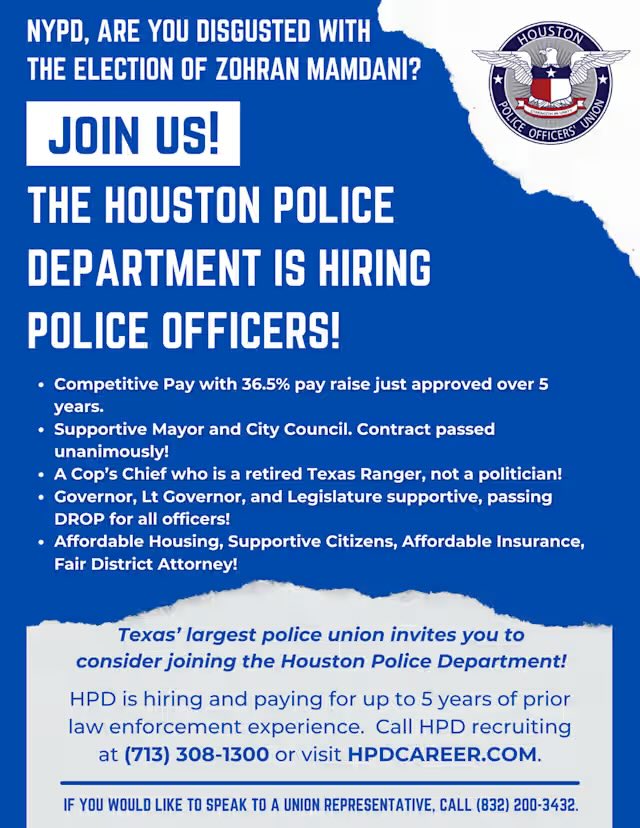
When Houston’s Police Officers’ Union posted, “NYPD, are you disgusted with the election of Zohran Mamdani? Join us!”—it wasn’t just a trolling post. It was a political signal. Within 24 hours of New York City electing its first openly socialist mayor, one of America’s largest police unions in Texas openly invited disillusioned NYPD officers to pack up and head south. That’s not a small gesture. It’s a declaration of how deep the cultural divide in America’s law enforcement and politics has become.
This wasn’t some rumor on social media. The Houston Chronicle, Newsweek, and Police1.com all confirmed the post. The union highlighted what it sees as the Texas advantage: higher pay, affordable homes, supportive leadership, and a police chief “who is a retired Texas Ranger, not a politician.” They used humor to make a point—but also drew a line between cities that back their police and those that, in their view, don’t.
Let’s be real. Zohran Mamdani ran his campaign by calling the NYPD racist, corrupt, and overfunded. He promised to redirect resources toward social programs and “community care.” That message resonated with progressive activists but alienated rank-and-file officers who already feel vilified. Now, Houston is capitalizing on that tension. The timing couldn’t be more precise: one day after the election, Texas sent a public invitation for New York’s cops to come work where they’re “respected.”
But the story is bigger than one social-media post. It speaks to a nationwide shift—a reverse migration of skilled professionals leaving blue states for red ones. We’ve seen it in business, construction, and healthcare. Now, law enforcement may be subsequent. While Mamdani talks about “reimagining public safety,” southern cities are offering NYPD officers relocation bonuses, lower taxes, and lower mortgage rates. That’s not ideology—that’s economics.
Zohran Mamdani’s repeated statements labeling the entire NYPD as racist and his long-standing goal to “defund the police” may win applause from progressive activists, but it’s a disaster for retention inside the department. Officers who already feel politically targeted and unsupported have little incentive to stay under leadership that openly disrespects them. That’s where Houston sees an opening. With its own force 1,200 officers short, Houston Police is seizing the moment—actively recruiting experienced NYPD cops who want to work in a city that pays better, taxes less, and publicly supports its police. What Mamdani calls reform, Houston calls opportunity.
The Money Talks: Why Cops Are Listening to Houston
Let’s break this down by the numbers. A rookie officer in New York City starts at around $60,000 a year. In Houston, that same officer would begin at $81,600—before overtime, bonuses, or shift differentials. Over five years, both departments can reach into six-figure territory, but here’s the catch: in Texas, there’s no state income tax. In New York, officers lose nearly 10% of their paycheck between city and state taxes alone. That’s a pay cut just for wearing the same badge in a different zip code.
Then there’s the cost of living.
In New York City, the average rent for a one-bedroom apartment hovers near $3,300 a month. In Houston, it’s roughly $1,300. The median home price in NYC sits at over $750,000, while Houston’s average is about $330,000. Translation: the same officer’s salary in Houston buys a home, a yard, and a retirement plan—while in New York, it barely buys time.
Add to that lower property taxes, cheaper gas, affordable groceries, and minimal commuting costs, and the financial math becomes undeniable. Even if the NYPD matched Houston’s base pay tomorrow, officers in Texas would still take home more real income because the government takes less of it.
So when Houston’s police union says, “Join us,” they’re not just talking about a paycheck—they’re talking about quality of life. They’re offering officers what every working professional wants: respect, stability, and the chance actually to keep what they earn. That’s not politics—that’s economics. And it’s the kind of logic that explains why so many working-class people, Black and white alike, are quietly heading south.
The Broader Shift: Black Middle Class on the Move
This trend isn’t just about cops. It mirrors what’s already happening with Black middle-class families and small business owners who are leaving New York, California, and Illinois for states like Georgia, Texas, and Florida. They’re not running from diversity—they’re running from dysfunction. They’re tired of being over-taxed, over-regulated, and under-represented. They’re looking for opportunity, ownership, and breathing room.
For decades, our leaders told us to stay loyal to the same political machine while our neighborhoods lost schools, contracts, and safety. Now the results are catching up. You can’t build wealth where policies punish success. You can’t make safety where leadership treats law enforcement as the enemy. And you can’t create freedom where every dollar you earn is taxed before you even see it.
Houston’s open invitation to the NYPD is more than a recruitment post—it’s a snapshot of America’s new migration map. Talent, discipline, and ambition are all heading to places that value work over rhetoric. That should make every mayor in the North take notice, especially those who think ideology can replace economics.











Cops started out. in America as “slave catchers.” Some of them became todays demons. Five black cops brutally murdered Tyre Nichols. One of those cops was a Jamaican! Only a demonic human? would want to be this evil. They should all go back to wherever they came from in Europe!