



America does not need a single company to “own the media” for narrative control to exist. Recognizing how ownership, editorial leadership, and cultural legitimacy converge can empower audiences to understand their roles during geopolitical crises.
If the proposed Paramount-Skydance acquisition of Warner Bros. Discovery succeeds, the risk isn’t only the loss of free speech but also the rise of narrative concentration around Israel, Gaza, and U.S. foreign policy, which can distort public understanding.
The Ellison family, led by Oracle co-founder Larry Ellison, has a well-documented record of strong support for Israel expressed through philanthropy, public statements, and longstanding political relationships. Most notably, in 2017, Ellison donated $16.6 million to Friends of the Israel Defense Forces (FIDF), at the time the most significant single contribution in the organization’s history. He has also maintained close personal ties with Israeli leaders, including former Prime Minister Benjamin Netanyahu. At the same time, Oracle executives have publicly emphasized the company’s commitment to Israel and its technology sector. Taken together, these actions place the Ellison family firmly within the pro-Israel camp of U.S. political and philanthropic life.
Politically, Larry Ellison is a major American donor, primarily aligned with Republican candidates and causes that advocate a strong U.S.–Israel relationship. While individual campaign contributions are not always tied to a single issue, Ellison’s broader giving patterns—combined with his Israel-focused philanthropy and associations—reflect consistent alignment with policies favoring robust military, diplomatic, and strategic support for Israel. This context has taken on greater significance as Ellison-backed entities expand their footprint across American media, raising questions about how concentrated ownership, leadership influence, and openly stated foreign-policy commitments may intersect with news framing and cultural influence during highly contested debates over Israel, Gaza, and U.S. foreign policy.

This context has taken on greater significance as Ellison-backed entities expand their footprint across American media, raising questions about how ownership, leadership, and openly stated foreign-policy commitments may intersect with news framing and cultural influence during contentious debates over Israel, Gaza, and U.S. foreign policy.
That expanding influence is underscored by Paramount-Skydance’s hostile takeover bid for Warner Bros. Discovery, a move that would dramatically reshape the U.S. media landscape if successful. The Ellison-backed entity has made an unsolicited, all-cash offer directly to Warner Bros. Discovery shareholders, seeking to override existing negotiations and fold Warner’s vast portfolio—including CNN, HBO, Warner Bros. Pictures, and Discovery’s cable networks—into its growing media empire. By pursuing a hostile bid rather than a negotiated merger, Paramount-Skydance has signaled both urgency and ambition, positioning itself to consolidate unprecedented control across broadcast news, cable, film studios, and streaming platforms. The proposal is now subject to shareholder response and intense regulatory scrutiny, given the scale of media concentration it would create and the implications for competition, editorial independence, and narrative diversity.
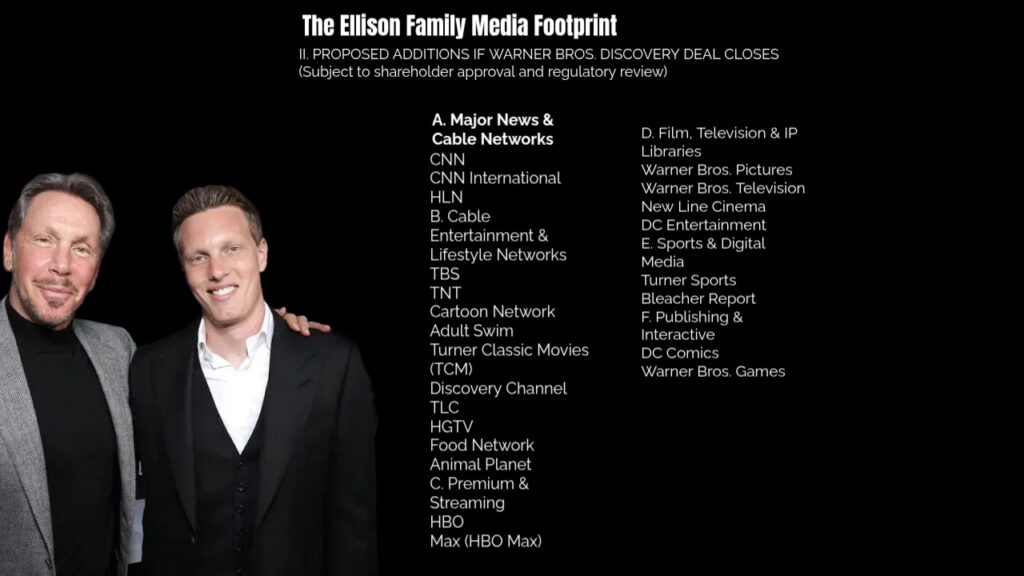
A combined Paramount–Warner entity would control CBS News and CNN, two influential platforms that set framingthrough language and sourcing, shaping the national understanding on issues like Israel and Gaza, as seen in their coverage patterns.
This matters because the Israel–Gaza conflict is not a distant foreign issue. It directly affects U.S. military aid, arms transfers, campus speech, protest policing, surveillance laws, and social-media regulation. In this context, media framing does not simply inform public opinion; it helps manufacture public consent.
The concern deepens when media consolidation intersects with Black-facing platforms. BET — Black Entertainment Television — is no longer Black-owned. It is a subsidiary of Paramount Global. While BET continues to brand itself as culturally representative of Black America, ultimate financial and executive authority rests with a multinational corporate parent whose broader media holdings have taken clear positions on foreign-policy issues.
This is not about symbolism. It is about who controls amplification.
BET occupies a unique position within Black America. Its trustworthiness fosters cultural legitimacy, empowering the audience to see Black media as a source of agency and resilience against narrow narratives shaped by corporate interests.
Recent changes in editorial leadership reinforce these concerns. Following the Paramount-Skydance restructuring, Bari Weiss, founder of The Free Press and an open, self-described Zionist, was elevated to a senior editorial role that influences CBS News. Weiss’s political and ideological positions are publicly stated.
In parallel, there have been reported allegations within media and journalism circles that recent CBS News layoffs and restructuring disproportionately impacted journalists of color, including Black journalists. Paramount and CBS have not released demographic breakdowns of the layoffs, and no court has ruled on these claims. Still, the reports have fueled broader concern about how ideological alignment at the top of major news organizations can shape newsroom culture, staffing decisions, and coverage priorities, particularly on contentious issues like Israel and Gaza.
This is where Christian Zionism enters the discussion.
Christian Zionism is not a fringe belief or a conspiracy theory. It is a well-documented political theology holding that support for the modern State of Israel is a Christian obligation tied to biblical prophecy. It has major institutions, donors, media platforms, and decades of influence on U.S. foreign policy.
What is new is its open emergence within Black influencer culture. Some Black public figures have publicly identified themselves as Christian Zionists. These voices are authentic, self-directed, and entitled to their beliefs. The issue is not their existence — it is their institutional amplification.
When Black Christian Zionist influencers are elevated within a media ecosystem controlled by non-Black corporate interests with strong foreign-policy alignments, they function as cultural translators. They normalize a geopolitical position inside Black Christian discourse by framing it as faith, morality, or biblical clarity rather than policy debate. This does not require coordination. It requires alignment.
Narrative power today is rarely exercised through overt propaganda. It operates through:
- Which pastors, scholars, and influencers are platformed
- Which scriptures are emphasized
- Which humanitarian suffering is centered on or minimized
- Which protests are framed as moral and which are framed as dangerous
- Which dissent is treated as “complex” and which is labeled “extreme.”
This dynamic becomes even more consequential when paired with platform control. TikTok — the primary news source for much of Gen Z — disrupted traditional war narratives by showing unfiltered footage from Gaza. That disruption triggered bipartisan political action, revived a stalled sell-or-ban bill, and elevated Oracle’s role in TikTok’s U.S. infrastructure. In the modern media ecosystem, control over distribution is as robust as control over production.
When one corporate ecosystem holds:
- Major broadcast news
- Major cable news
- Major film and television studios
- Streaming platforms
- Black-branded cultural media
- And influence over a dominant youth information pipeline
This dynamic becomes even more consequential when paired with platform control. Recognizing how distribution shapes narratives can inspire the audience to stay vigilant and question mainstream legitimacy.
This is why Black media ownership isn’t optional but a vital safeguard for diverse narratives and democratic integrity in the media landscape.
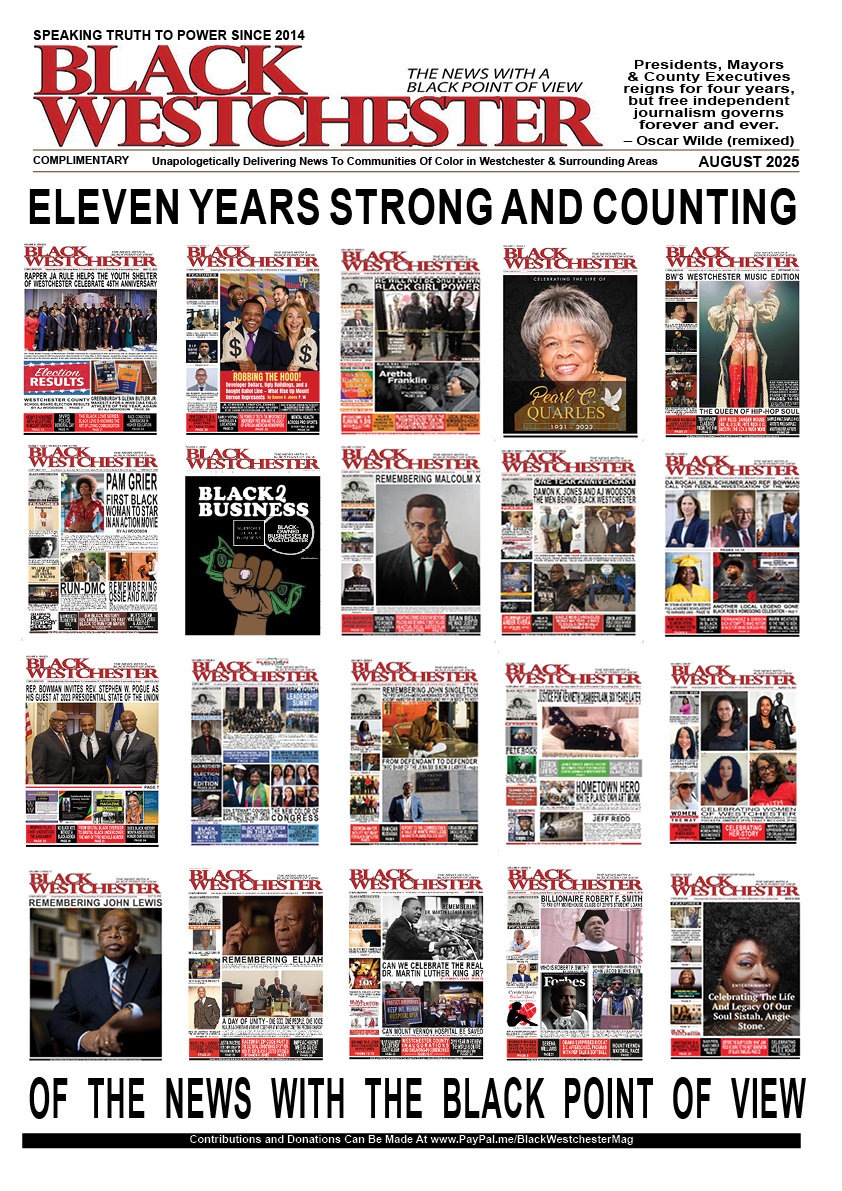
Historically, Black America understood that representation without ownership was insufficient. That is why earlier generations built independent Black newspapers, radio stations, magazines, and publishers — not simply to be seen, but to set boundaries on how Black life, Black politics, and Black morality were discussed. Ownership was about narrative sovereignty.
Today, Black faces on screen are often mistaken for Black control behind the scenes. They are not the same. Without independent Black-owned media, Black audiences are left consuming narratives filtered through corporate interests that do not share their historical experience, political vulnerability, or global perspective.
Independent Black media creates space for:
- Moral complexity instead of forced alignment
- Policy debate instead of theological absolutes
- Solidarity without erasure
- Faith without geopolitical obedience
The real question is not whether dissent will disappear. It is whether dissent will remain credible, amplified, and normalized in the places where most Americans — including Black Americans — actually get their information.
When ownership, foreign-policy alignment, and cultural authority converge, narrative control does not announce itself. It becomes invisible — accepted as common sense.
That is why Black media ownership matters now more than ever — not as a brand, but as a democratic safeguard.