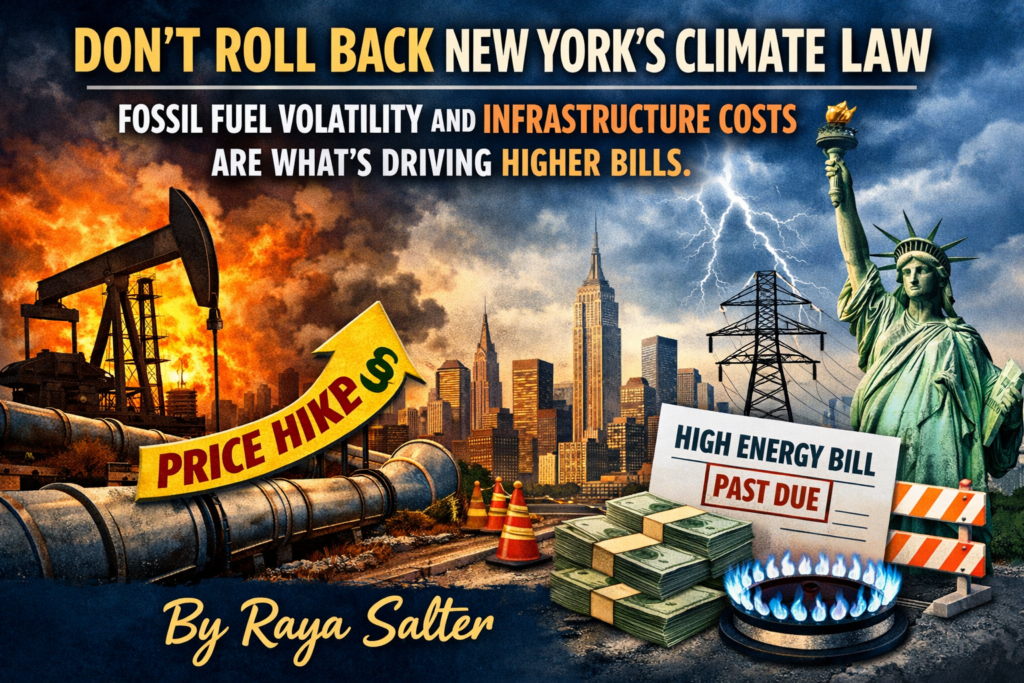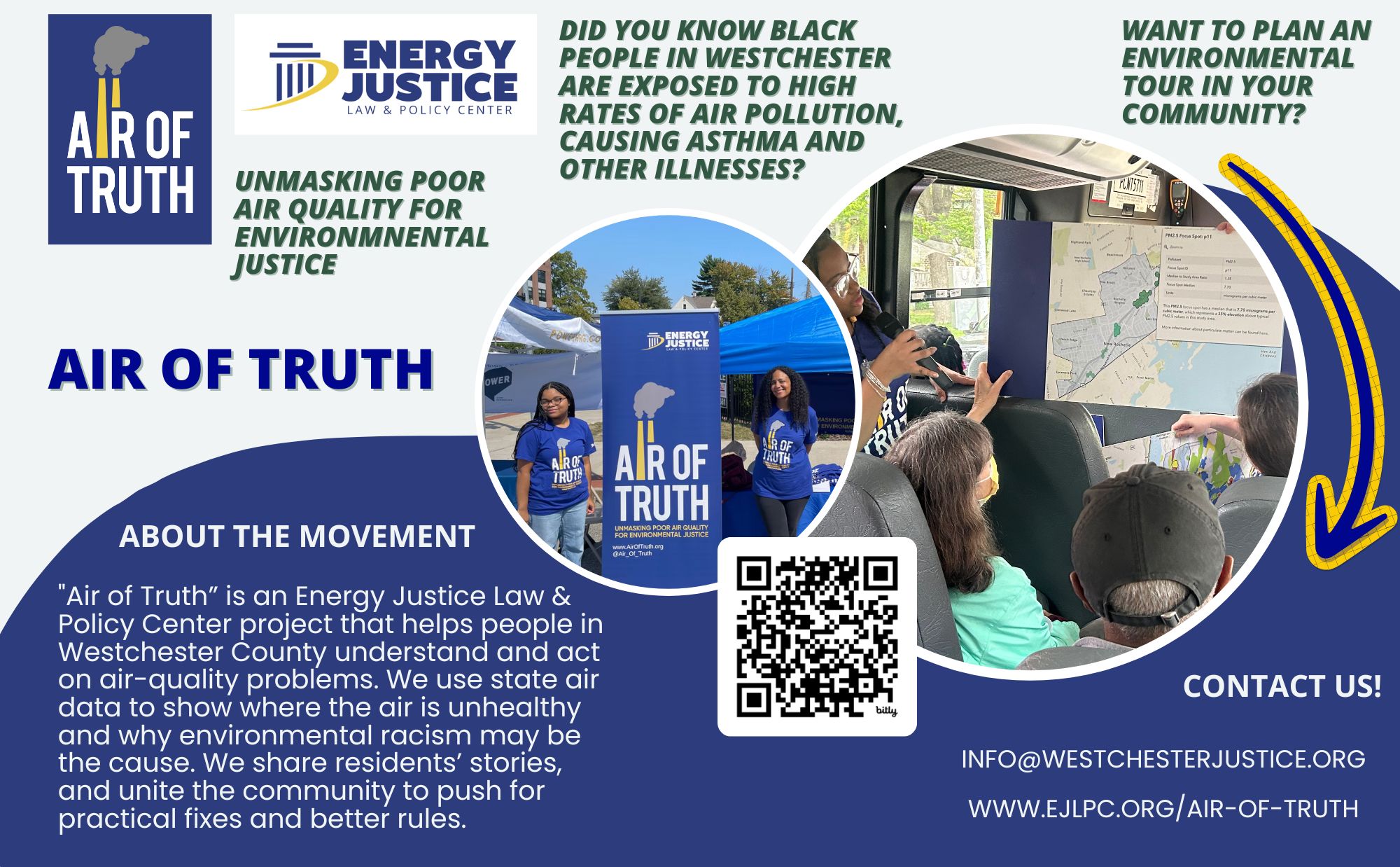




Fossil Fuel Volatility and Infrastructure Costs are What’s Driving Higher Bills
New Yorkers opening their utility bills are asking a fair question: Why are energy costs rising?
In Albany, some policymakers are pointing to New York’s Climate Leadership and Community Protection Act (CLCPA) as the cause and suggesting the state should roll back the law.¹ Those claims rely on contested cost projections and misleading narratives about today’s energy prices. More importantly, they ignore the real drivers of rising bills.
The primary factors pushing energy costs upward today are well understood: the cost of maintaining aging infrastructure and supply costs, including volatile fossil fuel markets. This very much includes the wars in Ukraine and Iran. Weakening New York’s climate law will not solve those problems. In fact, it risks locking them in.
To understand why, we need to look at what actually drives utility bills.
The Infrastructure We Are Paying For
A large share of what New Yorkers pay on their energy bills is the delivery system — pipelines, distribution networks, and other infrastructure required to move energy into homes and businesses.
Utilities recover the cost of building, maintaining, and financing that infrastructure through rates approved by regulators. These investments last for decades, meaning customers continue paying for capital projects long after they are built. Delivery charges, therefore, make up a substantial portion of many utility bills across New York.²
These costs are not the result of the CLCPA. They reflect decades of investment in fossil fuel infrastructure.
Meanwhile, the fossil fuel industry has lobbied aggressively to maintain and expand that infrastructure because it generates guaranteed returns through regulated utility rate structures. Those costs ultimately fall on customers.
Fossil Fuel Volatility Shows Up on Bills
Next are supply costs, including fuel prices. Because fossil gas is a large share of New York’s electricity generation, fluctuations in gas markets quickly translate into higher electricity prices. New York’s grid operator has noted that electricity prices in the state closely track fossil gas costs.²
Global events demonstrate how quickly those markets can shift. The Russia-Ukraine war disrupted global natural-gas supply chains and contributed to significant price spikes that affected electricity markets in New York.³ Now, the Iran war and the disruption of the Strait of Hormuz — one of the world’s most important energy shipping routes — have rattled global oil and gas markets, pushing prices higher in ways that are likely to increase consumer energy costs.⁴
Fossil fuel volatility is not theoretical. It is already showing up on utility bills.
Our Climate Law Is Not the Cost Driver
Despite this reality, some critics now argue that New York’s climate law will make energy unaffordable. Recent critics have cited unsourced cost projects as proof that the CLCPA is too expensive.
But those projections rest on contested assumptions and fail to fully account for the economic and climate risks of continued fossil fuel dependence.⁵ More importantly, they are planning tools that don’t explain why bills are rising today.
Using those projections to justify rolling back the CLCPA confuses future modeling exercises with the structural drivers of current energy costs. Weakening the law would not lower today’s bills or future costs — it would simply eviscerate our climate commitments.
The Real Affordability Solution
If policymakers are serious about affordability, the solution is not to retreat from the clean energy transition — it is to manage it responsibly.
Energy efficiency, electrification and grid modernization can reduce long-term system costs while protecting consumers from fossil fuel price shocks.⁶ Studies consistently show that efficiency improvements and clean energy deployment lower overall system costs and reduce household energy burdens over time.⁷
For environmental justice communities, these investments are particularly important. Low-income households and communities of color often face the highest energy burdens while also bearing the greatest health impacts from fossil fuel pollution. Implementing the CLCPA will deliver cleaner air and healthier communities.
Done right, the clean energy transition is not only a climate strategy — it is an affordability strategy. Rolling it back will cause real harm.
The Wrong Moment to Retreat
New York enacted the CLCPA because the climate crisis demands urgent action and because the state recognized the long-term risks of continued fossil fuel dependence.
Today’s global energy instability only reinforces that logic.
Doubling down on fossil fuel infrastructure will leave New Yorkers exposed to the same cycles of volatility that have driven energy costs for decades.
This is not the moment to weaken New York’s climate law. It is the moment to implement it carefully, responsibly, and with a clear focus on affordability, stability, and justice.
New Yorkers deserve an energy system that is cleaner, more stable, and more affordable over time. Don’t roll back our climate law.
About the Energy Justice Law and Policy Center: EJLPC is Westchester’s energy, climate, and environmental justice organization, focused on building healthy and thriving communities. www.EJLPC.org.
Raya Salter is the Executive Director of the Energy Justice Law and Policy Center and Member, NYS Climate Action Council and the NYS Permanent Environmental Justice Advisory Council
Sources
1. The City.
Energy costs fuel debate over Hochul climate law after NYSERDA memo.
https://www.thecity.nyc/2026/03/03/energy-costs-hochul-climate-law-nyserda-memo/
2. New York Independent System Operator (NYISO).
The Costs Behind Rising Electricity Prices.
https://www.nyiso.com/documents/d/guest/costs-behind-rising-electricity-prices-whitepaper
3. NYISO analysis cited in reporting on global gas markets.
Russia-Ukraine war and LNG exports driving higher gas costs affecting New York electricity prices.
https://nationaltoday.com/us/ny/new-york/news/2026/02/02/nyiso-cites-global-gas-market-for-high-electricity-prices
4. U.S. Energy Information Administration (EIA). World Oil Transit Chokepoints: Strait of Hormuz.
https://www.eia.gov/international/analysis/special-topics/World_Oil_Transit_Chokepoints
5. Spectrum News. N.Y. Climate Action Council member weighs in on high utility costs.
https://spectrumlocalnews.com/nys/central-ny/politics/2026/02/27/n-y–climate-action-councilmember-on-high-utility-costs
6. New York Focus. Virtual Power Plants Could Help Lower Energy Costs in New York.
https://nysfocus.com/2026/02/28/virtual-power-plants-utilities-jigar-shah
7. International Energy Agency (IEA). Energy Efficiency 2023.
https://www.iea.org/reports/energy-efficiency-2023