



Every February, Westchester County wraps itself in the language of progress. We celebrate “firsts,” applaud diversity panels, and repost sanitized snapshots of Black achievement. But Black History Month in 2026— a century after the first formal observance—demands more than applause. It demands honesty.
February is designated as Black History Month, a period annually set aside to commemorate and contemplate the profound and enduring achievements of Black individuals in the United States and beyond. In 2026, it holds particular significance as it commemorates the centennial of the observance that commenced in 1926 as Negro History Week and subsequently evolved into a month-long celebration honoring the history, culture, resilience, and leadership of Black communities.
Carter G. Woodson (1875–1950), a distinguished historian and author, instituted “Negro History Week” in February 1926 to advance the examination of African American accomplishments. He selected the second week of February to align with the birthdays of Abraham Lincoln and Frederick Douglass. It was extended to Black History Month 50 years later in 1976.
In the attempt to whitewash our history, we cannot forget our past locally. We must also discuss the uncelebrated Black history of Westchester County—the stories that built the county but rarely make the banners, textbooks, or February programs. This is the history beneath the history. What’s missing from the story: Westchester is often framed as an abolition-leaning, “North = free” region. That’s a myth.
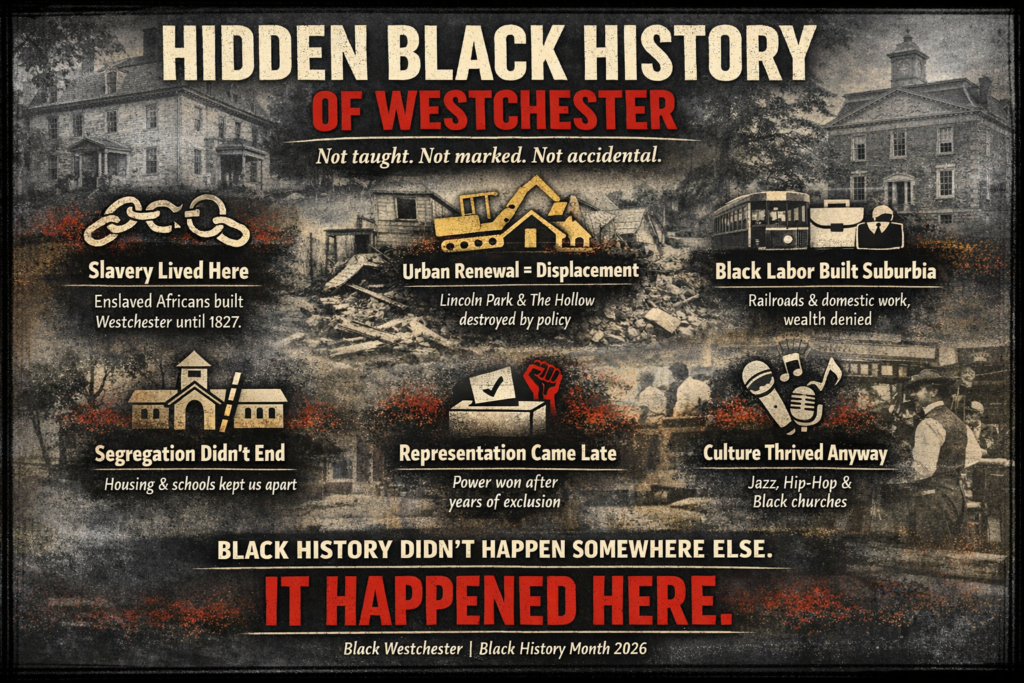
The myth that slavery was a Southern problem collapses the moment we look honestly at Westchester’s past. Enslaved Africans lived and labored across the county, particularly on large estates owned by elite families. Black men, women, and children were forced to build the very infrastructure—roads, farms, docks, and homes—that generated generational wealth still visible today.
Westchester’s Black history is not just a story of triumph. It is also a story of enslavement, erasure, displacement, and resistance—much of it still missing from the county’s official memory. Truth is that slavery was legal and widespread in Westchester well into the 1800s. Powerful families like the Philipses, Van Cortlandts, and the Jay family neighbors enslaved Africans. Enslaved Black people built roads, farms, docks, and estates that became the backbone of county wealth. Most historic homes name the owners, not the enslaved people who made those homes possible.
Why does it matter? New York didn’t fully end slavery until 1827—meaning enslaved Black people lived in Westchester decades after the Revolution. Children born enslaved after 1799 were still bound until adulthood. Many were sold south before emancipation to avoid “losing property.” This history is rarely connected to Westchester’s current racial wealth gap.
Westchester also carries a long history of Black community destruction dressed up as “urban renewal.” Thriving neighborhoods were labeled blighted, then cleared for highways, municipal buildings, and private development. What’s not discussed in the classroom every February is the fact that Black communities were erased by Urban Renewal.
In New Rochelle, the Lincoln Park community—home to Black professionals, homeowners, and businesses—was systematically dismantled. This thriving Black middle-class community was bulldozed for development. In White Plains, neighborhoods like The Hollow met a similar fate – Black residents were displaced under “slum clearance.” In Yonkers and Mount Vernon, displacement followed the same script: Black land removed, Black wealth erased, white development rewarded, and parts of Yonkers and Mount vernon were cleared for highways and civic projects.
These weren’t accidents or unfortunate side effects of progress as advertised. They were policy choices.
Let’s not forget the uncelebrated labor history or the Black Railroad & Domestic Workers Who Built Suburbia. The suburban dream Westchester is famous for did not run itself. Black men worked the railroads as Pullman porters, station agents, track and maintenance workers, connecting Westchester to New York City’s economic engine. Black women worked as domestic laborers—cooks, caregivers, cleaners—sustaining households that accumulated wealth they themselves were denied. Westchester’s “quiet suburbs” ran on Black labor that never translated into Black ownership or generational wealth for those they worked for. The county benefited from Black labor without extending Black opportunity.
The Hard truth is Segregation didn’t end—it adapted. Even after Brown v. Board of Education, segregation in Westchester did not disappear. It reorganized itself through housing policy, zoning, and school district boundaries. Federal courts eventually intervened—most notably in Yonkers—confirming what Black residents had long known: segregation here was intentional. Yet today, Westchester remains one of the most racially segregated counties in the nation, a reality rarely addressed during Black History Month programming.
Yonkers faced federal court orders for segregation. Mount Vernon and New Rochelle used housing patterns to maintain racial separation. But not speaking about it does not erase the fact that it happened.
What else is often overlooked is that Black residents organized long before representation existed. Voting power was suppressed through districting and economic pressure. Many “first Black” officials came shockingly late for a supposedly liberal county. While we have celebrations, focusing on the firsts, we leave out the decades of resistance before them in our classrooms and celebrations. The story of Black history in Westchester is not just about who finally got elected—it’s about how long Black communities were shut out.
There is a lot of Cultural History That Never Got a Plaque. Like how Jazz musicians rehearsed in basements and churches, Hip-hop culture thrived in Mount Vernon and Yonkers before it was profitable. and how Black churches doubled as political, cultural, and economic hubs. Again the culture is celebrated—but the conditions that shaped it are often ignored.
So why does this matter in 2026 – Black History Month isn’t just about celebration—it’s about truth-telling. In 2026, Black History Month cannot remain a comfort ritual. In Westchester, it must become a reckoning. What does that mean or look like? That means marking lost communities, not only celebrating leaders, naming enslavement, not just abolition, acknowledging displacement, not just diversity, and teaching policy harm, not just personal success. If the county wants an honest Black History Month, it must honor communities lost, not just leaders crowned.
Black History Month serves as a retrospective examination of past hardships and accomplishments while simultaneously urging individuals and communities to persist in their efforts to learn, honor, and elevate Black voices and history throughout the whole year.
Black history did not happen somewhere else. It happened here—on this land, in these towns, under policies still shaping outcomes today.
Until Westchester tells the whole story, Black History Month remains incomplete.
Sources & Further Reading
Primary & Scholarly Sources
- New York State Archives – Records on slavery, gradual emancipation, and manumission
- New-York Historical Society – Slavery in New York collections
- Philipse Manor Hall State Historic Site – archival materials on enslaved labor
- Van Cortlandt Manor Historic Site – documentation of enslavement in the Hudson Valley
Urban Renewal & Housing
- Lincoln Park Conservancy – community preservation research
- Federal court records on Yonkers desegregation (U.S. District Court, S.D.N.Y.)
- Richard Rothstein, The Color of Law
Education & Segregation
- NAACP Legal Defense Fund – housing and school segregation cases
- New York State Education Department demographic archives
Labor & Migration
- Pullman Porter histories (A. Philip Randolph Institute archives)
- Library of Congress – African American railroad labor collections
Local Oral History & Journalism
- Black Westchester reporting and archives
- Westchester County African American Heritage Trail materials









Every February we get the pageantry: “firsts,” panels, and feel-good posts that never touch the root. This piece refuses that performance and that’s exactly why it works.
It dismantles the lie that the North, or Westchester, was somehow innocent. Slavery lived here. Black labor built the wealth here. Segregation didn’t disappear, it rebranded through zoning, housing policy, and “urban renewal,” which was really just Black community removal with a PR team.
What hits hardest is the insistence on policy over platitudes. Lincoln Park. The Hollow. Yonkers. Mount Vernon. These weren’t accidents. They were choices. And celebrating “first Black” officials without naming how long Black people were deliberately shut out is historical malpractice.
This article understands the assignment:
Black History Month is not about comfort, it’s about truth.
Name the enslaved. Mark the erased communities. Teach the harm, not just the heroes.
Because Black history didn’t happen somewhere else.
It happened here.
Thank you my sister