




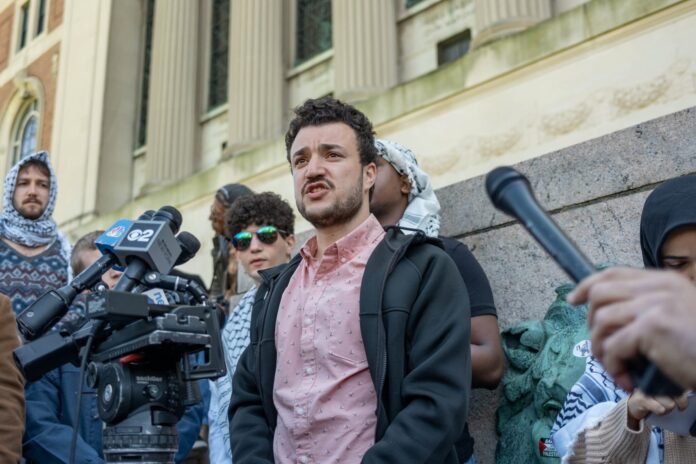






The detainment of Mahmoud Khalil, a Palestinian American graduate student at Columbia University, by Immigration and Customs Enforcement (ICE), was not an isolated incident. It was an act of retaliation against him for exercising his First Amendment right to protest in support of Palestine. Such retaliation is not applied equally to all citizens—state repression disproportionately targets specific communities.
State Repression of Protest Movements
Throughout U.S. history, the government has systematically sought to suppress political dissent, particularly from communities advocating for justice. Examples include the FBI’s COINTELPRO program, which targeted the Civil Rights Movement, and the crackdowns on Black Lives Matter protests.
These and other authoritarian actions have led to the arrests of countless activists who challenge the status quo. Khalil’s arrest follows the same pattern: a politically engaged individual is detained under the pretense of “violating the law” and faces the threat of deportation based on unfounded allegations of terrorism.
Weaponization of Immigration Enforcement
Using immigration enforcement as a tool for political suppression is not a new tactic. While immigration controls impact many, they disproportionately target Black immigrants from Africa and the Caribbean. This group faces the harshest enforcement, is most likely to be detained, and is frequently deported. Khalil’s case is not an isolated incident—it represents a much larger problem.
Criminalization of Marginalized Voices
The U.S. has a long history of labeling Black leaders and organizers as “radical” or “dangerous” to justify their arrests, surveillance, and even assassinations. Figures like Martin Luther King Jr., Malcolm X, and Angela Davis were all targeted by the government for their activism. Khalil’s case is part of this same legacy—he is being framed as a national security threat, just as Black activists have historically been persecuted for challenging systemic racism.

Anti-Blackness and Islamophobia
Khalil’s arrest underscores how closely state surveillance and policing are intertwined with anti-Muslim and anti-Black racism. Since 9/11, the U.S. has dramatically expanded state surveillance and police powers, with the FBI, local law enforcement, and private security firms routinely targeting communities of color. These efforts have normalized widespread “intelligence” gathering, community infiltration, and the deployment of paid informants as standard practice.
Intersectional Solidarity
The struggles of Black and Palestinian activists have long been interconnected. From the Student Nonviolent Coordinating Committee (SNCC) expressing solidarity with Palestine in the 1960s to today’s shared strategies of resistance against state violence, both movements understand that their fights are deeply linked. Khalil’s arrest is not just about immigration enforcement or campus protests—it reflects a broader state apparatus designed to silence marginalized communities and suppress justice movements.
Mahmoud Khalil’s arrest is a reminder that state repression does not operate in a vacuum. Just as instruments of repression were used against Black organizers, the same are now being brought to bear against pro-Palestine activists. This makes an immediate call for cross-movement solidarity all the more imperative. When the state comes for one, it sends a message to all, and the only way for justice to be accomplished is through collective action.

About the author: Dr. haley pilgrim is a sociologist, corporate strategist, and activist. A Ph.D. graduate from the University of Pennsylvania, she has deep expertise in inequality and intersectionality. She is currently a board member for the Boys and Girls Club of Mount Vernon, Mount Vernon’s Charter Review Commission, and the Westchester Black Women’s Political Caucus. With a track record of driving change across sectors, dr. pilgrim is dedicated to advancing equity, transparency, and strong governance.

AJ Woodson is the Editor-In-Chief and co-owner of Black Westchester, Host & Producer of the People Before Politics Radio Show, An Author, Journalism Fellow (Craig Newmark Graduate School of Journalism), Rap Artist – one third of the legendary underground rap group JVC FORCE known for the single Strong Island, Radio Personality, Hip-Hop Historian, Documentarian, Activist, Criminal Justice Advocate and Freelance Journalist
whose byline has appeared in several print publications and online sites including The Source, Vibe, the Village Voice, Upscale, Sonicnet.com, Launch.com, Rolling Out Newspaper, Daily Challenge Newspaper, Spiritual Minded Magazine, Word Up! Magazine, On The Go Magazine and several others.
All my books are available on Amazon, or you can purchase my autographed copies directly from me at www.AJROKPublishing.com. Pre-order your Autographed Deluxe Edition of “Black Women of Westchester” and the 914 Hip-Hop books (email MrAJWoodson@gmail.com for more info)
Follow me at Blue Sky https://bsky.app/profile/mrajwoodson.bsky.social and Spoutible https://spoutible.com/MrAJWoodson

Great information shared.. really enjoyed reading this post thank you author for sharing this post .. appreciated