



In Part One of Follow the Money, I asked a simple question: Who has the key? Who knows where the money is, which banker to call, when the opportunity opens, who gets the email first, and who keeps finding out after the deadline like, “Oh, you didn’t hear about that?” No, we did not hear about that, friend, and that’s exactly why we’re having this conversation. While I was following the money locally through Apple Bank and Westchester, Washington was proposing changes to the Community Reinvestment Act rules themselves, and this conversation just got much bigger.
Before the government language makes your eyes glaze over, let’s start with the numbers. Once you understand what they’re attached to, they hit differently. $10 BILLION!!! The proposed threshold for an “intermediate bank” would increase to $10 billion in assets, changing how many banks are classified and regulated under CRA. 15%. For a large bank, more than $10 billion in assets, to receive CRA consideration for certain community-development grants, a recipient’s indirect costs for administering the grant generally could not exceed 15%. This is not a universal 15% cap on nonprofit overhead, but it deserves attention. $1 BILLION
The proposed small-bank threshold would rise from $412 million to $1 billion, changing which institutions fall into that CRA category. OCTOBER 13, 2026! That’s the deadline for the public to comment on these proposed changes. Before you say, “I’m not a banker, what does this have to do with me?” remember something important: you are the public.
WHAT IN THE WORLD IS CRA?
The Community Reinvestment Act, or CRA, has been around since 1977. At its core, federal regulators evaluate how covered banks help meet the credit needs of their entire communities, including low- and moderate-income neighborhoods, while operating safely and soundly.
Here’s the kitchen-table version: if a bank is doing business in a community, we should be able to understand how that institution is helping meet that community’s credit needs. CRA shouldn’t be a conversation only bankers, attorneys, and regulators understand. Sometimes power isn’t hidden behind a locked door; sometimes it’s hidden behind language people were never taught. If the language makes you believe the conversation isn’t for you, you may remove yourself before anyone ever has to tell you that you can’t participate.
PAY ATTENTION TO THAT 15%
The proposed 15% provision caught my attention because infrastructure costs money. Somebody has to handle payroll, insurance, compliance, reporting, technology, data collection, and all the other things that keep a nonprofit functioning. In a grassroots organization, that “somebody” may be the same executive director who is fundraising, running programs, answering emails, and moving folding tables after the event. You cannot sustainably serve people if the organization serving them cannot sustainably operate.
That doesn’t mean anything called “overhead” deserves a blank check, because accountability matters too. The real question is whether this proposed standard could unintentionally make it easier for larger organizations with established infrastructure to qualify for bank-supported funding than smaller grassroots organizations. That’s exactly the kind of question regulators need to hear from people doing the work. Don’t just be mad at the number; explain the consequence of the number.
THIS IS WHERE YOUR POWER ENTERS THE CHAT
The rule is proposed, not final, and public comments are open until October 13. You don’t need a law degree or banking title to participate, but you do need to make your point clear. Remember four words: EXPERIENCE → EVIDENCE → IMPACT → RECOMMENDATION. Tell regulators what happened, what you can document, why it matters, and what you believe they should do about it.
Instead of writing, “This 15% rule will hurt nonprofits,” explain how it could affect your actual organization. Instead of writing, “Banks never tell us about opportunities,” describe what you tried to find, what information was or wasn’t publicly available, and what greater transparency could look like. You don’t have to speak for everybody; speak accurately about what you know. Your experience becomes more powerful when you connect it to evidence and a specific recommendation.
KEEP THE RECEIPTS AND CHANGE THE QUESTIONS
If you’ve tried to access a bank grant, business loan, technical assistance or community-development opportunity, document what happened. Keep the dates, emails, requirements, contacts and outcomes, and document successful experiences too because good systems leave receipts. Then stop asking banks only, “Do you have money for my organization?” Ask what their CRA community-development priorities are, where opportunities are publicly posted, when applications open, who handles community development, and what assistance exists for organizations or businesses that aren’t funding-ready.
And ask my favorite question: Where can I find all of this if I don’t know you personally? That question helps reveal the difference between a resource existing and a resource actually being accessible. Business owners should ask questions too. Ask what small-business lending products exist, what would make your business bankable, what you need to improve if you don’t qualify today, whether the bank works with CDFIs, and how your company can become a vendor. That is economic literacy. It isn’t simply knowing how to ask for money; it’s understanding the ecosystem where money moves and knowing how to participate in it.
YES, I’M STILL FOLLOWING THE MARKETING MONEY
Bank advertising and marketing are not automatically CRA-qualified activities, so let’s keep the categories honest. But when we examine the broader economic relationship between financial institutions and communities, I’m still asking who gets paid.
Banks want our deposits, mortgages, businesses and attention, so who receives their advertising contracts, sponsorships, vendor opportunities and professional-service dollars? And yes, I’m going to keep asking how much reaches Black-owned and Latino-owned media and businesses, because that is an economic-circulation question, even when it isn’t a CRA question.
WESTCHESTER OPENED THE DOOR. AMERICA IS THE ROOM.
This investigation started with Apple Bank and Westchester, but CRA is federal. What happens in Detroit, Atlanta, Baltimore, Chicago, rural America or anywhere else may look completely different, and that is precisely why public participation matters.
Federal regulations may be written in Washington, but they land inside real businesses, nonprofits and neighborhoods. Public comment gives people living with those consequences an opportunity to put their experiences into the official record.
AACCHV CRA COMMENT LAB
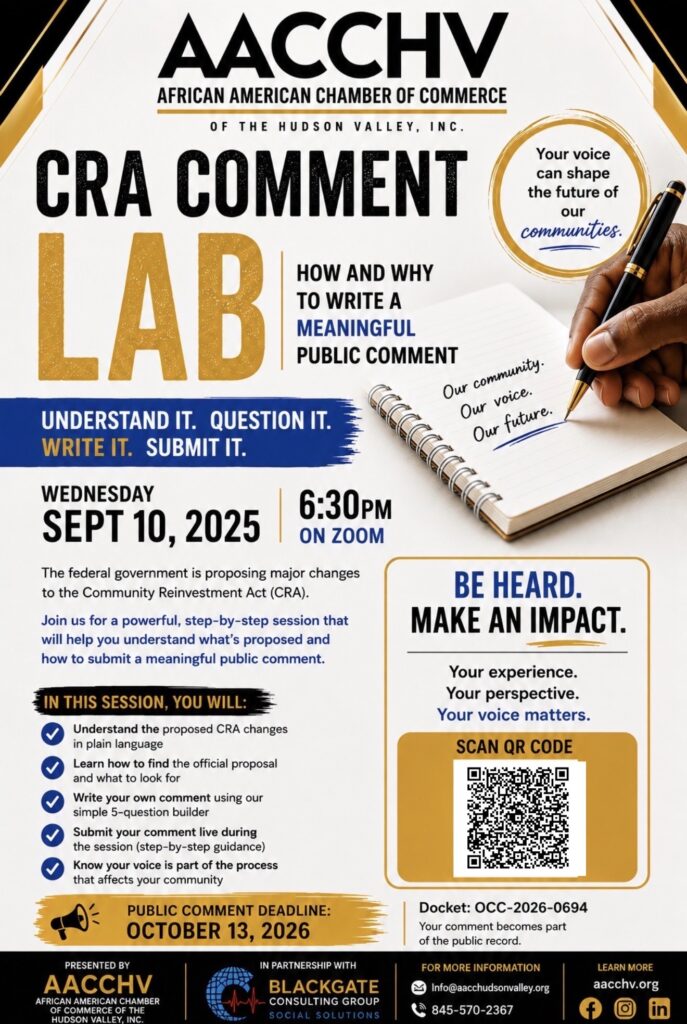
Now we’re taking this article into action. On Thursday, September 10, 2026, at 6:30 PM on Zoom, the African American Chamber of Commerce Hudson Valley (AACCHV) will host the CRA Comment Lab: How and Why to Write a Meaningful Public Comment.
This isn’t another panel where experts talk at the community, and everybody leaves with a folder. It’s a lab, which means we’re working, translating the proposal into plain language and helping participants move from Experience → Evidence → Impact → Recommendation.
The goal isn’t to tell you what position to take. It’s to make sure you understand enough to speak for yourself and know how to put your experience into the federal record.
Business owners, nonprofit leaders, residents, community organizations, advocates, bankers and community-development professionals are welcome. To learn more, email Info@aacchudsonvalley.org or call 845-570-2367.
AND ABOUT THAT KEY…
In Part One, I asked, Who has the key? Let me be clear: I don’t want the key, and I don’t want AACCHV, another Chamber, nonprofit, elected official or community leader controlling it either. Changing who guards the door doesn’t create access. I want the door labeled, the requirements posted, the application public, the deadline visible, the contact information available, and the rules understandable.
I want the business owner who has never attended the right fundraiser to find the opportunity. I want the nonprofit director who doesn’t have a bank executive’s cellphone number to find it too, because access should not depend on proximity to power.
The key shouldn’t be inherited because we shouldn’t need a secret key in the first place. Economic literacy means understanding the system, while economic agency means knowing what to do with that information once you have it.
OCTOBER 13 ISN’T JUST A DEADLINE
Banks, banking associations, attorneys and policy organizations will put their perspectives into the federal record, as they should. Communities should be there too, explaining what works, what doesn’t, and what regulators may not see from Washington.
Part One started with Apple Bank and a question about where community investment actually goes. Part Two follows the rules governing how some of that money moves, because the numbers are the beginning, the questions are the point, and knowing how to use the information is where the power starts.
So follow the money, follow the access, and follow the rules. When the government opens the door and asks what the public thinks, don’t stand outside wondering whether they meant you; they did, so walk in knowing what you came to say.
Read It for Yourself / Resources
These directly support the CRA explanation, proposed changes, statistics, and October 13 deadline.
- Federal Register — Full Proposed CRA Rule: This is the primary source and the most important link for anyone who wants to read exactly what is being proposed, including the reasoning and regulatory details.
https://www.federalregister.gov/documents/2026/08/12/2026-16454/community-reinvestment-act-regulations - OCC — CRA Proposed Rule Summary: This is probably the easiest supporting source for your article. It specifically confirms the proposed $10 billion intermediate-bank threshold, $1 billion small-bank threshold, 15% provision, lending emphasis, and reporting changes.
https://www.occ.gov/news-issuances/bulletins/2026/bulletin-2026-35.html - OCC & FDIC — Joint Announcement: The agencies explain why they proposed the changes, including their stated goal of making sure community-development grants reach intended communities.
https://www.occ.gov/news-issuances/news-releases/2026/nr-ia-2026-64.html - OCC — Official CRA Information: This is useful for readers asking, “What exactly is CRA?” It explains the 1977 law, low- and moderate-income communities, examinations, performance evaluations, and other CRA resources.
https://www.occ.gov/topics/consumers-and-communities/cra/index-cra.html - OCC — Comment Deadline & Submission Page: This page lists the proposed CRA regulation as opened August 12, 2026, closing October 13, 2026, and provides access to Submit Comments and Read Comments.
https://www.occ.gov/topics/laws-and-regulations/occ-regulations/proposed-issuances/occ-proposed-issuances-2026.html - Federal Register — Official Public Inspection PDF: For someone who wants the actual government document rather than a summary, this is another primary-source copy of the proposal.
https://public-inspection.federalregister.gov/2026-16454.pdf?utm_source=