



By Derek H. Suite, MD | Full Circle Health
Patient names and identifying details have been changed, and certain clinical details have been combined to protect privacy.
Gloria had followed the instructions. By the time she came to see me, she could recite them better than some of the residents I have trained. She kept her bedroom dark, cool, and quiet, and did box breathing to relax. She had pulled all of it from a couple of reels and a podcast she liked. She had even asked her doctor to order thyroid studies and magnesium levels, which came back normal, and she ran ocean waves all night. “I’ve done a lot of research on this, doc,” she told me, “but I still wake up wired and exhausted.”
It took us three visits to reach something her research had never touched: her bedroom. In it were two laptops, a tablet, and an exercise bike. She kept every device on silent and dark mode, and still, Gloria admitted, she was aware of them, and she slept with one ear open for the buzz of a notification. Most mornings she would lie in bed answering email before she had showered. The online advice was sound as far as it went. It was just scratching the surface. In our sessions, we began exploring what staying connected was doing for her, what she feared she might miss, and why letting the devices go felt harder than the sleep advice suggested it should. Those were questions no algorithm had thought to ask. We are still working on them. Last I checked, one laptop had made it out into the hallway, which she counted as a win, and so did I.
Gloria is not unusual anymore. In a 2026 Pew Research Center survey, four in ten American adults, and about half of those under fifty, said they get their health information from influencers or podcasts, and Black Americans are among the most likely to. Before many ever call for an appointment, they have already watched, listened, searched, and more or less made up their minds.
Scolding people for searching online misses what I keep hearing in the office, which is that many started looking elsewhere after the traditional system failed to earn their confidence.
That said, in twenty years of this work, I can count on one hand the patients who have raised Tuskegee with me, or brought up a history of medical harm. That history, real and painful as it is, rarely comes up. What I have come to understand is that people are protecting themselves by holding on to some control. For some, that means resisting a system they have experienced as impersonal, commercial, or too quick to take ownership of their symptoms. What gets shared, sometimes with real frustration, are the micro-insults: that somewhere along the line a doctor talked down to them, ignored them, or dismissed their complaints, depleting the little faith they had left.
Unlike the doctor, a reel is always accessible. It’s there at midnight, costs nothing, and asks for no copay, no transportation. It takes no days off, and there is no six-week wait for the next opening. When the front door of the clinic is hard to reach, the one on the phone is always unlocked.
The creators people keep returning to usually offer the opposite of a rushed appointment. They sound accessible, take the worry seriously and hand the faith back as a feeling of agency. They tell us we can manage this ourselves, that a few vitamins or the right herbs might be the answer, and that the medical world has been keeping something from us. Some of this lands differently for Black Americans. In the same Pew survey, twenty-four percent of Black influencer users said what they heard was very different from what their own providers told them, compared with sixteen percent of white users. And about one in five Black users said a major reason they go online is to learn about things they would rather not ask a doctor at all, roughly double the white share. That last number is worth noting.
I want to tread carefully here, because what earns trust in my office has surprisingly little to do with information. It begins before I utter a word, with whatever reputation walked in ahead of me, and then with a warm handshake, steady eye contact, and the small talk that lets a person know I am seeing them and not a chart. When we happen to share a culture, and in our community that matters more than people like to admit, some of the distance closes on its own. Then comes the part that does most of the quiet work. I listen long enough to hear the whole story, and I say it back in my own words, so the person feels respected and knows I am with them. There is room to ask questions, and a pause before I answer. And near the end there is the question that opens the trapdoor, when I ask whether there was something else they wanted to tell me. That is usually where the real history comes out: the family, the marriage, the habit that never made the first pass.
Trust is built differently on a screen. A line like what your doctor doesn’t want you to know can manufacture intimacy by handing you a secret, and being let in registers, somewhere below thinking, as being cared for, even when the person on the other side has never asked you a single thing about your life.
That said, I have also seen online creators do work that medicine has often struggled to do well. Many are taking the shame out of mental health, moving people toward care they had put off, and explaining hard things in language people can hold. Some are licensed clinicians using the platform beautifully. The trouble here is more structural than personal. Many platforms reward attention, certainty, and novelty, and some accounts are selling untested supplements or lab panels built to surface a problem that justifies the next thing they sell. I will admit I do not always know where the line sits between a supplement that helps someone feel in charge of their health and one that is quietly delaying a conversation they need to have. Most people are nobody’s fool about this. But skepticism does not always protect us, though, from a confident voice, a frightening story, or a promise that lands at the right emotional moment. Only about one in ten say they trust most of what they hear online, and close to a quarter trust little or none of it. The skepticism is already there. It just does not always land in the right place. And the viewer is not encountering these claims in a neutral library. The platform learns what holds attention and keeps serving more of it, which can make a suspicion feel widely confirmed long before it has been carefully examined.
I remember a young man who came in certain that his weight loss meant cancer. He had a family history of it, and he had done real homework, the kind of deep search that turns up a frightening amount of accurate information. He arrived braced for the worst thing he could imagine. What he had not recognized as relevant, and so had never included in his search, was that he had been taking a stimulant for his attention for months, and it had steadily suppressed his appetite the whole time. The medication offered a plausible explanation, though it did not replace the ordinary workup that unexplained weight loss deserves, and we did that too. When we worked that out together, the fear left him.
The screen is often useful for discovery. It can help you name a symptom, feel less alone, or walk into an appointment with sharper questions. The trouble begins when discovery quietly turns into diagnosis, and diagnosis turns into treatment, with no history, no exam, and no one accountable for what happens next.
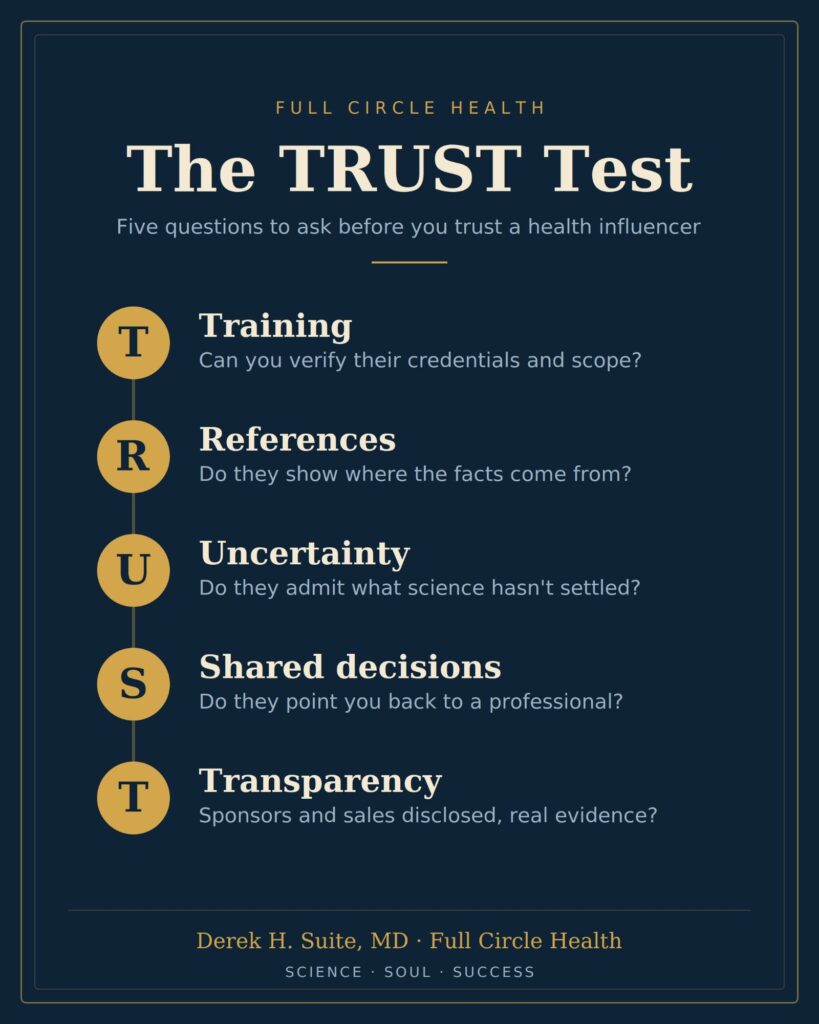
How to vet a health influencer: the TRUST test
I give patients a simple filter I call TRUST. Training: can you verify the person’s qualifications, and are they speaking within the limits of their training and professional scope? References: do they tell you where their information comes from? Uncertainty: are they honest about the limits and the places the science is still moving? Shared decision-making: do they send you toward a conversation with a professional instead of trying to be the last word? And transparency: are sponsorships, financial interests, and product sales out in the open, and if something is being sold, is the evidence for it stronger than testimonials, ratings, or the creator’s own word? Then build a small team around this filter: a primary care clinician if you have one, and if you do not, finding that person is the first job and not the last; a mental health professional when you need one; a credible public health source; and a couple of creators genuinely worth your time. Let them start the conversation. Don’t let them end it.
Let me admit the harder part to my colleagues. Good doctors are not missing from these spaces because they have stopped caring. They are missing because doing it well takes real time, energy, and resources. Doctors get fifteen minutes with you as it is; their days run long, and responsible public education asks for research, production, consistency, and a willingness to stand behind every word, on top of a schedule that is already full. There is also a license to protect, which keeps doctors careful, and careful hedging can read as evasion, while the person with no license at stake gets to sound certain, sell a product, and answer to no scientific or ethical standard at all. This is why I am careful not to push every clinician to become a content creator. What I know is that when the careful voices stay home, the confident ones inherit the whole room. Some clinicians are already finding their way through, building real educational podcasts on their own terms, and the profession is making progress. If the front door to our health has become a digital one, then those of us who have earned people’s trust, the clinicians, the researchers, the churches, the community that raised us-have to stand in that doorway too. Feeling understood and getting good care should never be a choice anyone is forced to make.
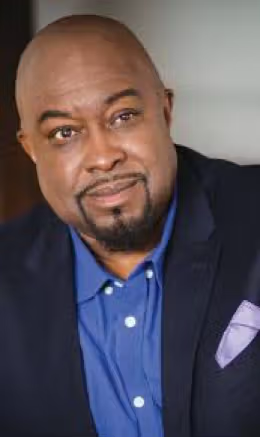
Derek H. Suite, MD, is a board-certified psychiatrist whose work focuses on sports psychiatry and sleep medicine. He is an alumnus of the Columbia University Graduate School of Journalism and a former adjunct professor of psychopharmacology at Teachers College, Columbia University.
Dr. Suite is the founder of Full Circle Health, hosts the weekly SuiteSpot podcast, and is a frequent health contributor to Black Westchester Magazine.