


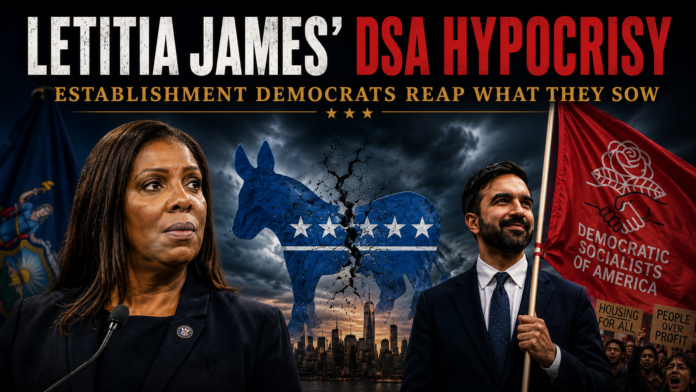





According to THE HILL, New York Attorney General Letitia James is now sounding the alarm about the very progressive forces reshaping the Democratic Party in New York. Her comments about Mayor Zohran Mamdani’s DSA-backed candidates sharpen the central issue: leaders who praise the movement now warn that it is overrunning the party. James criticized the mayor for endorsing outsiders who, in her view, “do not understand the politics of New York City, the cultural differences from district to district,” and lack connection to the “history and the struggle” of local communities.
This is rich coming from a leading figure in the very establishment that helped elevate Mamdani to power. James and other prominent Black Democrats backed his mayoral campaign against incumbents like Eric Adams and Andrew Cuomo. Their support helped empower the same political force she now criticizes.
I do not know how Tish James and other black leaders or elected officials failed to see it coming. At the Black and Latino Caucus, Mamdani was embraced with near-messianic fervor. While many politicians, accustomed to their own rhetorical games, focused on short-term votes and alliances, Mamdani’s strategy was clearer: accept their support to build a formidable DSA power base in New York City, then leverage it to advance his agenda across the state. That is how political karma operates. Now that the consequences are unfolding, it may already be too late for the establishment to course-correct.
For years, James and other prominent Black leaders have aligned with, defended, or remained silent as progressive and DSA-aligned policies gained ground—from criminal justice reforms to expansive social mandates. Even allowing AOC to bastardize Black history and the Black American struggle without correction. Now, as Mamdani’s influence delivers victories for candidates James sees as disconnected from race, class, and neighborhood realities, the Attorney General warns that the party is being “blown up.” The warning lands because it follows years of accommodation.
James’ critique of Mamdani’s slate inadvertently highlights a deeper problem: the disconnect between elite progressive visions crafted in certain enclaves and the lived realities of working families across the city and state. That disconnect is the real issue, because candidates who overlook cultural nuances, historical context, and district-specific struggles risk imposing one-size-fits-all approaches that fail the very people they claim to champion.
This internal Democratic tension is not abstract. It plays out in policy fights over public safety, economic development, education, and now family law—where recent efforts to replace “mother” and “father” with gender-neutral terms in state statutes have drawn bipartisan pushback. Southern states and Bible Belt communities, with their strong emphasis on traditional family structures rooted in faith and proven outcomes, will not quietly embrace such shifts.
James is right to worry about outsiders remaking the party without understanding local dynamics. But accountability starts at home. What James and other prominent Black Democrats failed to acknowledge is that they were in the kitchen helping to bake this monster. Their early and vocal support for Mamdani’s mayoral campaign—bolstered by her platform as the state’s Attorney General—lent him critical credibility and legitimacy. Now she wants to complain about the very force she helped empower. That is the hypocrisy at the center of this moment: it is like Frankenstein complaining about the monster he created. New York Democrats, including the Attorney General, have long tolerated or advanced the ideological infrastructure now bearing fruit—complaining about the harvest while ignoring the seeds they planted.
Voters—especially in Black communities that have consistently delivered loyalty—deserve better than factional infighting masquerading as concern They deserve leaders who prioritize measurable results over performative ideology.
The Democratic Party in New York, as we used to know it, is on life support Whether establishment voices like James can course-correct—or whether the DSA wave will further fracture coalitions—will shape not just city and state politics, but the national brand heading into 2026 and beyond.
Black New Yorkers should watch closel . Political power without accountability is simply another form of neglect.