




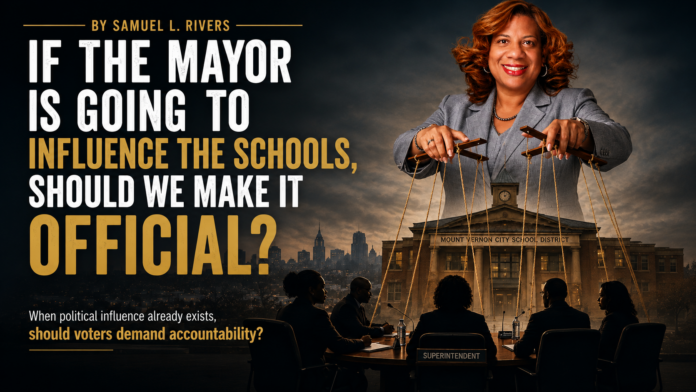





The recent school budget vote has reignited a conversation that many in Mount Vernon have quietly discussed for years.
Mayor Shawyn Patterson-Howard publicly supported the school budget. She participated in outreach efforts, appeared alongside school leadership, and used her political influence to encourage residents to vote yes.
There is nothing illegal about that.
There is nothing improper about an elected official expressing an opinion.
But it does raise a larger question:
If the Mayor is going to play a significant role in school affairs, should Mount Vernon begin exploring a system of mayoral control similar to New York City and Yonkers?
That question deserves an honest conversation.
For decades, Mount Vernon has operated under a divided government structure. The City of Mount Vernon and the Mount Vernon City School District function as separate entities. Separate budgets. Separate administrations. Separate legal departments. Separate maintenance operations. Separate procurement systems.
Yet both are funded by the same taxpayers.
The question taxpayers should ask is simple:
Are we getting the most value for our tax dollars from this arrangement?
Former Mayor Ernest Davis often spoke about what he viewed as duplication of services.
The city has a Department of Public Works.
The school district has facilities and grounds operations.
The city purchases equipment.
The school district purchases equipment.
The city maintains properties.
The school district maintains properties.
The city employs administrative staff.
The school district employs administrative staff.
Taxpayers ultimately fund both.
Should some of these services be consolidated?
Could millions of dollars potentially be saved through shared services agreements?
Would taxpayers benefit from greater efficiency?
These are legitimate questions—not political attacks.
Supporters of mayoral control point to cities such as New York City and Yonkers.
They argue that when one elected executive is ultimately responsible for educational outcomes, there is clearer accountability. Voters know exactly who to praise when schools improve and exactly who to blame when they do not.
There is no finger-pointing.
There is no confusion.
One person owns the results.
But critics of mayoral control raise equally valid concerns.
School boards were created to provide independent oversight of education.
Many believe schools should remain insulated from City Hall politics.
They worry that mayoral control concentrates too much power in one office and reduces community representation.
They argue that education decisions should be made by educators and elected school board members rather than politicians.
Those concerns deserve serious consideration.
What makes this conversation particularly relevant today is the perception among many residents that City Hall already exerts influence over school district affairs despite having no formal authority.
If taxpayers believe the Mayor’s endorsements, political influence, and public advocacy played a meaningful role in the outcome of the recent budget vote, then a reasonable question follows:
Why do we have unofficial influence without official responsibility?
If City Hall is helping shape outcomes, should City Hall also bear direct responsibility for those outcomes?
Or should the Mayor remain completely separate from school governance?
The current system often creates a gray area where influence exists but accountability does not.
That may be the worst of both worlds.
Mount Vernon residents should not be afraid to have this discussion.
This is not about personalities.
This is not about Mayor Patterson-Howard.
This is not about any particular school board member.
This is about structure.
It is about governance.
It is about accountability.
Most importantly, it is about taxpayers.
As property taxes continue to rise and residents are repeatedly asked to pay more, every aspect of government should be open for examination—including whether Mount Vernon’s current division between City Hall and the school district remains the most efficient model.
Perhaps the answer is yes.
Perhaps the answer is no.
But refusing to ask the question serves no one.
At Mount Vernon Under the Microscope, we believe every institution should be examined, every dollar should be tracked, and every assumption should be challenged.
The question is no longer whether the Mayor has influence.
The question is whether Mount Vernon taxpayers are receiving accountability equal to that influence.
That conversation is long overdue.
Question for the community:
Should Mount Vernon continue with an independent Board of Education, or should residents explore a mayoral-control model similar to New York City and Yonkers? What safeguards would you require before supporting either approach?
MountVernonUnderTheMicroscope #MountVernonNY #FollowTheMoney #GovernmentAccountability #TaxpayerFirst #SchoolBudget #MountVernonSchools #PublicPolicy #CivicEngagement #CommunityDiscussion #MountVernonPolitics


Seeing as most people think the mayor already has control of the schools even though she doesn’t and she gets blamed for the actions of the schools even though as the poster said there is no official authority. Why not? People already want to emulate the structure of the school district with a city manager and council. Why not just go all the way.