




One of the most important questions in public policy is not whether a proposal sounds compassionate, inclusive, or progressive. The more important question is whether it strengthens or weakens the institutions upon which society depends. Throughout history, nations have risen and fallen not simply because of economic policy or military power, but because of the strength or weakness of their cultural institutions. Among those institutions, none is more important than the family.
The family is the first school, the first government, the first economic unit, and the first place where values are transmitted from one generation to the next. Long before a child encounters a teacher, a politician, a police officer, or an employer, that child encounters a mother and a father. For this reason, any public policy that alters society’s understanding of motherhood, fatherhood, and family deserves serious examination.
This is why New York Senate Bill S9316 should concern every citizen, regardless of political affiliation. The legislation replaces references to “mother,” “father,” and “paternity” throughout portions of New York Family Court Law with terms such as “gestating parent,” “non-gestating parent,” “parent,” and “parentage.” The bill also changes Article 5 of the Family Court Act from “Paternity Proceedings” to “Parentage Proceedings” and removes legal definitions of mother and father that have existed in New York law for generations.
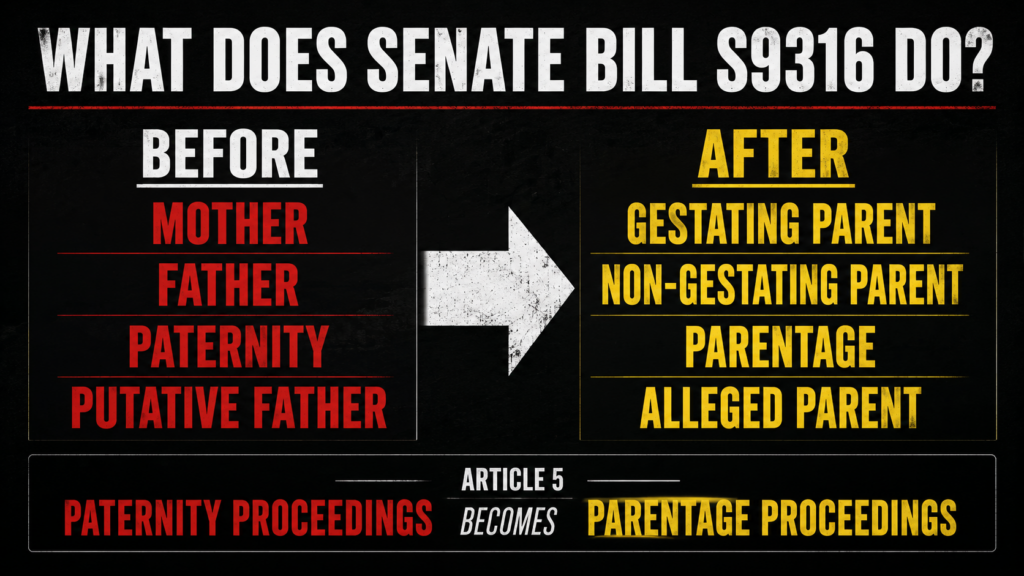
Supporters of the legislation argue that these changes simply modernize legal language and make family law more inclusive. Perhaps that is their intention. However, public policy should not be evaluated solely on intentions. It should be evaluated on consequences. Before embracing any significant change, citizens should ask a simple question: What problem is being solved?
For generations, New York law recognized mothers and fathers as distinct legal and social realities. Those terms were universally understood. They reflected biological relationships, family responsibilities, and social expectations that formed the foundation of family life. Today, lawmakers are replacing those terms with language that is increasingly bureaucratic and clinical. A father becomes a non-gestating parent. A mother becomes a gestating parent. The issue is not whether those new terms can be defined. The issue is why the old terms needed to be removed.
This question becomes even more important when viewed against the backdrop of family instability. For decades, policymakers, educators, clergy, and community leaders have discussed the consequences of fatherlessness, declining marriage rates, and household fragmentation. Entire industries of research have examined the importance of parental involvement in the lives of children. While no family structure guarantees success, there is overwhelming evidence that children generally benefit when responsible mothers and fathers actively participate in their upbringing.
This reality is particularly relevant in Black America. For generations, Black leaders have spoken about the consequences of family breakdown. They have discussed absent fathers, declining marriage rates, and the weakening of institutions that once reinforced personal responsibility and community stability. Whether one agrees with every diagnosis offered over the years is not the point. The point is that countless leaders have argued that stronger communities require stronger families. If that is true, it is reasonable to ask whether removing the language of motherhood and fatherhood from law advances that goal or undermines it.
The larger concern is not merely the language itself. The larger concern is the philosophy behind it. Laws are rarely isolated acts. They reflect a worldview. They communicate assumptions about society and human nature. When government removes the legal distinctions between mothers and fathers, it is making a statement about whether those distinctions remain important enough to preserve. Supporters may insist that nothing substantial has changed, but if nothing substantial has changed, why was the change necessary in the first place?
History teaches that cultural institutions are often weakened gradually rather than suddenly. Rarely does society announce that it intends to dismantle an institution. Instead, the process begins by redefining terms, altering assumptions, and changing the language through which people understand reality. Over time, what was once considered foundational becomes optional. What was once considered essential becomes interchangeable. Eventually, society forgets why those institutions existed in the first place.
One of the most troubling aspects of this debate is the silence from many of the very institutions that have historically defended the family. For generations, the Black church stood at the center of community life. Black pastors spoke boldly about issues affecting Black families, whether those issues involved civil rights, education, poverty, crime, or economic opportunity. The church understood that spiritual leadership required engagement with the issues shaping the lives of its members.
Yet as New York lawmakers move to remove the legal definitions of mother and father from family law, many pastors remain silent. This silence is difficult to understand because family is not a peripheral concern within Christianity. Family is foundational to the biblical worldview. Before there was a church, there was a family. Before there was a nation of Israel, there was a family. Before there was civil government, there was a family. Scripture consistently presents the family as one of God’s primary institutions for transmitting faith, values, and responsibility across generations.
Throughout the Bible, God works through families. Abraham was called to build a family. Israel was organized around families. Parents were instructed to teach their children. Fathers were given responsibilities. Mothers were given responsibilities. Marriage was treated as sacred. The health of the family was inseparable from the health of the community. In many respects, faith itself was preserved through the family structure. If family is foundational to faith, then legislation that redefines the language of family should concern every church leader, every pastor, and every believer.
This concern becomes even more significant when viewed through the lens of Scripture. Genesis 1:27 states, “So God created man in his own image, in the image of God created he him; male and female created he them.” The Fifth Commandment instructs believers to “Honour thy father and thy mother.” Ephesians 6:4 specifically addresses fathers, saying, “And, ye fathers, provoke not your children to wrath: but bring them up in the nurture and admonition of the Lord.” Throughout Scripture, God consistently speaks in terms of fathers and mothers, male and female, husband and wife. These distinctions are not presented as social inventions. They are presented as part of God’s created order.
This raises a question that every believer should consider carefully. When God’s law consistently recognizes fathers and mothers, but man’s law increasingly replaces those terms with gender-neutral alternatives, are we witnessing a godly progression or an ungodly departure from God’s design? When government removes language that Scripture repeatedly affirms, should Christians remain silent simply because the change is presented as modern or inclusive?
These questions are not motivated by hostility toward anyone. They arise from a concern about consequences. Strong societies require strong families. Strong families require clear responsibilities, clear expectations, and clear identities. When government begins altering the language through which society understands those relationships, citizens have every right to ask where that path ultimately leads.
The debate surrounding Senate Bill S9316 is therefore much larger than a dispute over terminology. It reflects competing visions of family, society, and human identity. One vision sees motherhood and fatherhood as foundational institutions that deserve explicit recognition because they perform distinct and irreplaceable functions. The other increasingly views those distinctions as unnecessary and seeks to replace them with broader, more flexible language.
The people of New York must decide which vision they believe will produce stronger families, stronger communities, and a stronger society. Because at the end of the day, no amount of political language can substitute for the institutions that hold civilization together. The future of New York will depend less on the sophistication of its legal terminology than on the strength of the families raising the next generation. Before lawmakers redefine motherhood and fatherhood, they should first explain how doing so will make those families stronger.
Until they can answer that question convincingly, skepticism is not only reasonable. It is necessary.