




The NAACP’s recently announced “Out of Bounds” campaign, supported by members of the Congressional Black Caucus, raises a question that Black America should not be afraid to ask. After decades of political organizing, legislative advocacy, legal challenges, voter mobilization, fundraising, and public activism, why are Black children now being asked to carry a burden that belongs to adults?
According to the campaign, Black athletes should reconsider attending certain universities in Southern states because of concerns over congressional redistricting and political representation. Whether one agrees or disagrees with the legal arguments surrounding those issues is not the central point. The more important question is why some of the most powerful Black political institutions in America have arrived at a strategy that places responsibility on teenagers instead of the adults and organizations that claim to represent them.
A high school athlete did not draw congressional maps. A college recruit did not write election laws. A student athlete did not create the political conditions currently being debated. Yet the solution being offered by the NAACP and echoed by members of the Congressional Black Caucus is for those young people to use their scholarships, athletic careers, and educational opportunities as leverage in a political fight they did not create.
For many Black families, a scholarship is not simply a ticket to a football field or basketball court. It is often the first real opportunity for economic mobility. It may represent the first college graduate in a family. It may represent years of sacrifice from parents and grandparents who worked extra shifts, delayed retirement, or struggled financially so the next generation could have opportunities they never had. Asking young people to walk away from those opportunities should not be treated lightly.
What makes the proposal even more troubling is who is making it. The Congressional Black Caucus exists to influence legislation, shape federal policy, and advocate for the interests of Black Americans in Congress. The NAACP is one of the oldest and most influential civil rights organizations in American history. Together, these institutions possess political influence, legal expertise, fundraising networks, media access, and relationships with elected officials throughout the country.
If anyone should have the ability to pursue legislative, legal, and policy solutions, it would be organizations with this level of influence.
That reality makes this campaign difficult to understand. Black Americans are being asked to believe that, after generations of political engagement, legal advocacy, elections, endorsements, lobbying efforts, and coalition building, the best solution available from the NAACP and the Congressional Black Caucus is to tell Black teenagers where they should not attend college.
If that is truly the best strategy our most prominent Black political institutions can produce, then perhaps the conversation should not be about athletes at all. Perhaps the conversation should be about the effectiveness of the political strategy that produced this outcome.
The problem is that too much of modern Black politics measures activity rather than results. Press conferences are treated as victories. Symbolic gestures are treated as victories. Representation itself is often treated as a victory. Yet representation was never supposed to be the destination. It was supposed to be the vehicle that produced tangible improvements in the lives of ordinary people.
When Black families think about progress, they are not thinking about congressional press conferences. They are thinking about whether their children attend quality schools. They are thinking about whether neighborhoods are safe. They are thinking about whether they can afford a home, start a business, find a good job, build wealth, and leave something behind for the next generation.
Those are the outcomes that matter.
That is why one of the most striking aspects of the “Out of Bounds” campaign is what was missing from the conversation. There was extensive discussion about political power, voting rights, representation, democracy, and redistricting. There was very little discussion about improving schools, increasing homeownership, expanding business ownership, strengthening families, reducing crime, creating wealth, or improving health outcomes.
Yet those are the issues that affect the daily lives of Black Americans far more directly than congressional district maps.
Supporters of the campaign may argue that political representation eventually influences all of those outcomes. That may be true. But if representation is the means, then outcomes must be the measurement. After decades of support for the Congressional Black Caucus and organizations like the NAACP, Black Americans have every right to ask whether the promised outcomes have materialized.
Consider HR 40. Regardless of one’s position on reparations, the legislation was first introduced by Congressman John Conyers in 1989. It was not a reparations payment bill. It was a bill to establish a commission to study reparations. More than three decades later, it still has not become law.
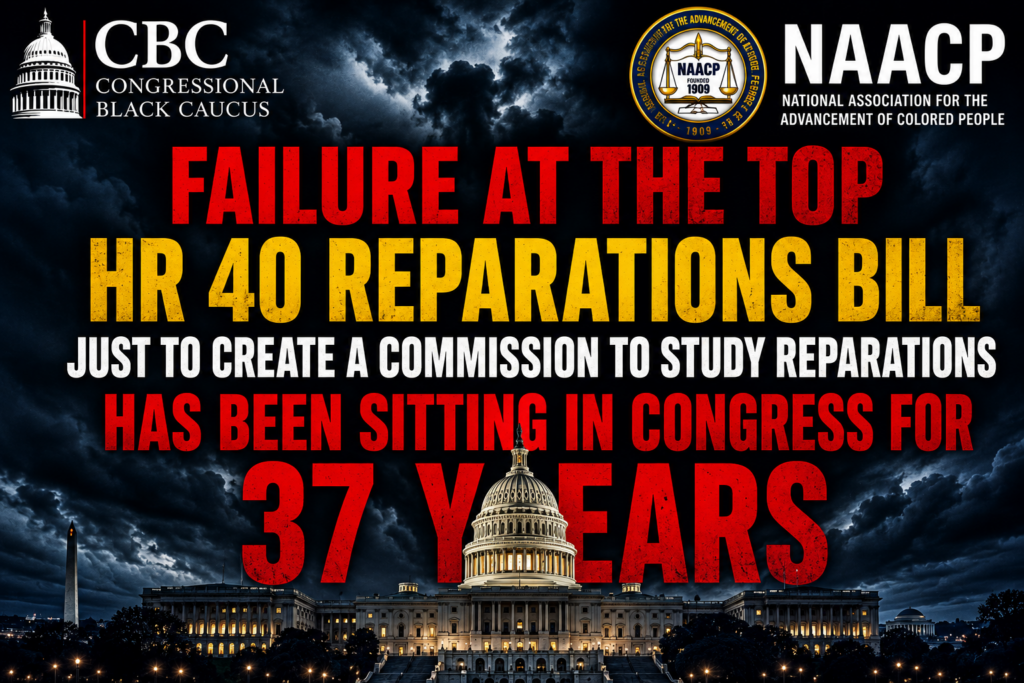
Again, the point is not whether one supports or opposes reparations. The point is that one of the most visible priorities in Black politics has remained unresolved for nearly four decades, despite the existence of the Congressional Black Caucus, decades of NAACP advocacy, and generations of Black voter support.
That reality should force a difficult but necessary conversation.
Real political power is not measured by speeches, media appearances, social media campaigns, or symbolic victories.
Real political power improves schools.
Real political power creates jobs.
Real political power increases homeownership.
Real political power strengthens families.
Real political power creates safer communities.
Real political power expands business ownership.
Real political power builds wealth.
The deeper concern raised by this campaign is that it reflects a political culture that increasingly confuses symbolism with achievement. Asking young athletes to sacrifice opportunities may generate headlines and media attention, but neither headlines nor attention should be mistaken for progress.
Leadership should create opportunities for children, not ask them to pay for the failures of adults.
If after decades of political influence, legislative representation, legal advocacy, and institutional power, the best solution being offered by the NAACP and the Congressional Black Caucus is another sacrifice from the next generation, then Black America deserves an honest conversation about what political power has actually produced.
Because a seat at the table is not power.
Results are power.









Thank you Damon for speaking truth to power. I will share this editorial with as many people as I can!