


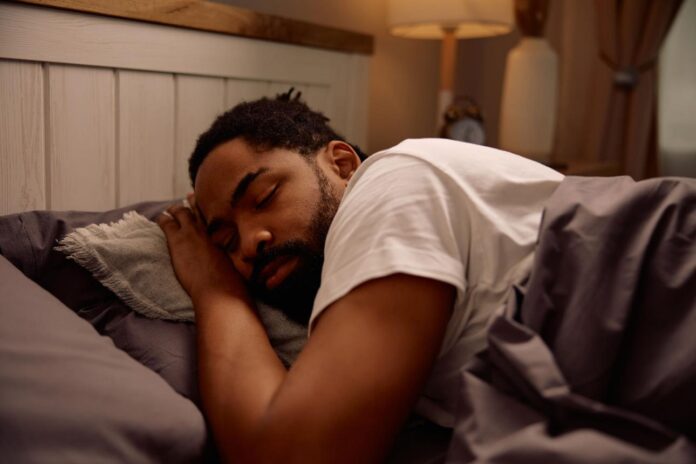





Nearly one in four Black Americans has Sleep Apnea. 95% have never been diagnosed.
Patient stories in this piece are composites drawn from years of clinical experience, with identifying details changed.
Ron came to see me because his wife insisted.
He was 47, an operations manager at a logistics company in the Bronx, coaching his son’s basketball team on weekends in the same worn-out Nike Monarchs he had been wearing for three years. By every measure Ron was functioning, showing up, doing what the day required. His wife had started sleeping in the guest room six months earlier because the snoring had become unbearable. She had also started watching him sleep, and one night she recorded it on her phone and played it back for him the next morning. Long pauses, complete silence, then a desperate gasp, and silence again.
Ron watched the video and said he thought he was just tired.
He had been tired for so long that he had stopped noticing it. He figured it came with the territory, the job, the commute, the kids, the weight of keeping everything together. He was a Black man in his late 40s. Tired was just part of the deal.
He was wrong about that. This was much more than just being tired.
Ron had severe obstructive sleep apnea. His airway was collapsing over 60 times an hour. Every night, his brain was being robbed of oxygen while he slept. His blood pressure, climbing for two years despite two medications, was being driven in part by a condition nobody had ever looked for. Stress alone didn’t explain it. He was suffocating in his sleep, and in fifteen years of seeing doctors the question had never come up.
Ron is not an exception. He is closer to a disturbing pattern.
A Story That Disappeared
A 2022 analysis of two decades of CDC mortality data found that Black men were the only demographic group in America whose sleep apnea mortality had continuously increased, while rates for white Americans and Black women had flattened. The study got a Medscape write-up and a university press release. Then it disappeared, though the condition it documented has not.
“He was suffocating in his sleep, and in fifteen years of seeing doctors the question had never come up.”
A Crisis That Doesn’t Know It Exists
Sleep apnea affects a large share of Black Americans in some measurable form. Research from the Jackson Heart Sleep Study, one of the largest cardiovascular studies ever conducted in African Americans, found that 24% of participants had moderate to severe sleep apnea, with the figure rising to 37% under more sensitive scoring criteria. Only 5% of those with the condition had ever received a physician diagnosis.
Which means that in any room full of Black adults, a meaningful share are living with a condition that is interrupting their breathing dozens of times a night, driving up their blood pressure, fragmenting their sleep, clouding their thinking, straining their hearts, and quietly shortening their lives. Almost none of them know it.
The clinical pathways that should catch it don’t always reach the people carrying the most risk.
Something I’ve Had to Sit With
Early in my career, before sleep medicine became central to my clinical thinking, I was part of this problem. I had patients sitting across from me describing exhaustion that should have prompted a sleep conversation, and I reached for the more familiar explanations first. Stress, depression, the cumulative weight of navigating a world that asks more of Black people and gives back less. Those things were real, and they were also, sometimes, a convenient explanation that let me stop asking.
Looking back, I can see the pattern in patients I was seeing a decade ago. The exhaustion in the chart, the blood pressure that wouldn’t come down, the partner who came to the appointment carrying a worry I didn’t know how to meet. The question I should have been asking wasn’t on my intake form. I suspect it isn’t on a lot of intake forms, in a lot of clinical offices, right now.
What Is Actually Happening Inside
Understanding why sleep apnea kills helps explain why it kills disproportionately in the Black community, where cardiovascular disease is already the leading cause of death.
Every time the airway collapses during sleep, oxygen levels drop, and the brain reads this as an emergency, repeatedly activating the body’s stress response. Heart rate spikes, blood pressure surges, and the cardiovascular system is pulled into a state it was never designed to sustain. Breathing resumes, and the body briefly settles, until the airway collapses again. Dozens of times a night, sometimes more than a hundred, the body is running a silent emergency drill it was never designed to run repeatedly. Over months and years, that cycle damages blood vessels, drives oxidative stress, inflames arterial walls, and accelerates the hardening of the arteries that precedes heart attack and stroke.
There is also a mechanical dimension that rarely gets discussed in plain language. When someone strains to breathe against a collapsed airway, the chest creates intense negative pressure, physically pulling on the walls of the heart with each attempt. Night after night, that strain accumulates. This is structural cardiac stress, happening while the person sleeps.
This is why treating hypertension in someone with untreated sleep apnea often produces disappointing results. The blood pressure medication is working against a physiological storm that restarts every night.
A Note on Body Size
Obesity is a recognized risk factor for sleep apnea, because excess weight around the neck narrows the airway. The relationship runs in both directions. Poor sleep disrupts the hormones that regulate hunger and fullness, making weight management harder. The two conditions can feed each other in a cycle that is difficult to break without addressing both.
More importantly, body size doesn’t tell the whole story.
Sleep apnea is increasingly documented in athletes and physically fit individuals. Jaw structure, neck anatomy, airway dimensions, and nasal anatomy all contribute independently of body weight. A lean, physically active person can have severe sleep apnea.
The assumption that someone doesn’t “look like” a sleep apnea patient has cost lives and is one of the more persistent and dangerous myths in this space. Smaller-framed Black men and women are not exempt. Neither are Black children, Black athletes, or anyone who has been told they are too young or too fit to have this condition.
Why Black Men Are Dying From This
Black men tend to be diagnosed later, with more severe disease by the time they reach a sleep lab. Clinical data show a higher apnea-hypopnea index, greater symptom burden, and more coexisting medical conditions at the point of diagnosis compared with white men. They are more likely to stop breathing completely during sleep, more likely to fall asleep at the wheel, and more likely to carry years of cardiovascular damage that traces directly back to what happens in the bedroom every night.
When a Black man dies of a heart attack at 53, the chart doesn’t usually mention sleep apnea. It mentions hypertension, obesity, and stress. The airway collapse that was happening dozens of times a night for a decade, flooding his system with stress hormones, straining his heart, driving his pressure up while he slept, that part doesn’t make the record. It was never diagnosed. Nobody looked.
Research tracking two decades of mortality data found that Black men were the only demographic group to show a continuous increase in sleep apnea-related deaths over the most recent ten-year period studied. That trajectory has not reversed.
The Women Nobody Is Asking
Denise is 52, a school administrator in Pelham, mother of three grown children, grandmother of one. She described her fatigue to me the way many Black women do, carefully, almost apologetically, as if exhaustion were a personal failing instead of a symptom. She had mentioned it to her primary care doctor twice in three years, and both times the conversation moved toward stress management and sleep hygiene tips. Her labs were fine. She was told to try going to bed earlier.
The sleep-related questions never came up. No one asked about snoring, checked in with her husband about what he might have noticed at night, or considered whether a sleep study belonged in the workup.
When we finally did one, Denise had moderate sleep apnea. She had almost certainly had it for years. The fatigue, the brain fog she had attributed to getting older, the morning headaches she thought were from stress, all of it had a name, and all of it had a treatment.
Sleep apnea doesn’t look the same in women.
The dramatic gasping that sends a man to a sleep lab isn’t always how it presents. In women it can surface as fatigue that won’t lift, mood that won’t stabilize, concentration that keeps slipping. In a Black woman’s clinical visit, those complaints can easily get absorbed into a conversation about stress or depression before anyone considers what is happening during sleep.
Black women have some of the worst sleep quality of any group measured, and that holds across income levels, education levels, and work schedules. They are also among the groups least likely to be referred for a sleep evaluation, least likely to complete one, and least likely to receive consistent follow-up afterward. Those gaps compound across a lifetime.
A System Built for Someone Else
Sleep labs are concentrated in wealthier, predominantly white ZIP codes, and transportation barriers alone eliminate a significant share of Black patients who might otherwise pursue evaluation. Home sleep testing is more accessible, and research shows over 80% of urban Black patients prefer it, though insurance coverage through Medicaid is inconsistent and varies by state.
When a primary care physician does make the referral, the loop often doesn’t close. In one community-based study of Black patients referred for possible sleep apnea, only 38% made it to the sleep consultation, and of those who did, the overwhelming majority received a diagnosis. The signal was there in the clinical record, and the follow-through stalled.
When CPAP is prescribed, the follow-up support needed to troubleshoot fit, comfort, and adherence is less available in lower-resourced clinical settings. When CPAP fails, surgical options exist, and Black patients are less likely to be offered them at comparable rates. The pathway narrows at every stage where another choice could have been made.
None of this is new. Black Americans have a documented history of receiving less aggressive diagnostic workups and less comprehensive treatment across nearly every disease category studied. Sleep medicine sits squarely in that pattern. It has just not been talked about enough outside of academic journals.
It Starts in Childhood
Black children have higher rates of sleep-disordered breathing than children of any other racial or ethnic group.
Some of it is anatomical, and a lot of it is environmental. Growing up in neighborhoods with elevated noise, poor air quality, and chronic stress affects airway development and sleep architecture in ways that accumulate over time.
A child who can’t sit still in class, who is falling behind, who is being labeled a behavior problem, may simply not have slept well in years. Untreated sleep apnea can mimic ADHD in the classroom, with inattention, restlessness, and poor impulse control all presenting in ways that are hard to tell apart from a teacher’s desk. One presentation gets a medication, and the other needs a sleep study. When the wrong answer gets established early, it follows a child for a long time.
One Thing to Do Tonight
If you are waking up tired despite a full night of sleep, if someone has told you that you snore loudly or stop breathing, if your blood pressure is not responding to medication the way it should, if you are dragging through the day in a way that feels bigger than stress, ask your doctor specifically about a sleep evaluation at your next visit.
If your doctor doesn’t bring it up, you bring it up. You are not being difficult. You are asking for a diagnostic conversation that should have happened years ago.
And tonight, before you go to sleep, ask the person next to you one question: do I stop breathing during the night? That question has saved lives. It may save yours.
Ron got his diagnosis. He started CPAP therapy, and within three months his blood pressure had dropped enough that his cardiologist reduced one of his medications. His wife moved back into the bedroom. He told me recently that he had forgotten what it felt like to wake up rested.
Denise called her daughter after her first full night of treated sleep and said she had not felt that clear-headed in a decade. She asked her daughter to make an appointment with her own doctor.
Her daughter is 31.

About the author: Derek H. Suite, M.D., M.S., is the Founder and CEO of Full Circle Health and Full Circle Wellness. He is the host of the daily SuiteSpot podcast and a frequent guest health contributor for Black Westchester Magazine. Dr. Suite is a board-certified psychiatrist, specializing in high performance, mental resilience, and sleep medicine. He is an alumnus of the Columbia School of Journalism and a former clinical professor of psychopharmacology at Columbia University.