







Affordability for Whom? The Fiscal Case for Scrutiny in Mount Vernon
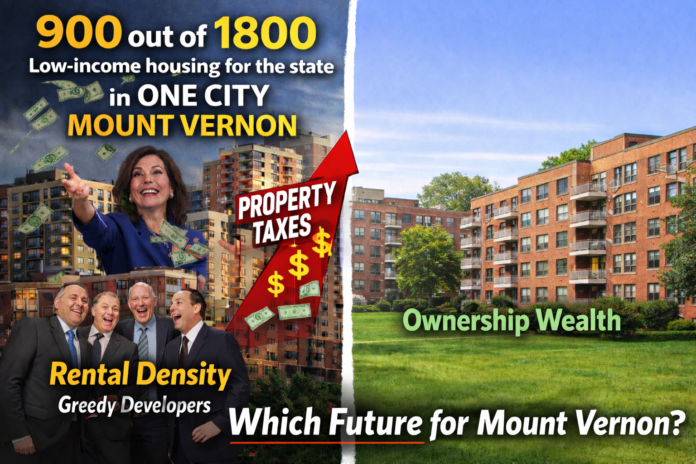
Governor Kathy Hochul recently announced more than $240 million in tax credits and subsidies to create or preserve approximately 1,800 affordable housing units statewide. Roughly 900 of those units — half the total — are projected to be built in Mount Vernon.
Mount Vernon encompasses approximately four square miles. It is already one of the most densely populated cities in New York State, a municipality facing documented financial stress and recent homeowner tax increases. When half of a statewide housing initiative is concentrated in a single four-square-mile city that has already raised property taxes to close fiscal gaps, proportionality becomes relevant.
If affordability is the stated objective, the question must be asked: affordability for whom?
The Taxpayer Is Also a Resident
Affordable housing policy typically focuses on rental affordability. But homeowners are taxpayers. When municipal obligations increase faster than unrestricted revenue, the burden shifts to them — through higher taxes, diminished services, or both. Affordability for renters cannot be evaluated in isolation from affordability for taxpayers.
Mount Vernon is not operating from a fiscal surplus. The city has experienced recurring budget pressure, tax cap overrides, and a tax base weighted heavily toward renters rather than owner-occupied property. State audits have identified weaknesses in financial controls that contributed to instability. These conditions limit fiscal flexibility.
Under such circumstances, expanding rental density — particularly through projects that carry reduced real property taxes under a PILOT arrangement — requires disciplined analysis.
A tax abatement may make a project feasible for a developer. Reduced tax exposure improves return on investment, and that logic is rational within private markets. Municipal finance, however, operates under different constraints. When full property taxation is reduced for extended periods, unrestricted revenue growth is constrained. At the same time, the costs associated with additional residents — policing, fire protection, sanitation, infrastructure maintenance, and education — are not reduced. If service obligations increase faster than unrestricted revenue, the difference is borne by existing taxpayers.
This is precisely how Mount Vernon arrived at its current fiscal condition. Once known as the City of Homes, Mount Vernon has gradually become a concentrated destination for low-income rental housing. Each successive wave of subsidized development reduced the tax base a little further, increased service demand a little more and left existing homeowners and taxpayers to absorb the gap. The city’s financial distress is not a mystery. It is the cumulative result of decades of policy choices that prioritized short-term project feasibility over long-term municipal sustainability. Approving more of the same will not reverse that trajectory. It will extend it.
This is arithmetic.
The Numbers Aren’t on the Table Yet
At a recent public hearing, the finance chair asked directly whether building this project would require the city to raise taxes or subsidize the development. He referenced the public backlash following a recent tax increase and framed his concern plainly: constituents want to know whether additional burdens will fall on homeowners. He also noted that even operational costs — such as increased garbage tonnage — rise significantly with the building of this size.
The applicant’s representative acknowledged that the developer would be seeking a reduction in real property taxes to make the project financially feasible. It was also acknowledged that projections regarding student impact, a cost-benefit analysis, and return on investment for the city were not yet available and would be produced later as part of the review process.
In other words, the city is being asked to move forward procedurally before the public has clear numbers on the net fiscal impact. That is not a technical concern. It is the core question of governance.
The Enrollment Argument Is Backward
It has been suggested that additional children in the school system would improve fiscal stability. But enrollment is not revenue. Each additional student represents cost — instruction, transportation, facilities, administrative overhead, and long-term benefit obligations. A school district stabilizes when its funding base is stable, not merely when headcount increases.
Mount Vernon’s educational challenges are not rooted in a shortage of rental housing or children. They are rooted in fiscal strain and instability. When enrollment shifts in ways that strain resources or weaken performance metrics, families with means respond predictably: they remove their children from public schools. That response is not ideological — it is incentive-driven. If policy increases enrollment without improving instructional quality, discipline, and measurable outcomes, it does not strengthen the district. It accelerates the exit of the very taxpayers whose property values fund it.
Performance and stability restore confidence. Enrollment growth alone does not.
Capital Retention and the Ownership Gap
Mount Vernon’s core challenge is not the absence of rental units. It is a constrained tax base within a geographically small, already dense city — and a structural failure to retain capital locally.
The city pays the salaries of municipal employees, yet there is no coordinated strategy to expand homeownership among those same workers within its borders. Many firefighters, police officers, teachers, and sanitation workers earn wages funded by Mount Vernon taxpayers and purchase homes in neighboring municipalities. When that occurs, property tax revenue and equity formation leave the city. Those workers’ wages strengthen other towns instead.
Economics is clear on this point: capital retention matters. It is more sustainable to circulate income within a local economy than to export it. When city-funded wages are converted into ownership inside Mount Vernon, capital stays. When those wages flow outward, they take both tax revenue and generational wealth with them.
This dynamic also explains why large concentrations of subsidized rental housing are not embraced in the most affluent white municipalities in Westchester County. Many higher-income towns maintain strict zoning codes and density limitations that effectively prevent this kind of development. Those policies are not accidental, and they are not racist. They exist to preserve property values, protect school stability, and control long-term fiscal exposure. Mount Vernon, by contrast, is being asked to absorb half of a statewide initiative within a city already operating under fiscal constraint. Concentrating that level of subsidized rental density here does not broaden the tax base. It increases service demand while constraining revenue.
When development outpaces unrestricted revenue, the tax base does not grow. It erodes.
A Path Worth Considering: Cooperative Ownership
Housing policy can pursue short-term affordability or long-term capital formation. If the objective is economic mobility and fiscal resilience, ownership must be part of the equation. Homeownership builds equity through principal reduction, appreciation, leverage, access to collateral, and intergenerational transfer. Rent does not.
Rather than concentrating additional low-income rental units under reduced tax arrangements, a portion of development could be structured as cooperative housing priced within reach of working families — perhaps in the range of $150,000 to $250,000 per unit. That price range creates a path to ownership rather than permanent tenancy. Monthly payments build equity rather than simply covering occupancy. A structured maintenance fee covers shared building costs and operations, aligning housing expenses with capital formation.
A cooperative ownership model would create a measurable pathway for city workers and middle-income residents to invest in the place where they work. Ownership changes incentives. Residents who hold equity invest in long-term stability. Turnover decreases, maintenance improves, and capital formation occurs within municipal boundaries.
If public subsidies or zoning flexibility are granted, an ownership component should be a condition of that support. Public concessions should produce public capital formation.
This does not eliminate renting. Rental housing has a role in any functioning market. But in a four-square-mile city already facing fiscal pressure, the distinction between expanding rental and expanding ownership is consequential.
What the City Should Require Before Moving Forward
Before approving additional units under reduced tax arrangements, the city should require a clear comparison between projected PILOT payments and full taxable assessed value, a service cost model for municipal operations, a student-generation estimate tied to unit mix and net school fiscal impact, and a documented cost-benefit analysis demonstrating measurable return to the city and school district.
If such an analysis is unavailable, the decision is made without full fiscal information.
This is not an attack on Grace Baptist Church or the partners involved. Grace has a longstanding presence in Mount Vernon and a record of community engagement. That history is not in question. But goodwill does not offset arithmetic.
Developers evaluate feasibility. Municipal officials must evaluate sustainability. If projected costs exceed projected unrestricted revenue, the difference will be borne by taxpayers.
Growth that expands obligations faster than revenue produces strain. Growth that expands ownership and strengthens the tax base produces stability.
The distinction is not ideological. It is mathematical.