









Public debates tell us what people feel. Outcomes tell us what people prioritize.
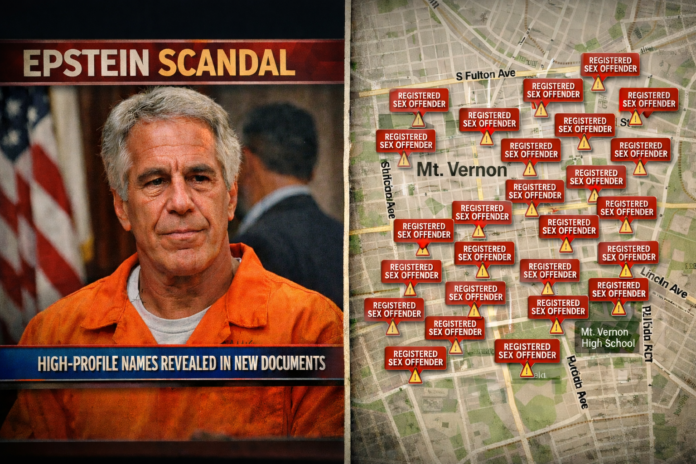
For weeks, timelines have been dominated by outrage over the Epstein files — a national scandal involving powerful people, distant locations, and courtroom documents. The language used is moral: protect the children. But protecting children is not measured by statements. It is measured by exposure to risk.
Start with proximity.
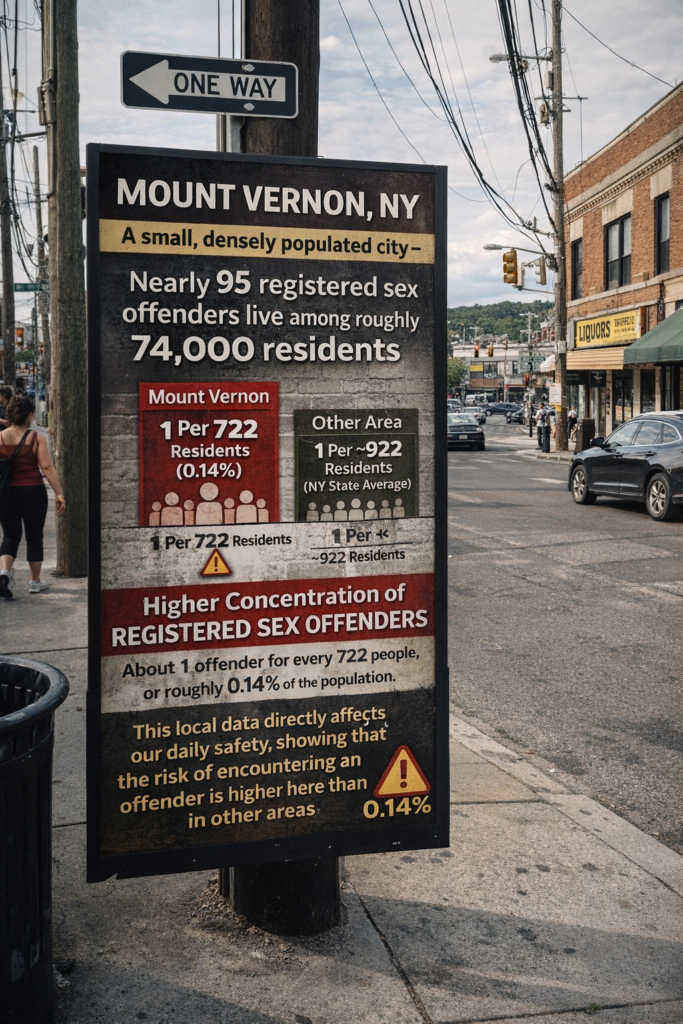
In Mount Vernon, New York — a small, densely populated city — registry data shows a significantly higher concentration of registered sex offenders relative to its size than surrounding suburban municipalities. Approximately 95 registered offenders live among roughly 74,000 residents — about 1 offender for every 722 people, or roughly 0.14% of the population. This local data directly affects our daily safety, showing that the risk of encountering an offender is higher here than in other areas, which should influence our community priorities.
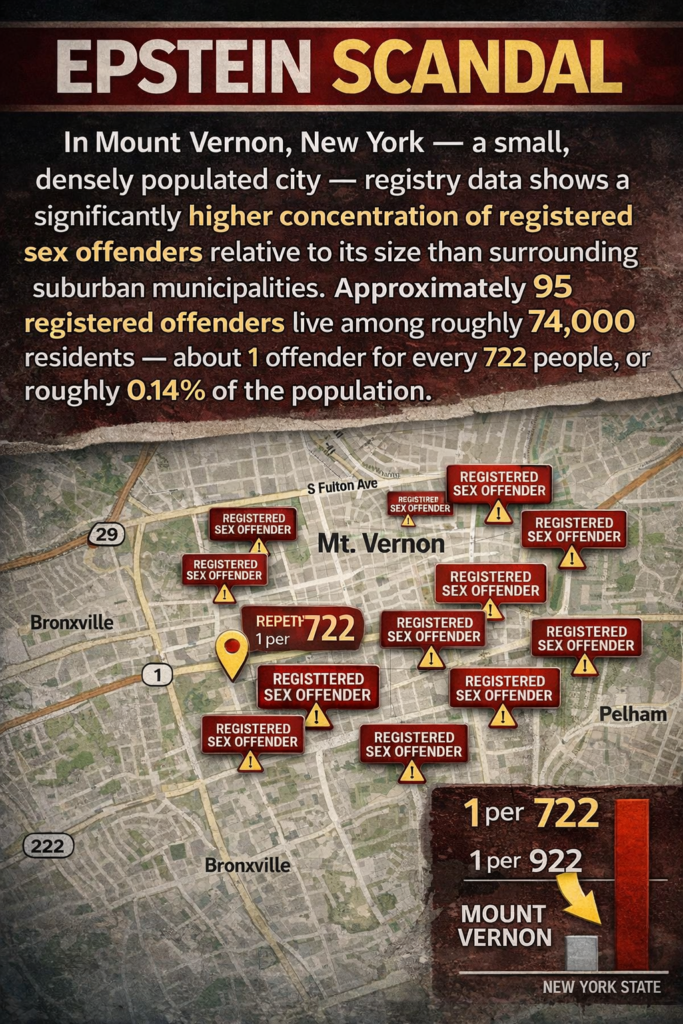
The state does not publish a ranking, so the relevant question is not whether it is number one. The relevant question is probability. When concentration rises in a confined geographic space, the chance of encounter increases. That is not political. It is arithmetic.
When I lived in Mount Vernon, I checked a public registry app to assess how close the issue actually was. Within my own apartment building alone, four registered offenders were listed. That is what proximity looks like in real life — not a headline, not a trending topic, but a daily environment.
A child’s safety is determined less by who appears in a national court filing and more by who lives within walking distance of home, school, and transit routes. The daily environment determines risk frequency. National scandals do not.
And this is where the contradiction shows itself. If the concern is truly “protect the children,” then the most urgent conversation should be the one closest to the children. Yet when Mount Vernon’s own reality is in front of us — the concentration of registered sex offenders inside a small Black city — timelines are largely silent. The same people who post daily about Epstein rarely post about that. The moral language is loud when the scandal is far away, and quiet when the risk is next door.
This is not taking away any accountability that may come from the files. Crimes should be investigated and wrongdoing exposed wherever it exists. But distance changes behavior. It is always easier to condemn people far away than to question people you know, see at fundraisers, or interact with locally. Distant accountability costs nothing. Local accountability costs relationships.
Read: The Clock and the Culture: What Did Mount Vernon’s Leadership Know, and When Did They Know It?”
A recent local case involving a head coach arrested in connection with alleged sexual activity involving a minor produced limited sustained public pressure from many of the same voices who regularly post about the Epstein story. There were also public accusations that the mayor contacted the individual connected to the case, and she publicly acknowledged having a conversation with him. Whether one agrees with that decision or not, the reaction pattern is notable: no protests outside the Westchester County District Attorney’s office, no broad public demand for an explanation, no emergency community forums. Timelines were largely quiet. The same accounts posting daily about Epstein barely addressed the local incident at all.
The difference in response shows a consistent social pattern. People react most strongly when responsibility is lowest.
Discussing distant wrongdoing requires opinion. Addressing local conditions requires decisions. Local issues force practical scrutiny — and scrutiny creates social friction. So attention shifts toward safer outrage rather than uncomfortable accountability.
This pattern appears beyond crime. Communities often invest emotional energy in narratives as they adapt to measurable conditions. Over time, abnormal exposure becomes routine simply because it is familiar. Familiarity lowers reaction, not risk.
Incentives shape attention. National outrage produces agreement and moral signaling. Local scrutiny produces conflict and obligation. The result is predictable: the discussion expands while the environment remains unchanged.
Whether names appear in the Epstein files will not alter where offenders live in a specific city. It will not change supervision practices. It will not change the daily encounter probability. Those are local realities governed by local awareness and local leadership decisions.
This does not make national crimes unimportant. It establishes scale. The likelihood of harm is governed by proximity, not publicity.
If the objective is safety, priorities must follow outcomes.
Based on reaction patterns, society shows greater energy for distant scandals than for nearby risks. That is not a moral accusation. It is an observable behavior. Observable behavior reveals the true hierarchy of concern.
We debate nationally.
We live locally.
But we rarely apply urgency to what affects us most.
Until attention follows probability, conversations about protecting children will remain expressive rather than effective.


I encourage people to examine and report their family members that target the vulnerable in their household and neighborhood. If you look up the offenders and their victims, you’ll most likely find that the criminal was known to the victim. I’m more worried about a neighbor than a random offender. Protect yourself and your community. As for the high concentration in MV, it’s probably simple economics. Comparatively, housing may be slightly cheaper than our surrounding communities. No need to think that we’ve fallen short as a City or in leadership.