








Linda from White Plains thought she cracked the code. She started sleeping eight hours a night. She bought blackout curtains, skipped late-night scrolling, even protected her weekends. She did everything “right.”
But three weeks later, she still felt wrecked.
“I don’t get it,” she told me. “I’m sleeping more than ever, but I feel just as tired as when I was only getting five hours.”
That moment is when I hit her with the truth that stuns almost every patient I see: You can sleep eight hours and still wake up exhausted. Because your body doesn’t just need time in bed. It needs restorative sleep. And that’s a whole different game.
The Hidden Sleep Equation
What most people never learn is this: your brain cycles through four distinct stages of sleep every night, and only about 15 to 20 percent of that time is physically restorative. The rest? It’s important, but it won’t rebuild your brain, clear toxins, or refill your emotional tank.
Think about it like this:
– You could sleep 8 hours and get 30 minutes of real restoration.
– Or you could sleep just 6 hours and get a full 90 minutes of deep, healing sleep.
Who wakes up feeling better? Exactly.
Meet Your Brain’s Night Shift Crew
Your body runs a tight overnight operation, like a rotating construction crew. Each stage of sleep plays a role—but only one does the real heavy lifting.
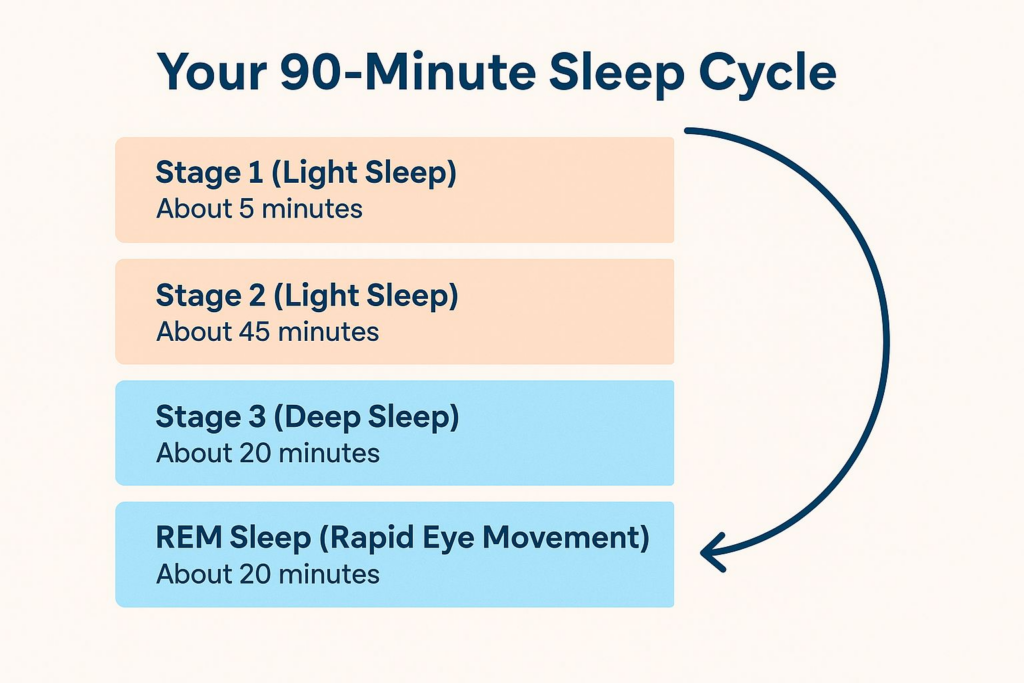
– Stage 1: The Security Guard (5 minutes)
You’re barely asleep. It’s the lightest phase, a transition zone. Any noise—your partner shifting, a car alarm—can yank you back awake.
– Stage 2: The Prep Crew (45 minutes)
This is maintenance mode. Heart rate slows, body temp drops, brain starts sorting files. You spend most of your night here.
– Stage 3: The Heavy Construction Team (20 minutes)
This is where the magic happens. Blood pressure drops, growth hormone surges, and your brain clears toxic waste. This is your restoration zone.
– REM Sleep: The Electricians (20 minutes)
Brain activity spikes again—almost as if you’re awake. You’re dreaming, processing emotions, wiring in new memories.
Your brain repeats this 90-minute cycle four to six times per night. So in theory, a full night’s sleep gets you around 90 to 110 minutes of Stage 3 deep sleep. That’s your goal. That’s the math.
But here’s the problem: most people never get there.
Why You’re Not Getting What You Think You’re Getting
Linda’s sleep tracker told the story. She was clocking in 8 hours, but only landing about 25 minutes of Stage 3 sleep. The rest was light and fragmented.
Why? Because her body never felt safe enough to go deep.
The Sleep of the Hypervigilant
In 25 years of practice, I’ve seen this pattern over and over—especially among caregivers, night shift workers, and high-stress professionals.
They tell me they’re sleeping. But they’re really hovering—half-awake, always on alert, listening for kids, parents, late-night work calls.
Linda nailed it when she said, “Even when I’m asleep, part of me is on guard.”
This isn’t insomnia. It’s vigilance.
And it blocks your brain from entering Stage 3.
Black Americans, in particular, are at higher risk for disrupted sleep due to environmental stress, shift work, and chronic social pressures. NIH studies show they average 6.8 hours of sleep per night, compared to 7.4 hours in other groups—and with lower sleep efficiency.
Translation: less time asleep + more fragmented sleep = health risk.
How to Tell If You’re Getting Restorative Sleep
You don’t need fancy gadgets, but data can help
– Trackers: Look for 15–20% of sleep in Stage 3. Less than 10% means your body’s not rebuilding.
– Feel test: Can you focus by 10 AM? Or are you dragging until noon?
– Dreams: Remembering dreams may mean you’re waking at a natural cycle—usually a good sign.
– Afternoon crash: A heavy 2–3 PM slump may signal fragmented sleep the night before.
Try this weekend experiment: Don’t set an alarm. Notice when you naturally wake up. That’s likely the end of a full cycle.
What Our Grandparents Already Knew
Long before scientists named these sleep stages, elders had a phrase for it: “sleeping like a baby.” They meant uninterrupted, deep sleep.
Many of my patients report that their best sleep comes after prayer or meditation. And science backs this up—spiritual practices activate your parasympathetic nervous system, the part of your body responsible for deep rest and recovery.
Think of it as your internal “brake pedal”—it slows your heart rate, lowers stress hormones, and signals to your brain that it’s safe to go deep.
Don’t Just Sleep Longer—Sleep Smarter

If you’ve only got 5 or 6 hours to sleep (hello, caregivers and night shifters), make those hours count.
– Keep a consistent sleep/wake schedule, even on weekends.
– Wind down for 30–60 minutes before bed—no screens, no chaos.
– Make your room dark, cool, and quiet (or use earplugs or white noise).
– If you sleep “with one ear open,” try tools that give you peace of mind:
– Baby monitor, if you’re a parent.
– Earplugs that filter out random noise but still let you hear real emergencies.
Linda started using filtered earplugs. She still heard her teens come in, but wasn’t startled by every street noise. Her deep sleep doubled within two weeks.
When to Worry
If you’ve optimized your sleep habits and still feel wiped, talk to a provider.
Sleep apnea, restless leg syndrome, and other medical conditions can rob you of deep sleep no matter how long you’re in bed.
If your doctor brushes it off with, “Just lose weight,” or “It’s just stress,”—keep pushing.
You deserve restorative sleep.
The Bottom Line
Linda’s breakthrough came when she stopped chasing hours and started chasing restoration.
“Now I know why I can sleep all weekend and still feel terrible,” she told me.
“And why a short nap sometimes feels more refreshing than a whole night of tossing and turning.”
If you’re waking up groggy after 8 hours?
That’s not laziness. That’s sleep fragmentation. Your brain never made it to the restoration zone.
Start tuning in. Your body already knows the truth.
It’s not how long you sleep.
It’s how well you rebuild.
Dr. Derek Suite is a board-certified psychiatrist, Columbia University faculty member, and founder of Full Circle Health—a holistic health practice serving New York communities since 1999. For questions about this monthly series, email info@fullcirclehealthny.com
Next in the Series:
“Sleep Disruptors: From Blue Light to Life Stress” – What’s Stealing Your Deep Sleep (and How to Take It Back)
Medical Disclaimer: This article is for educational purposes only. It does not replace medical consultation or diagnosis. Always speak with your healthcare provider if you have concerns about your sleep.