



When Zohran Mamdani burst onto New York’s political scene with promises of rent freezes, free buses, and a war on billionaires, he presented himself as the people’s champion — a man of the working class taking on the establishment. However, a closer look at the money trail, rather than the message, reveals a different narrative.
Behind the seemingly noble slogans of socialism and equity, a web of sophisticated financing is at play. This network, connecting nonprofit foundations, political action groups, and billion-dollar donors, reveals a different narrative. It’s not a revolution of the poor against the rich, but rather the rich sponsoring a revolution that never truly challenges their interests.
Black Americans must start researching who funds a candidate instead of being swept up by emotion, personality, or slogans that sound good in the moment. Political decisions built on feelings rather than facts always come with a cost — and that cost is usually paid by the very communities most loyal to the system. Every campaign promise, every “movement for the people,” and every speech about equity must be traced back to its financial source. Because money is policy. The one who funds the candidate sets the agenda, and the one who votes without researching becomes a spectator to decisions made in someone else’s interest. Logic must replace emotion, and accountability must replace loyalty — or Black America will continue to mistake symbolism for progress and personality for power.
The Illusion of Grassroots Power
Mamdani’s campaign was branded as grassroots — a “movement powered by small donors.” Yet public filings with the New York City Campaign Finance Board tell a more complex story.
By March 2025, Mamdani had raised over $8 million, far surpassing most rivals. He boasted thousands of small contributions, but disclosure records show a heavy concentration of out-of-state money and several large institutional contributions routed through political action committees (PACs) and affiliated nonprofits.
One PAC — the Unity and Justice Fund, linked to CAIR — moved about $100,000 in support of his campaign. Another — the Working Families Party PAC — bundled additional contributions from out-of-state networks.
According to Forbes, two billionaire donors, Elizabeth Simons and Tom Preston-Werner, contributed through independent committees supporting Mamdani. These are not working-class donors; they are members of the same economic class he rails against.
The Soros Connection: Following the Money
In a meticulous analysis presented on The Publisher’s Desk, forensic accountant Sam Antar unravels the intricate financial channels that link George Soros’s Open Society Foundations to a network of nonprofits. These nonprofits, in turn, provide field and campaign support for Mamdani, painting a complex picture of his financial backing.
Here’s how that pipeline allegedly works:
- Charitable donations flow to a Soros-backed 501(c)(3) foundation, such as Open Society or Bend the Arc Jewish Action.
- That 501(c)(3) then grants money to its sister 501(c)(4) — the political arm allowed to engage in advocacy and “issue-based” campaigning.
- The 501(c)(4) then endorses candidates, provides canvassing, and mobilizes voters — all without the transactions appearing as direct campaign expenditures.
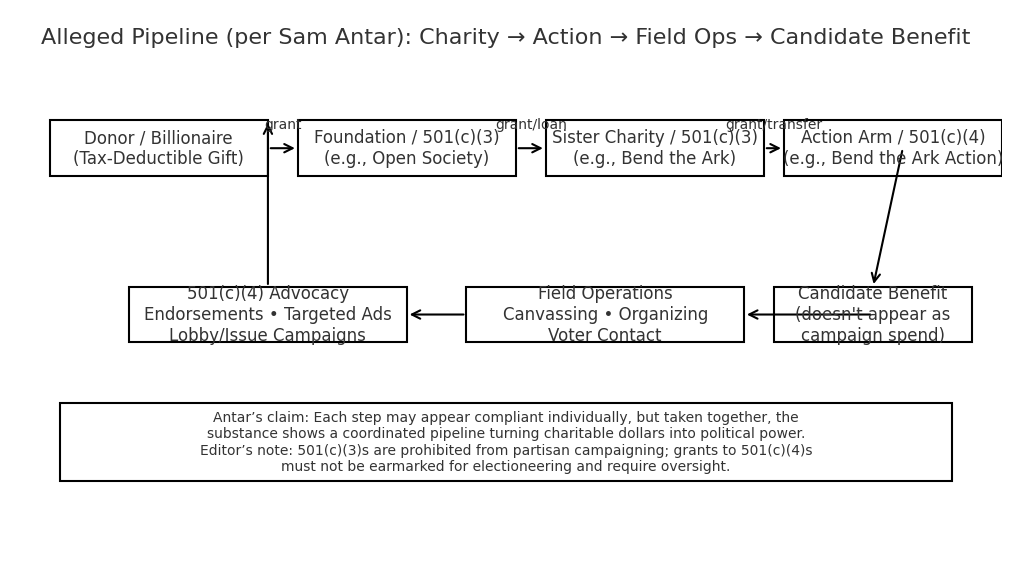
Antar described it as an “incestuous relationship — not just in money, but in management,” pointing out that Alex Soros, George’s son, has chaired both entities. Funds move back and forth as grants and loans, sometimes even on the same day.
On paper, each transaction may appear legal. But as Antar put it, “When you look at the behavior, not the paperwork, it shows a coordinated network that blurs the line between charity and politics.”
Invisible Money and the Tax Loophole Game
Under IRS rules, a 501(c)(3) charity cannot participate in partisan politics. However, when such an organization gives money to a 501(c)(4) “social-welfare” group — and that 501(c)(4) engages in electioneering — the chain becomes difficult to trace.
This allows major donors to convert tax-deductible charity dollars into political influence.
A direct political donation offers no tax break. But a donation to a foundation that funnels money through sister nonprofits allows a wealthy donor to claim a deduction while indirectly funding campaigns.
That is what Antar calls “tax arbitrage” — influence at a discount.
And in Mamdani’s case, that invisible money flowed through several channels, making it almost impossible for voters to see who was really footing the bill for his “grassroots” revolution.
When the Anti-Capitalists Take Capital
For someone who insists he wants to “tax the rich” and make the wealthy “pay their fair share,” Mamdani’s donor pool reads like a Wall Street directory.
- Real-estate professionals — including figures tied to the same development firms blamed for New York’s affordability crisis — appear in his filings.
- He accepted contributions from executives in the very industries his platform condemns.
- And foreign contributions — at least $13,000 worth — were flagged by regulators as possibly illegal and are still under review.
He tells voters that businesses are the enemy, but it’s the business class — the very rich, he claims, he’ll make “pay” — that funds his campaigns. That is not reform. That is political theater financed by the same investors who profit from both sides of the debate.
This is not a movement detached from money; it is a movement powered by elite money, laundered through activism.
The Mamdani Campaign is not unique. It represents a national model in which the same donor class that funds establishment Democrats also funds their ‘progressive challengers.’ The intent is not ideological purity; it’s market diversification.The Mamdani campaign is not an isolated case. It represents a national model where the same donor class that funds establishment Democrats also backs their ‘progressive challengers.’ This isn’t about ideological purity; it’s about market diversification, a systemic issue that needs to be addressed.
Billionaires like Soros, Simons, and other heirs of significant fortunes hedge their political bets by investing in both wings of the same bird.
They fund moderates and radicals alike — because influence, not ideology, is the goal.
As Thomas Sowell once wrote, “The real problem isn’t that politicians lack compassion; it’s that they lack consequences.” The donor class ensures that no matter which message wins, the money stays in control.
This pattern mirrors the political theater of Barack Obama — the original “people’s candidate.”
When Obama took office in 2009, he was hailed as the symbol of change — a historic breakthrough, a Black family in the White House, and a promise of racial progress. Yet, beyond the symbolism, the data tells another story:
- The median wealth of Black households collapsed during Obama’s presidency — falling from about $10,700 before the Great Recession to just $1,700 by 2013, according to the Institute for Policy Studies.
- White household wealth, by contrast, rebounded, growing roughly 6% between 2007 and 2013, while Black wealth dropped 75% (National Community Reinvestment Coalition).
- The Black-White wealth ratio shrank from 6.4% in 2007 to 2.4% in 2016 (Pew Research Center).
Obama’s presidency proved that representation without reform changes optics, not outcomes.
The same illusion now returns in Mamdani’s campaign — a progressive face funded by elite money, promising transformation while preserving the same economic hierarchy.
Why This Matters to Black New Yorkers
For Black New Yorkers, this isn’t just about campaign finance — it’s about political return on investment.
For decades, Black voters have given the Democratic Party their most consistent support. In this last mayoral cycle, Black voters made up roughly 40 percent of Mamdani’s total vote. Yet the communities delivering those votes are the same ones still facing rising crime, poor schools, and disappearing homeownership.
This is why we get nothing. You cannot run a multi-billion-dollar campaign for the largest political platform in the world outside of the presidency and still pretend it’s grassroots. There’s nothing revolutionary about a movement financed by the same elite interests that already run the city.
Mamdani’s rhetoric may sound like it fights for people with low incomes, but his campaign economics prove it answers to power.
And until Black voters connect campaign financing to the everyday realities in their neighborhoods — taxes, housing, jobs, safety — they will continue to invest loyalty where there is no measurable return.
Political dependency without economic power is a trap.
When billionaire foundations handpick who “represents” the people, they’re not empowering the Black community — they’re managing it.
Conclusion: Follow the Money, Not the Message
There’s nothing inherently illegal about Mamdani’s fundraising structure. What’s troubling is the contradiction — a movement built on anti-elite rhetoric but sustained by elite resources.
The lesson is simple:
When billionaires fund both sides of a political argument, it isn’t democracy — it’s strategy.
Mamdani’s rise shows that the revolution has investors.
And now that he’s been elected — chosen by people’s passions and emotions — the political reality begins. He must serve those to whom he truly owes his victory.
And it’s not you, the voter.
It’s the donor class.
Because when the rich finance the resistance, the only thing being overthrown is transparency.
References
- Institute for Policy Studies, “Obama-Biden and the Racial Wealth Divide” — inequality.org/article/obama-biden-close-racial-wealth-divide
- National Community Reinvestment Coalition, “Why Biden Must Build Back Better Than Obama for Blacks” — ncrc.org/why-biden-must-build-back-better-than-obama-for-blacks
- Pew Research Center, “Wealth Gaps Rise to Record Highs Between Whites, Blacks, Hispanics” — pewresearch.org/social-trends/2011/07/26/wealth-gaps-rise-to-record-highs-between-whites-blacks-hispanics
- Forbes, “Here Are the Two Billionaires Supporting Zohran Mamdani” — forbes.com/sites/kylemullins/2025/11/01/here-are-the-two-billionaires-liz-simons-preston-werner-supporting-zohran-mamdani
- NY1 News, “Zohran Mamdani Maxes Out Fundraising for Mayoral Primary” — ny1.com/nyc/all-boroughs/politics/2025/03/24/zohran-mamdani-maxes-out-fundraising-for-mayoral-primary
- The Guardian, “Zohran Mamdani’s Grassroots Campaign” — theguardian.com/us-news/2025/nov/06/zohran-mamdani-campaign-new-york-democrats
- NYP Post, “Mayoral Candidate Mamdani’s Real Estate Donations” — nypost.com/2025/03/22/us-news/mayoral-candidate-zohran-mamdani-hypocrite-for-real-estate-donations










I really like reading through a post that can make men and women think. Also, thank you for allowing me to comment!