




Following recent public discussion about Mount Vernon’s finances, City Comptroller Darren M. Morton submitted a January 6, 2026, letter to Black Westchester to clarify the record regarding the City’s fiscal progress. That clarification is necessary, not as a rebuttal, but as an essential accounting of what has actually been accomplished — and under what conditions.
Read: Mount Vernon’s Financial Crisis Is Not a Mystery — It Is a Structural Failure of Authority
Measuring Progress by Outcomes, Not Narratives
To fairly evaluate Mount Vernon’s current financial position, it is essential to begin with context.
When Comptroller Morton took office in 2022, he did not inherit a functioning financial system. He inherited years of unresolved audits, incomplete records, and institutional breakdown. Before addressing the fiscal years tied to his own elected term, he was required to complete the outstanding audits left undone under former Comptroller Deborah Reynolds.
That reality shaped everything that followed. Completing audits for fiscal years 2016 through 2020 — and filing the five corresponding State Annual Financial Reports — was not optional work; it was prerequisite work. Without resolving that backlog, the City could not move forward in any meaningful or compliant way.
Measured against that starting point, the concrete achievements under Comptroller Morton demonstrate tangible progress in restoring fiscal stability. Five audits have been completed and five AFRs filed. Financial policies are now in place. Three tax lien sales have been completed, and the In Rem foreclosure process has been initiated. These are not promises. They are actions.
Progress Under Constraint
It is also essential to understand why the City is not yet fully current.
Audits must be completed sequentially, and reconstructing records across agencies is labor-intensive, highlighting structural constraints rather than neglect.
Comptroller Morton has acknowledged that the City is not yet where it needs to be. But emphasizing the progress made can inspire confidence that positive change is underway, even amid challenges.
A History That Cannot Be Ignored
Credit where it is due also requires honesty about the broader institutional history.
Mount Vernon’s financial challenges are not the result of a single office or administration. They reflect a longstanding pattern of dysfunction across multiple parts of the City government.
That dysfunction spans the unresolved audit failures under former Comptroller Deborah Reynolds, the fiscal instability and governance issues during the administration of former Mayor Richard Thomas, and ongoing questions surrounding spending decisions under current Mayor Shawyn Patterson-Howard.
A critical and often overlooked factor in sustaining fiscal progress is the competence of departmental leadership. Even the strongest financial plans fail without commissioners who understand structure, staffing, and cost controls. In Mount Vernon, this challenge is compounded by a long political history of appointments driven more by nepotism, favoritism, and personal loyalty than by demonstrated competence. That culture weakens internal controls and allows overtime abuse, poor manpower allocation, and budget drift to become normalized. Sustainable fiscal recovery requires commissioners selected for their ability to manage operations, control costs, and execute policy — not for their political usefulness. Without that shift, progress made at the comptroller level will continue to be undermined inside city departments.
Comptroller Morton’s work must be evaluated within that reality. He did not create the conditions, he inherited it. He has been tasked with repairing them.
The Real Test Going Forward
The question now is not whether progress has been made. It has.
The real question is whether that progress can be sustained, completed, and institutionalized over time.
Rebuilding a city’s financial integrity is not a single event. It requires alignment across every level of government. It requires a Mayor who governs with an executive, taxpayer-first mindset. It requires commissioners who remain disciplined to the budget over time, resisting unnecessary and off-track spending. And it requires a City Council that legislates responsibly and exercises consistent oversight.
This work is measured over time — through completed audits, reliable financial reporting, enforceable policies, and consistent execution. By those metrics, Mount Vernon must move forward and govern accordingly, or it risks ending up in the same position as the school board.
Recognizing progress does not require ignoring remaining risk. But dismissing progress simply because the finish line has not yet been crossed would be intellectually dishonest.
Outcomes matter.
Context matters.
History matters.
And when judged by outcomes rather than rhetoric, Comptroller Morton’s tenure reflects repair — not stagnation — in a City that has spent too many years paying the price for dysfunction.
At Black Westchester, we do not traffic in feelings. We evaluate leadership by outcomes — because outcomes, not intentions, determine whether communities move forward or fall behind.

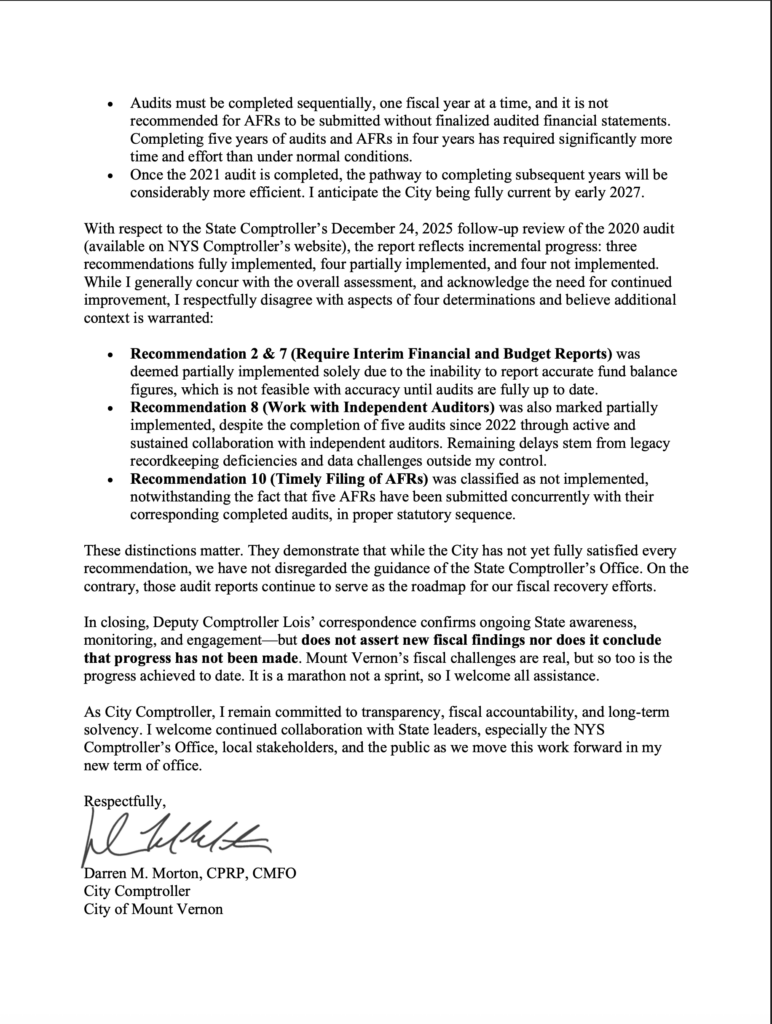
















This is what propaganda looks like in municipal font: big claims, zero evidence, and a smug slogan about “outcomes.”
You want to talk outcomes? Post the audit reports and opinions, AFR filing confirmations, the actual financial policies, lien sale dates/proceeds/parcels, and the In Rem filings. Otherwise it’s not “progress”, it’s branding, and you’re hoping nobody asks for receipts.
This article is a response to our first piece calling for stronger oversight of Mount Vernon’s city finances — something you’d know if you actually read it instead of rushing to label it “propaganda.”
We didn’t just talk about outcomes. We named them, and we also gave residents the exact offices and phone numbers to call to demand state oversight and legislation. That part seems to have gone right past you.
You can read it here since you didnt read the link in the article. https://blackwestchester.com/mount-vernons-financial-crisis-is-not-a-mystery-it-is-a-structural-failure-of-authority/
And let’s be clear: demanding receipts doesn’t magically erase work that’s already been done. Five completed audits, five AFRs filed, financial policies implemented, tax lien sales executed, and In Rem proceedings initiated are not “zero evidence.” They are verifiable actions. Public records exist whether you choose to look at them or not.
Here’s the part you seem determined to miss:
Two things can be true at the same time.
Yes, there is an active repair process underway.
And yes, oversight is still necessary.
Acknowledging progress is not propaganda. Pretending nothing counts unless it fits your preferred narrative is.
If your position is “show the documents,” fine — that’s how accountability works. But acting like recognizing documented progress somehow cancels the need for oversight, or that we didn’t explicitly call for oversight, just tells everyone you didn’t actually engage with the substance of what was written.
This wasn’t about asking people to stop questioning.
It was about stopping lazy arguments.