




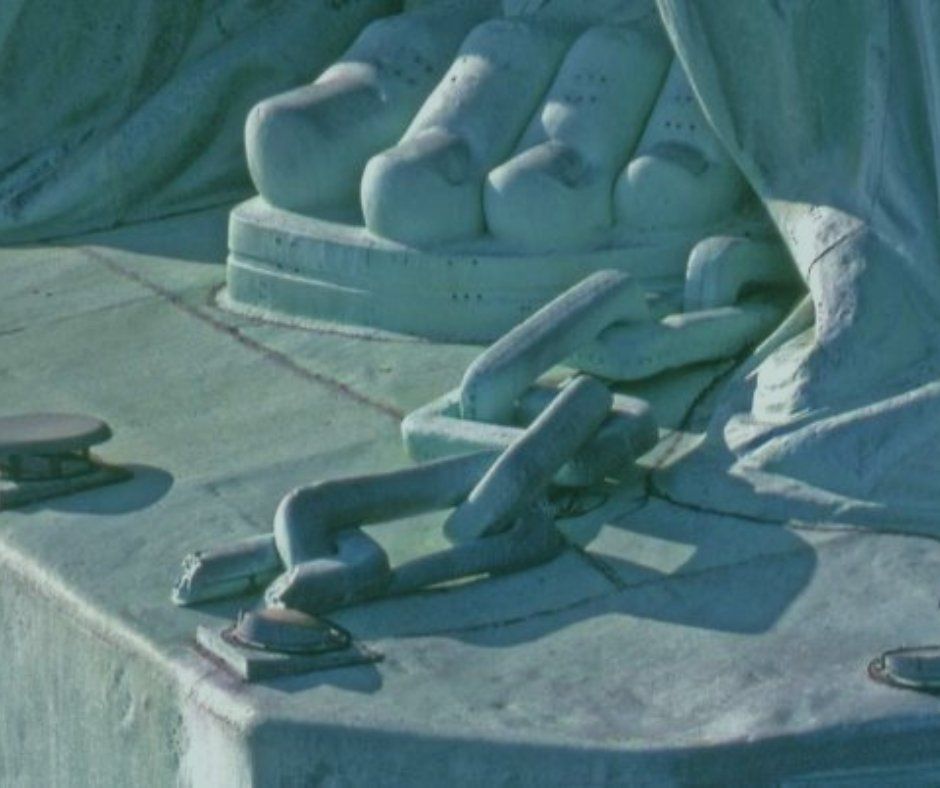
In celebrating the life & legacy of the late Malcolm Jamal-Warner, my cousin Michelle shared a clip of a podcast, hosted by Malcolm Jamal-Warner & Candace O. Kelley called Nah: In Case You Missed It. The episode shared with me was titled “The Hidden Truth About the Statue of Liberty.” The featured guest, Dr. Joy DeGruy talks about how she visited the Statue of Liberty (Liberty Enlightening the World) on the behest of her good friend Floyd V. Myers and expressed that most people do not know that the Statue was originally created to symbolize the end of slavery. “The broken chains at her feet tell a hidden story—one that America tried to erase.”
She explained that what most people do not know, especially since it’s not taught in school, is that the Statue of Liberty features broken shackles and chains at her feet, symbolizing the end of slavery and the abolishment of bondage in the United States. While many associate the statue with immigration, her original design and symbolism focus on emancipation from slavery. The broken chains, though subtle, were intended as a powerful statement by the statue’s designer, Frédéric-Auguste Bartholdi, and his French abolitionist collaborators, to celebrate the end of slavery after the American Civil War.
Dr. DeGruy, author of “Post Traumatic Slave Syndrome: America’s Legacy of Enduring Injury and Healing” spoke of seeing the original design for the Statue of Liberty in France, which included broken chains and shackles in her left hand. However, this design was changed before the statue was completed, and the chains and shackles were placed at her feet instead. (The episode is available to watch below).
In 1865, Édouard de Laboulaye, a French political intellectual, activist, and staunch abolitionist, was a strong supporter of Abraham Lincoln and the Union cause during the American Civil War. He admired Lincoln’s leadership and the ideals of freedom and democracy that the United States represented, particularly after the abolition of slavery. He proposed gifting the United States with a statue honoring the centennial of America’s independence, the abolition of slavery, and the long-standing friendship between the two nations. French sculptor Auguste Bartholdi supported Laboulaye’s idea and, in 1870, began designing the globally recognized statue, “Liberty Enlightening the World.”
The sculptor, Frédéric-Auguste Bartholdi, intended to represent this with broken chains and shackles in her left hand. The decision was made to move the broken chains to her feet, and her left hand was given a tablet instead. This was done, in part, to make the statue more palatable to a wider audience and to avoid reopening old wounds from the Civil War era. The sculptor compromised by placing the broken shackles and chains at the statue’s feet, hidden beneath her robes, as a subtle nod to emancipation while avoiding overt confrontation.
Bartholdi was told the inclusion of overt symbols of emancipation would be seen as potentially reopening wounds from the Civil War and Reconstruction, and faced resistance from American financiers who were crucial for funding the statue’s pedestal
While there has been some pushback to the claim, I am reminded of the quote, “History is written by the victors,” which reflects the idea that those who win a conflict or achieve power often control the narrative of the past, shaping how events are remembered and interpreted.
Let’s look at the time. The pedestal of the Statue of Liberty was completed in April 1886, and finally, on October 28, 1886, President Grover Cleveland oversaw the dedication of the Statue of Liberty in front of thousands of spectators. Just 21 years after the Civil War, which was fought in the United States from 1861 to 1865.
On June 19, 1865, Major General Gordon Granger arrived in Galveston, Texas, and announced the end of slavery in the state, fulfilling the Emancipation Proclamation, which had been initially issued two and a half years earlier on January 1, 1863. Issued by President Abraham Lincoln, it was a presidential proclamation that declared the freedom of slaves in Confederate territory during the American Civil War.
So the idea that the sculptor, Frédéric-Auguste Bartholdi, intended to represent and symbolize the end of slavery with broken chains and shackles in her left hand, but a decision was made by Americans in power at the time to move the broken chains to her feet, and her left hand was given a tablet instead, was done, in part, to make the statue more palatable to a wider audience and to avoid reopening old wounds from the Civil War era, is not that farfetched.
A quick Google search will show various websites making the same claim, including opinion editorials and letters to the editor published by the New York Times, Liberty’s Broken Shackles, Like Toes, Are Hard to See in 1999, and New Statue of Liberty Museum Illuminates a Forgotten History in 2019.
On The New York Historical Society’s History with David Rubenstein, Rubenstein explores the history and evolving symbolism of the Statue of Liberty in his series “Iconic America: Our Symbols and Stories,” which includes a New York Historical Society segment. The series examines the statue’s origins, its representation of liberty and immigration, and its connection to American values and conflicts. A related “History Minute” video from the New-York Historical Society delves into the hidden chains at the statue’s feet, symbolizing the nation’s struggle for racial equality, (see video below).
Meanwhile, as expected, other websites are claiming to debunk what they write off as a myth. But one thing that cannot be hidden, no matter how hard they try, they can not erase the fact that there are shackles at the base of the statue on her leg as she appears to be stepping forward out ofthe bondage of slavery. Like the toes of the statute, there is an attempt to hide the broken shackles under her long, flowing robe, but if you look hard enough, you can still see them.
In Ken Burns’ 1985 PBS documentary, The Statue of Liberty, the film explores the history of the statue, including its symbolism of freedom and refuge for immigrants. The documentary notes that Bartholdi, the sculptor, originally planned to incorporate broken chains in the statue’s left hand, but they were ultimately replaced with a tablet. However, the broken chains and shackles were moved to the statue’s feet to symbolize emancipation and freedom, according to the Statue of Liberty — Ellis Island Foundation.
While the statue was a gift from France, American financiers influenced the final design by requesting the removal of chains held in her hand, replacing them with a tablet. The focus on immigration, highlighted by the poem “The New Colossus” added later, has often overshadowed the statue’s original purpose as a symbol of emancipation.
The reason most people do not know of the original intention of the the statute symbolizing the end of slavery is because not only is that not taught but the shackles and chains at her feet are not easily visible to visitors on Liberty Island because the Statue stands on a 154 foot tall pedestal, which effectively obscure the broken chains at her feet. But as Dr. Joy DeGruy eloguently stated, these are “the lies we were told and [here is] the truth that sets us free.”
We are in the process of extending an invitation for Dr. Joy DeGruy to appear on an upcoming episode of Black Westchester presents People Before Politics Radio to delve deeper into the topic.