



There are no permanent victories in politics—only trade-offs. What we saw in the U.S. Senate this week was a case study in that reality. After more than a month of government shutdown, eight Senate Democrats broke ranks and voted with Republicans to reopen the government. The outrage from their own party was predictable. But beneath the noise lies a simple question: What was the alternative?
For weeks, Democratic leaders tied the reopening of the government to a demand to extend Affordable Care Act subsidies—effectively holding federal workers, small businesses, and citizens hostage in a policy negotiation. The logic was clear: use pain as leverage. The problem was also clear: pain cuts both ways.
While politicians in Washington postured, TSA officers went unpaid, food programs were halted, and national security personnel were stretched thin. In a contest between ideology and reality, reality tends to win—eventually.
When Idealism Meets Arithmetic
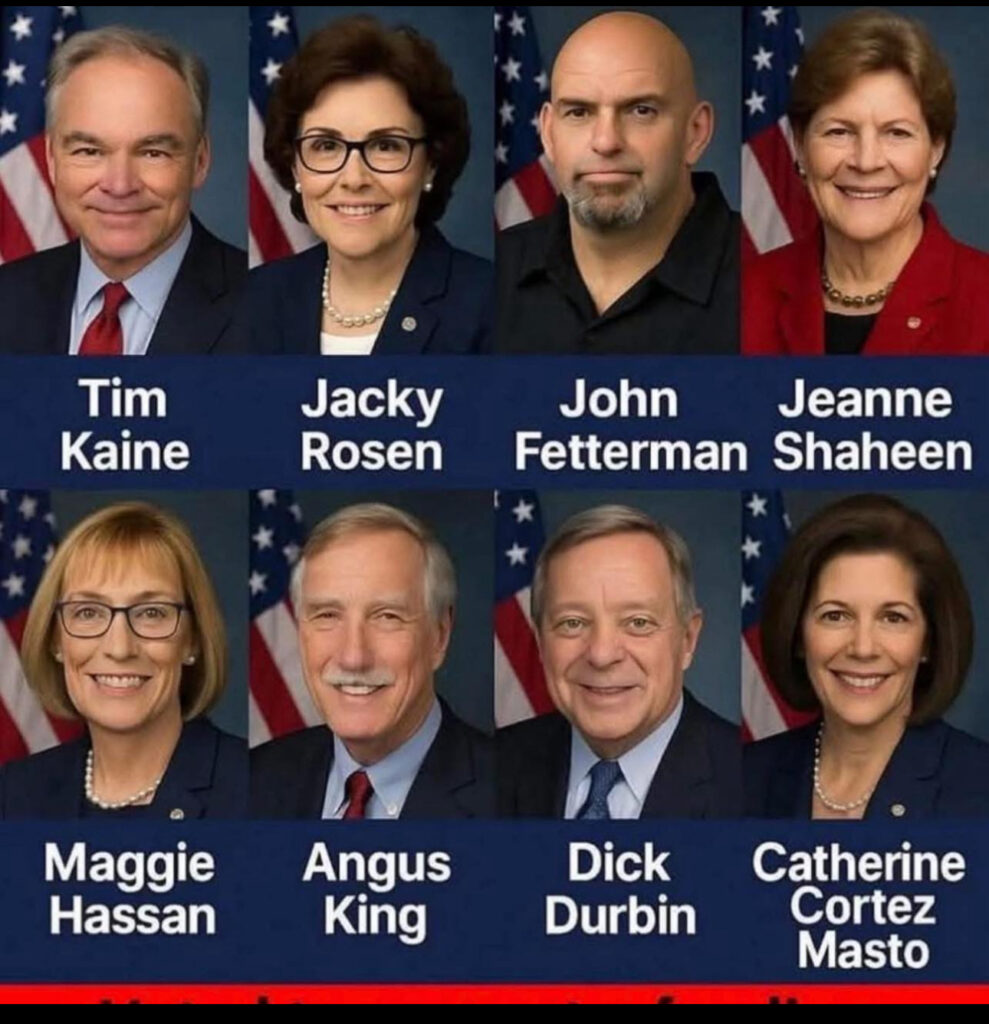
The eight Democrats who voted to break the impasse—Dick Durbin, John Fetterman, Catherine Cortez Masto, Jacky Rosen, Maggie Hassan, Jeanne Shaheen, Tim Kaine, and Angus King—demonstrated remarkable courage and chose arithmetic over ideology.
They recognized that a government cannot function on symbolic politics. Someone has to pay the bills. And shutting down the operations of a $6 trillion government over a disagreement over one healthcare provision is like refusing to pay your mortgage because you don’t like the color of the mailbox.
The vote wasn’t a betrayal of principles; it was an acknowledgment of limits. Durbin and Fetterman said plainly that their states couldn’t afford to keep bleeding. Federal workers were missing paychecks, airports were reporting staffing shortages, and SNAP recipients were at risk of going hungry. For senators from working-class or rural states, the cost of waiting outweighed the benefit of political purity. The sacrifice of these federal workers should not be overlooked.
Read: A Continuing Resolution Can’t Fix Healthcare
The Schumer Offer—and the Trump Counter
In the final days of the standoff, Senate Majority Leader Chuck Schumer offered what he called a “reasonable compromise”: reopen the government for a year and extend the Affordable Care Act subsidies for the same period, with a promise to negotiate reforms later.
President Trump countered with a plan that bypassed the insurance industry altogether. Instead of giving billions in federal subsidies to private insurers, his administration proposed sending those funds directly to the people in the form of refundable health credits or direct-pay vouchers—allowing citizens to choose their providers or pay cash for procedures.
That proposal was the first serious attempt in years to challenge Big Insurance’s power structure. But the political class—on both sides—had no appetite for it. Democrats rejected it because it cut out the insurance companies that fund their campaigns. Many Republicans quietly resisted it because it removed a key lobbying ally that helps them keep their own budgets intact.
Read: The ACA Offer and the Counteroffer: Would Cutting Out Big Insurance Finally Put People First?
So what happened to Trump’s offer? It vanished into the same void that swallows most ideas that threaten Washington’s intermediaries. The Senate refused to include it in the continuing resolution. The media ignored it. And the public—distracted by the theatrics of the shutdown—barely knew it existed.
The irony is that both parties claimed to be fighting “for the people,” yet both rejected the only proposal that would have given money directly to the people.
What Was Gained—and What Was Lost
The outcome is neither heroic nor tragic—it’s predictable. Government operations will resume through January 30, 2026. Workers will receive back pay. Programs that feed and serve millions of Americans will restart. But the ACA subsidy expansion, which many Democrats fought to tie to this bill, was left out—replaced by a vague promise of a future vote.
That’s not a compromise. That’s surrender with hope attached.
Republicans got what they wanted: a clean continuing resolution without policy riders. Democrats bought a reprieve at the cost of their leverage. In the logic of negotiation, they traded a concrete demand for a conditional promise.
If history is any guide, promises in Washington tend to expire faster than continuing resolutions.
The Broader Lesson
What makes this episode revealing is not just who voted which way, but what it says about how our politics functions—or fails to. A shutdown is not a policy instrument. It’s a symptom of a government addicted to performance politics. Both parties use it as theater: one side claiming moral high ground, the other claiming fiscal responsibility, while both quietly ensure that no structural reform ever happens. The need for systemic reform is urgent.
The same senators who shut down the government over healthcare spending have yet to propose real cost controls for healthcare itself. Instead, they fight over subsidies—a short-term patch that does nothing to lower costs for the long term. That’s like arguing over who should pay for a broken pipe instead of fixing the leak.
Meanwhile, voters continue to cheer for slogans rather than results. “Tax the rich.” “Protect the poor.” “Defend democracy.” These are applause lines, not policies. And every time politics becomes a contest of emotions instead of outcomes, the people who pay the price are the ones least able to afford it.
The Logic and the Outcome
The logic behind the eight Democrats’ decision was straightforward: governance is not a protest movement. They recognized that waiting for perfection meant leaving millions in limbo. Their critics, however, view compromise as betrayal. But politics is not religion. It’s arithmetic.
The outcome is as predictable as the dysfunction it stems from: the government reopens, but the underlying issues remain untouched. The same fight will return in January, and the same politicians will replay the same arguments—hoping the public forgets who created the problem in the first place.
Thomas Sowell once wrote, “There are no solutions. There are only trade-offs.” The Senate vote proved him right again. The trade-off here was between political leverage and national stability. Eight Democrats chose stability. Their party may call them traitors. History may call them adults.
And as for the offer that could have truly reformed the system—sending the money directly to the people—Washington did what it does best: bury the idea, protect the bureaucracy, and move on to the next crisis of its own making.