



Donald Trump’s proposal for a 50-year mortgage has stirred up fresh debate in the housing market — a market where Black Americans already face the steepest barriers to ownership. On paper, it sounds like relief: smaller monthly payments, more time to pay, and broader access to homeownership. But beneath the surface, this plan could either create a bridge to generational wealth — or lock another generation of Black families into long-term debt with little real gain.
The Promise: A Ray of Hope in the Housing Market. For millions of working-class Americans, the dream of owning a home has drifted further out of reach. Mortgage rates hover above 6%, housing inventory is tight, and first-time buyers are being priced out of even modest neighborhoods. In that context, a 50-year mortgage looks appealing.
By stretching payments over five decades, monthly costs drop by a few hundred dollars. That reduction could help a family qualify for a home they might otherwise be denied. Trump and housing advisor Bill Pulte describe the plan as a “game changer” that would “unlock the market for working people.”
For younger Black Americans — especially those burdened by student loan debt and stagnant wages — this could open doors. In cities like New York, Atlanta, and Los Angeles, where rent consumes half a paycheck, a lower mortgage payment could be the first step toward ownership.
But lower payments don’t automatically mean more wealth.
The Reality: You Own the Debt, Not the Home
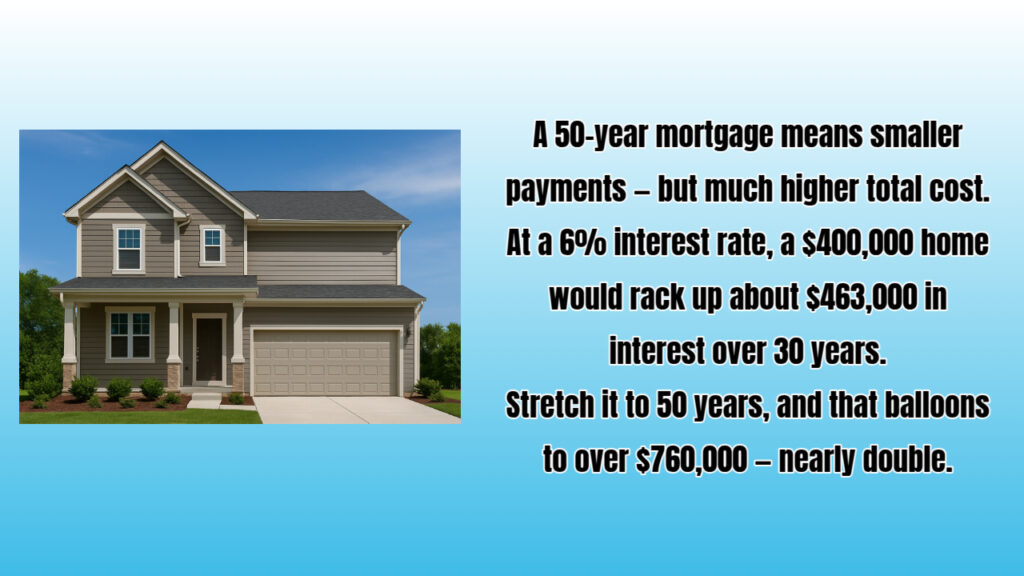
The math tells a more complicated truth. Extending the loan term from 30 to 50 years doesn’t just reduce monthly costs — it multiplies the total interest paid. A $400,000 mortgage at 6% interest over 30 years costs about $463,000 in interest. Stretch that to 50 years, and the borrower pays roughly $760,000 in interest — nearly double.
In other words, the bank gets richer while the homeowner builds equity at a crawl.
For Black homeowners — already battling appraisal discrimination, redlining, and lower property values — this slower equity growth could mean decades of owning less of what they pay for. And in neighborhoods with weaker appreciation rates, a 50-year mortgage might trap families in homes worth less than the debt they owe.
We’ve seen this movie before. Subprime loans in the 2000s promised “affordable payments” too — until the economy shifted, values dropped, and Black homeowners lost billions in generational wealth.
The Risk: Turning Ownership Into Perpetual Rent
If you stay in a 50-year loan without extra payments, you’ll spend the better part of your life mainly paying interest. For the first 15–20 years, the principal barely moves. That means little equity to borrow against for college tuition, business startup capital, or retirement.
And if inflation rises or property taxes go up — as they often do — that “affordable” payment could still become unsustainable—the result: foreclosures in communities already hit hardest by economic instability.
Thomas Sowell often reminded us that “there are no solutions, only trade-offs.” A 50-year mortgage is a prime example. It trades short-term relief for long-term cost.
How to Beat the System
Still, for the financially disciplined, the 50-year plan can be a tool—not a trap. If the loan allows prepayments without penalty, a homeowner can pay the 30-year equivalent each month while keeping the flexibility of the longer term.
That means if hard times hit, you can fall back on the lower required payment. But when times are good, you can pay more and build equity faster.
Empowerment through Knowledge: The Role of Financial Literacy and Community Support

The Bigger Picture: Credit Without Construction Is an Illusion
Addressing the Root Cause: The Housing Supply Problem
If the administration truly wants to expand ownership, it must also address zoning, development, and local access to credit. That means targeting the real barriers — not just stretching the payment clock.
The Bottom Line
The 50-year mortgage could help some Black families finally cross the threshold into homeownership. But it could also leave others with decades of debt and little wealth to show for it.
If we don’t pair this plan with strong financial education, fair appraisal standards, and community-based lending, it risks becoming another policy that promises empowerment but delivers dependency.
For Black America, the goal has never been just owning a house — it’s owning equity, stability, and the freedom that comes from real wealth. A 50-year mortgage won’t guarantee that. But smart strategy, disciplined payments, and community accountability might.