




Let’s cut the fluff:
There are rooms that hold conversations.
And there are rooms that hold you.
This was the latter.
On a Thursday evening at the Greenburgh Public Library, a portal opened—because the Westchester Women’s Agenda didn’t just host an event. They created a space for spiritual strategy.
The theme?
Coping. Compassion. Connection. Community. Care.
But those weren’t bullet points.
They were invocations.
They were mirror words—the kind that don’t just inform, but undress you in the best way.
They pulled the real you into the light and asked: Are you caring for her?
Coping – Kacing Morabito-Grean
She didn’t enter the room. She anchored it.
Kacing didn’t tell us how to cope—she showed us what it feels like to be safe enough to feel.
She brought us home to our bodies with her tone, her breath, her grounded presence.
She reminded us that true coping doesn’t always look strong. Sometimes it looks like softness.
And soft is sacred.
Compassion – Kym McNair
Kym came through like a priestess with a poetic tongue.
She didn’t teach compassion—she embodied it.
She took us through a timeline of Black girlhood, womanhood, and motherhood…
All the selves we’ve carried, all the selves we’ve hidden.
She gave us permission to go back and gather what trauma told us to forget.
Her voice wasn’t loud—but it echoed.
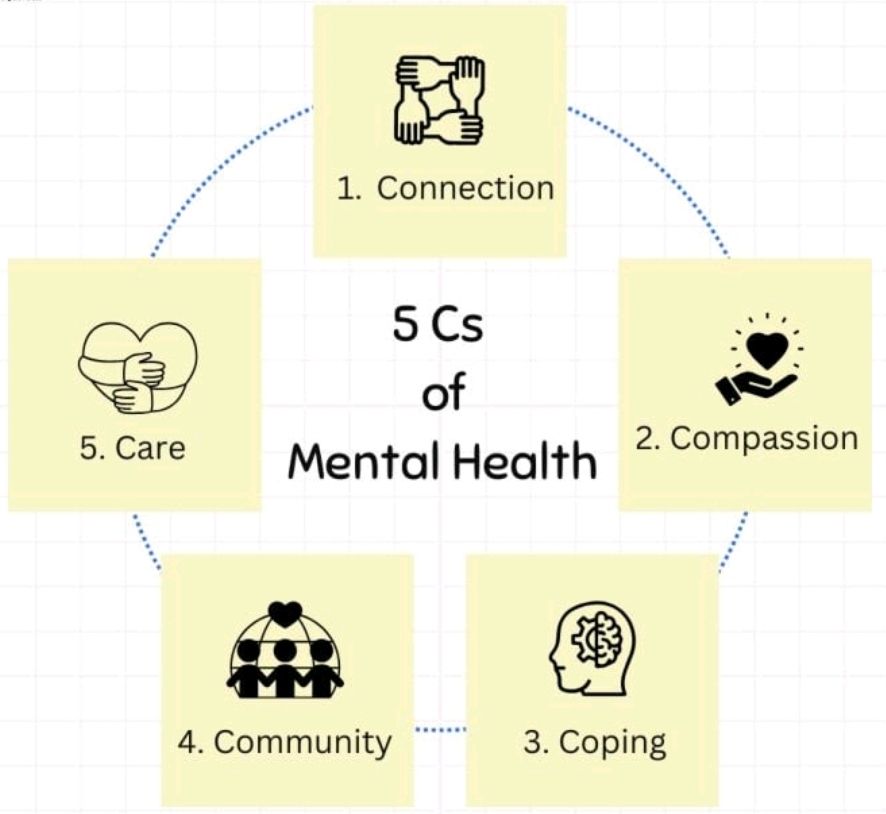
Connection – Kathleen O’Connor
Kathleen brought up the reminder that space is medicine.
That connection isn’t just about proximity—it’s about access.
Access to quiet. To green. To stillness.
In a world that won’t stop moving, she gave us a way to stand still and still feel held.
Community – Katie Pfeifer
Katie? She gave us fire in the form of structure.
She reminded us that community is built—it doesn’t just exist.
And that showing up for others is a kind of healing practice.
She turned “helping” into belonging.
Care – Dr. Leah Susser
Dr. Susser walked in with the receipts.
She made space for complexity—reproductive health, psychiatry, gendered pain—all of it.
She’s not just treating patients. She’s building systems of care that are precise, personal, and powerfully overdue.
Then came the soul witnesses:
Georgie D’Avanzo—a truth teller who didn’t perform healing. She offered it.
Her story was raw, and in that rawness, she handed us something rare: unfiltered hope.
Marie Considine, MPA, repped NAMI Westchester with grounded clarity—reminding us that without advocacy and infrastructure, healing is a luxury. She’s making it right.
And holding it all with grace and precision?
Dr. Sabina Bera—whose moderation was more like alchemy.
She pulled the gold out of every speaker with care, not control.
Her questions weren’t prompts—they were doorways.
Here’s the truth: This was more than a panel.
It was a collective remembering.
It was unlearning burnout as a badge.
It was learning to be witnessed in your whole humanity.
The room felt like church, therapy, revolution, and exhale—all at once.
So let me say this for those who keep asking where the healing is happening:
It’s happening right here.
In libraries turned sanctuaries.
In rooms where Black and brown women are trusted with the mic—and the moment.
In circles where silence is sacred, and stories are currency.
And if you missed it?
I say this with love:
Don’t miss the next one.
Because this kind of healing? This kind of clarity?
It doesn’t just talk about change.
It embodies it.
And me? I’ll keep showing up in these rooms.
You should too.











This is such a beautiful, inspiring piece. Thank you for sharing it.
I love it! Thank you for sharing.
Thank you for reporting on this tremendously important work!
There collective messages will vibrate for a long time.
Ms. Kinsey, your coverage of these events where women come together to support one another and teach one another are always so descriptive that if one is unable to attend, you are able to still feel the positive energy that was released in that space, through your writing. Thank you for that.