



Congress is preparing to debate a bill that Democrats say will protect free speech. The target is government intimidation. Under the proposal, federal officials would be barred from using regulatory threats to pressure networks, journalists, or entertainers into silence. On paper, it looks like a safeguard against abuse of power. In reality, it exposes how little protection legislation can offer once politics, economics, and employment collide.
The recent suspension of Jimmy Kimmel makes the problem plain. His remarks about Charlie Kirk led to affiliate stations pulling his show. The FCC chairman had already warned of “consequences” for networks, a threat that carried no legal order but plenty of weight. That is the kind of political pressure this bill claims to prevent. Yet even if the FCC had remained silent, affiliates still faced two other realities: economic decline and the leverage employers always hold over employees.
Free speech is not just a matter of government restraint. Market incentives and workplace rules also shape it. A law may stop regulators from bullying networks, but it cannot stop viewers from leaving, advertisers from pulling dollars, or bosses from enforcing contracts. The Constitution may protect speech from Washington, but it does not protect it from economics or employment.
Free speech is easier to defend in theory than in practice. The Constitution bars the government from silencing speech, but it does not stop officials from threatening consequences that make companies police themselves. When the FCC chairman warned of “consequences” after Jimmy Kimmel’s comments about Charlie Kirk, no paperwork was filed, but the message was clear. Fear can be as effective as censorship.
But politics alone do not explain why affiliates acted so quickly. Economics does. Charlie Kirk has a large and loyal following, and networks are aware of how fragile advertiser relationships can be. Viewers can disappear overnight, and sponsors with them. For affiliates, the risk of angering Kirk’s base meant gambling with millions in revenue.
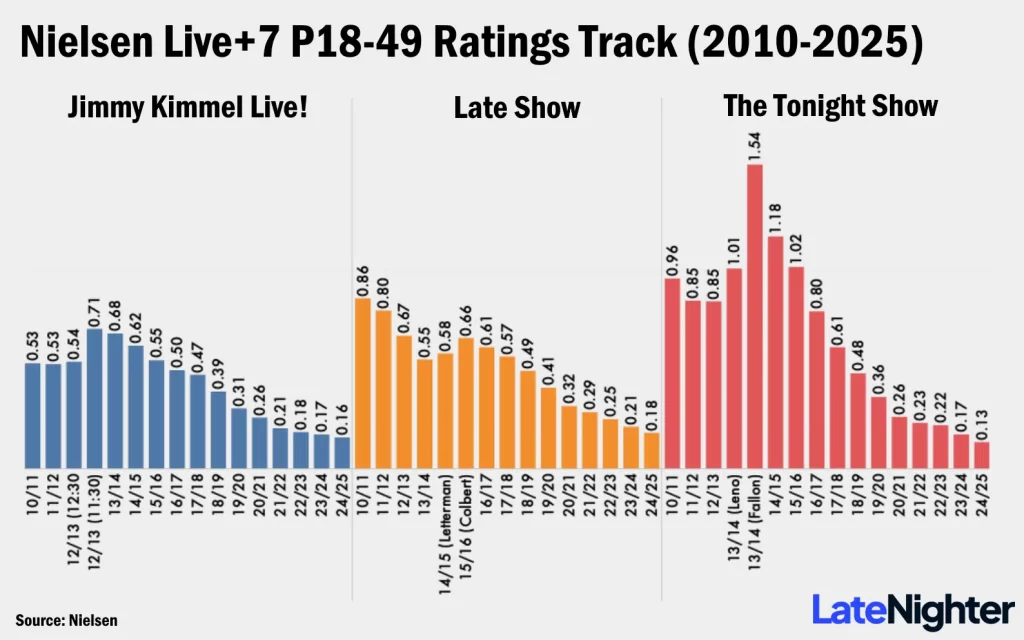
Late-night television itself is also in decline. Nielsen data show all three network 11:35 p.m. shows—CBS’s The Late Show, NBC’s The Tonight Show, and ABC’s Jimmy Kimmel Live!—down 70 to 80 percent in the key 18–49 demographic since 2015. That year Colbert replaced Letterman, Fallon succeeded Leno, and Kimmel moved into the late slot. By 2018, the decline was undeniable. Advertisers spent $439 million on late-night TV that year; by 2024, half that amount. For affiliates already squeezed by shrinking audiences and shrinking ad dollars, one controversy was not just a political risk — it was a financial accelerant to a business already collapsing.
There is another overlooked reality. Free speech is not free when you are an employee. Jimmy Kimmel may be a household name, but he is still an employee of Disney. His contract, like most contracts, has morality clauses and escape hatches designed to protect the company’s brand. The First Amendment does not shield workers from their bosses. Teachers, nurses, police officers, factory workers, or journalists all face the same truth: if your words cost the company money, your job can be gone by Monday.
So when Kimmel was suspended, three forces converged. Politics created fear of regulatory punishment. Economics magnified the danger of audience loss in a shrinking market. Employment rules gave the company the final authority to silence him in the name of brand protection. Each of these forces alone would have been enough. Together, they made suspension inevitable.
The proposed free speech bill may restrain political intimidation, but it cannot repeal economics or employment contracts. A law may stop an FCC chairman from threatening networks, but it cannot prevent advertisers from walking away or employers from protecting their bottom line. For ordinary Americans, that is the real lesson.
Teachers have lost jobs for Facebook posts. Nurses have been fired for speaking out about hospitals. Police officers have been pulled for job duties. Journalists have been dismissed for tweets that offended advertisers. In each case, politics, economics, and employment combined to decide what kind of speech survived. The Constitution may promise free speech, but in practice, it survives only when it carries no cost. Once it does, the marketplace — and your employer — will remind you that freedom always has a price.