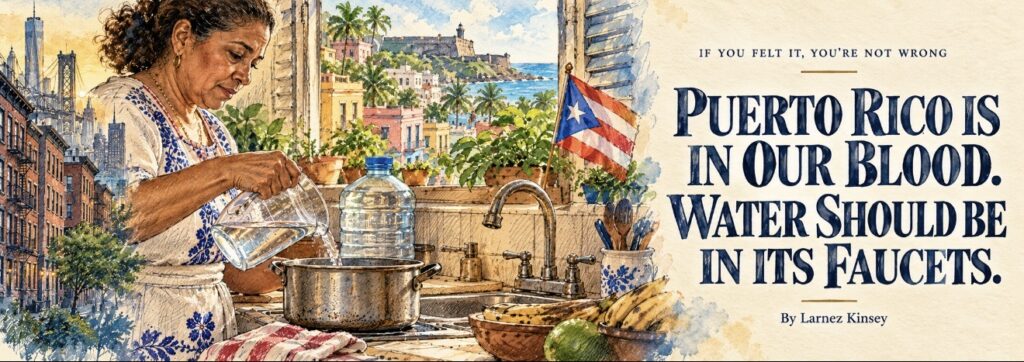






More than 180,000 households in Puerto Rico were subject to announced water rationing measures this summer, according to an August 11, 2026 congressional statement. Lawmakers reported that failing infrastructure leaks approximately half of the island’s treated water. The U.S. Census Bureau estimated that 37.3 percent of Puerto Rico’s population lived below the poverty line in 2024. These figures raise a practical question: How does a household afford to keep replacing something that should come out of the faucet?
Imagine standing at the kitchen sink, turning the handle, and waiting for a sound that never comes. There is a pot to wash before dinner. A child needs a bath. The toilet will not refill. You look at the containers against the wall and begin calculating what can wait.
This is an illustration, not a particular family’s account. It brings the crisis into the room where people live with it. Water shortages turn ordinary routines into decisions about what a household can postpone.
For those of us whose Puerto Rican identity took shape in New York, that household does not feel impossibly far away.
The island lives in the switch between English and Spanish halfway through a sentence. In the relative who asks whether you have eaten before asking why you called. In a kitchen where somebody lifts the pot lid after being told to leave it alone. In the song that interrupts a conversation because everyone recognizes the opening.
Being Nuyorican means knowing that a place can shape your life even when you did not grow up on its streets. We carry Puerto Rico through family relationships, language, memory, and traditions we continue making our own. That connection asks something of us when the conversation turns from celebration to hardship.
A call can begin with a birthday update and change with one question: “¿Tienes agua?” Do you have water?
Suddenly, you are asking who can deliver a container and whether somebody has checked on an older relative. You are trying to understand how much remains in a jug you cannot see. You hang up in White Plains or Yonkers, but part of your attention stays in that kitchen.
The White Plains Puerto Rican Cultural Committee is offering a way to turn that concern into assistance.
According to the organizers’ update shared for this article, several pallets of donated water have been collected, and shipping is underway. Monetary contributions will support additional water purchases in Puerto Rico during the organizers’ SOMOS trip.
Water collection has closed. The campaign is now accepting monetary donations only.
The original request for containers of one gallon or larger reflected how much water daily life requires. Drinking is only the beginning. Handwashing, dishes, toilets, and laundry all depend on a supply people can count on.
Every replacement container brings work. Somebody has to locate it, pay for it, transport it, and carry it inside. An older adult living alone may need assistance lifting it. Someone with limited mobility may be unable to collect it independently. Water can be available and still remain out of reach.
For a household with little financial cushion, that purchase competes with food, medication, electricity, and transportation. “Just buy bottled water” sounds simple until you are the person paying for it and carrying it upstairs.
This crisis also belongs in a larger conversation about who can afford to remain in Puerto Rico. Readers are right to ask whether unreliable services, development, and housing pressures intersect. But the evidence reviewed here does not establish that water shortages caused an increase in land sales or were deliberately created to force residents out.
The Government Accountability Office documented concerns from local officials about property purchases for short term rentals and difficulty finding affordable housing. It also concluded that the effect of resident investor tax incentives on housing prices was unclear. Those findings support further scrutiny without pretending the cause of every sale or relocation is known.
What we can ask is whether residents have a meaningful choice to stay when basic services become difficult to obtain. A home holds more than its potential selling price. It holds the neighbor who notices when an older resident has not come outside, the doorway relatives recognize, and the kitchen where the next generation learns a recipe by watching.
Those relationships deserve a place in decisions about Puerto Rico’s future.
Public accountability must accompany relief. Congressional leaders have requested a federal investigation into water infrastructure, repair spending, and project delivery. Families deserve clear answers about when dependable service will reach their homes. They also need water while that work proceeds.
Here in Westchester, the committee’s effort gives our connection a practical direction. The campaign flyer lists collaborators including the Hispanic Democrats of Westchester, LCLAA’s Westchester Chapter, the National Puerto Rican Agenda chapter, Mt. Hope A.M.E. Zion Church, and AFYA.
We know how to gather around culture. We raise the flag, bring the food, and find one another in a crowd. This appeal asks us to bring that same commitment to an everyday necessity.
To make a monetary donation, contact Councilwoman Evelyn Alicea-Santiago at 914-490-3676 for the campaign’s current payment instructions. Specify that your contribution is for Puerto Rico water relief. The number appears on the campaign flyer and the White Plains Puerto Rican Cultural Committee’s website.
Share the updated appeal with your family group chat, congregation, coworkers, or community organization. If you cannot contribute financially, help the request reach someone who can. Please share the monetary donation request rather than the closed water collection schedule.
For background, read the congressional request for a water crisis investigation, the Census Bureau’s Puerto Rico poverty data, and GAO’s discussion of investor incentives and housing.
Tonight, many of us will turn on a faucet without thinking. Somewhere, a family will check what remains in a container before deciding what to do next. We carried Puerto Rico into New York through the ways we speak, cook, gather, and remember. We can carry that connection forward through what we do now.