



For families like mine, Puerto Rico is not a headline.
It’s a grandmother’s voice that still lives in the ear.
It’s land that remembers footsteps even when people are forced to leave.
It’s a place where policy doesn’t stay on paper, it shows up in bodies, kitchens, and decisions about whether you can afford to stay where your people are buried.
And for those of us who are Newyorican, raised between boroughs and beaches, English dominant, Spanish remembered, Spanglish fluent, the connection doesn’t require perfect language. As soon as your feet hit the ground, the soul remembers. The heat. The rhythm. The familiarity that arrives before translation ever does.
So when the word “escalation” starts trending again, I don’t hear urgency.
I hear familiarity.
Because what’s happening right now isn’t new.
It’s just being said out loud again.
⸻
When the Empire Moves, the Islands Feel It First
Recent reports that the U.S. seized a Venezuelan oil tanker sent ripples across the Caribbean. Analysts call it geopolitics. Island communities call it a warning.
History has taught them to.
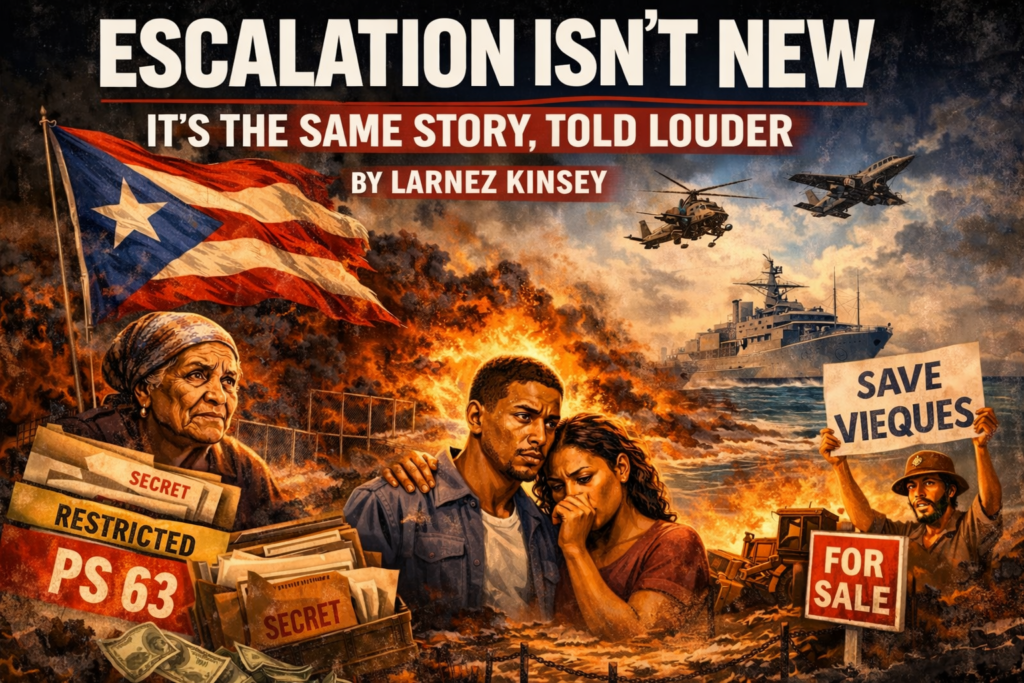
For Puerto Rico, military escalation has never been theoretical. It has been lived. Vieques still carries the toxic legacy of more than 60 years of U.S. Navy bombing exercises, an era that left the island contaminated with heavy metals and unexploded ordnance. Multiple studies and investigations have documented elevated cancer rates among Vieques residents compared to the rest of Puerto Rico, long after the bombs stopped falling.
That’s not ancient history.
That’s memory, confirmed by data, carried by bodies.
So when people hear that the U.S. is reportedly ordering a full year of food supplies for troops stationed in Puerto Rico, the concern isn’t conspiracy. It’s pattern recognition. It’s knowing that Puerto Rico has often been treated as a staging ground, not a sovereign community whose consent matters.
For Newyoricans especially, those taught to love the island from afar, that realization lands heavily. It carries the quiet fear that decisions are being made about our homeland while we’re expected to stay grateful and silent.
⸻
PS 63: When Information Gets Restricted, Power Gets Nervous
That fear sharpens with PS 63, a legislative move that fundamentally alters Puerto Rico’s transparency laws.
On paper, it’s framed as administrative efficiency. In practice, it doubles the amount of time government agencies have to respond to public records requests and expands what officials are allowed to withhold.
Let’s be clear: transparency laws exist because corruption thrives in the dark.
More than 50 journalism, civil rights, and press-freedom organizations publicly opposed PS 63, warning that the law weakens oversight at a moment when public trust is already fragile. When response times stretch, investigations stall. When information becomes harder to access, accountability softens.
For Puerto Rico, still navigating colonial governance structures, federal oversight, and austerity, this isn’t a minor policy tweak. It’s a narrowing of public sightlines.
And for Newyorican families like mine, it echoes something familiar: how many decisions about Puerto Rico’s future have already been made far from the people who carry it in their blood and memory.
⸻
Land Under Pressure, People Under Strain
At the same time, protected lands like El Yunque are facing increased risk as mega-projects advance across eastern Puerto Rico. Development is marketed as opportunity, but opportunity for whom?
Puerto Rico’s economy has grown more slowly than much of Latin America and the Caribbean, while residents continue to face some of the highest electricity costs under U.S. jurisdiction, a result of the island’s heavy dependence on imported fossil fuels. For families already stretched thin, those costs are not abstract, they’re monthly decisions between stability and sacrifice.
This is how structural pushout works.
Not with eviction notices but with electric bills that don’t make sense, grocery totals that don’t match wages, and land deals that quietly shift ownership away from the people who have stewarded it for generations.
When families leave, it’s framed as migration.
Rarely is it named for what it is: displacement under economic pressure.
For Newyoricans watching from New York, this becomes a double loss, watching a homeland strain while knowing return gets harder each year.
⸻
Why This Feels Personal Because It Is
For me, this isn’t analysis from a distance. This is family history intersecting with current policy.
Puerto Rico is where my people are from. Being Newyorican means living in the in-between, where English files the paperwork, Spanish arrives in fragments, and the soul carries the full story intact.
Lineage doesn’t require fluency.
It requires presence.
That’s why every conversation about transparency, militarization, land use, and economic strain isn’t abstract; it’s ancestral.
It’s the difference between a place being home
or being reduced to an asset.
⸻
Because Escalation Isn’t a Moment, it’s a Pattern
Escalation isn’t just tanks or seizures or headlines.
It’s when information becomes harder to access.
It’s when land becomes easier to sell than to protect.
It’s when people are told to trust systems that keep asking them to look away.
Puerto Rico doesn’t need less scrutiny right now.
It needs more light. More listening. More accountability.
And for families like mine and for Newyoricans everywhere, protecting Puerto Rico isn’t political theater.
It’s remembering who we come from.
Even when the language is mixed.
Even when distance complicates the return.
The soul already knows.
And we refuse to let it be erased by policy written in the dark.
Reference Links & More Info
Vieques: U.S. Military Presence & Health Impact
- U.S. Navy bombing history and environmental contamination in Vieques
https://www.epa.gov/vieques - Elevated cancer rates and health concerns in Vieques
https://www.ncbi.nlm.nih.gov/pmc/articles/PMC1447157/ - Overview of Vieques military legacy
https://en.wikipedia.org/wiki/Vieques,_Puerto_Rico
Transparency & PS 63 (Puerto Rico Public Records Law)
- AP News – Puerto Rico governor signs bill critics say restricts access to public information
https://apnews.com/article/puerto-rico-access-public-information-law-63-97a5654f62a0f23c8d207764ef517b96 - Freedom of the Press Foundation – Puerto Rico may roll back transparency just when it matters the most
https://freedom.press/issues/puerto-rico-may-roll-back-transparency-just-when-it-matters-the-most/ - Reporters Without Borders – Joint statement opposing PS 63
https://rsf.org/en/puerto-rico-new-law-threatens-access-public-information - The Latino Newsletter – Changes to Puerto Rico’s transparency law threaten democracy
https://thelatinonewsletter.org/p/changes-to-puerto-rico-s-transparency-law-threaten-transparency-and-democracy
Puerto Rico Economy & Cost of Living
- Puerto Rico Economic Activity Index (Department of Economic Development and Commerce)
https://docs.pr.gov/files/DDEC/Indice%20de%20Actividad%20Economica/ - World Bank data on regional growth (Latin America & Caribbean comparison)
https://www.worldbank.org/en/region/lac - Energy costs and dependence on imported fossil fuels
https://en.wikipedia.org/wiki/Energy_in_Puerto_Rico
Land, Development & Environmental Concerns
- El Yunque National Forest (U.S. Forest Service)
https://www.fs.usda.gov/elyunque - Reporting on land development pressures in eastern Puerto Rico
https://periodismoinvestigativo.com
Public Accountability / Contact
- Office of the Governor of Puerto Rico (La Fortaleza)
Phone: (787) 721-7000
Email: governor@fortaleza.pr.gov
https://www.fortaleza.pr.gov